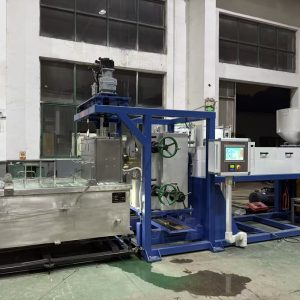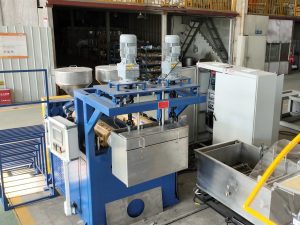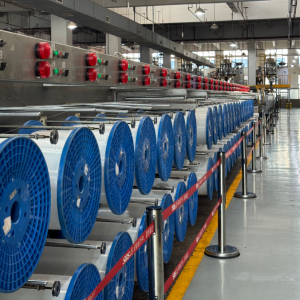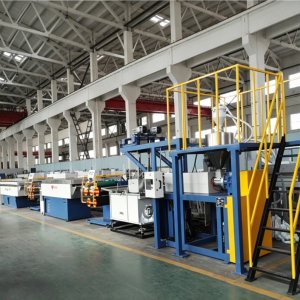
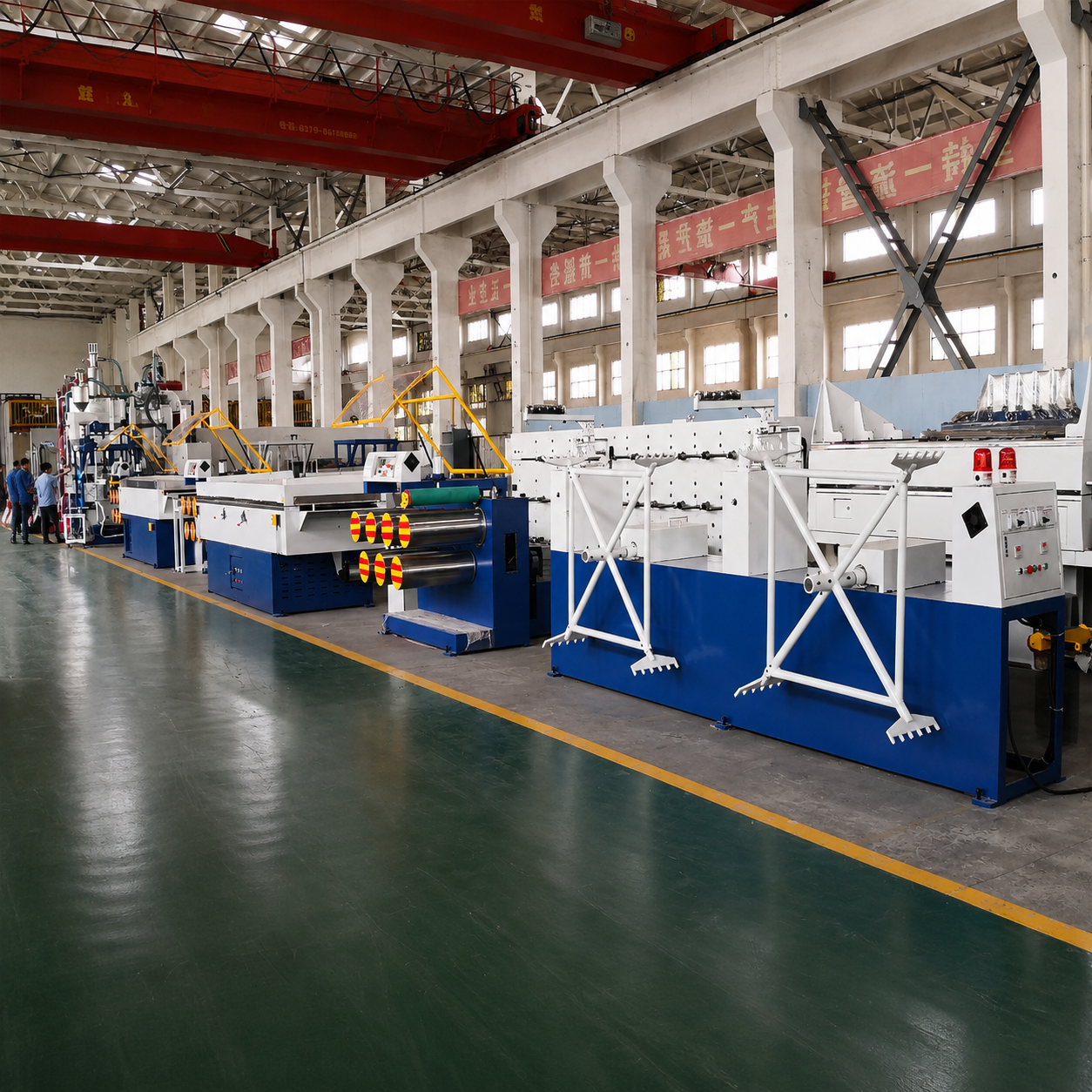
When purchasing a monofilament extruder machine, output capacity, filament diameter, and polymer type are only the starting points.
The specifications that determine actual extrusion performance include screw diameter, screw L/D ratio, screw geometry, barrel heating zones, drive system, melt-pressure stability, filtration, and whether a melt pump is required.
These parameters directly affect melting quality, pressure stability, filament diameter consistency, surface quality, energy consumption, and long-term production reliability.
This guide explains the main technical specifications to evaluate when selecting a monofilament extruder machine for PA6, PA66, PET, PP, PE, and other thermoplastic monofilament applications.
What Is a Monofilament Extruder Machine?
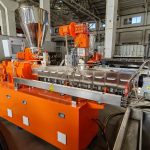
A monofilament extruder machine is the extrusion unit responsible for melting, homogenizing, pressurizing, and continuously delivering polymer melt to the die head.
In a complete monofilament extrusion line, the extruder normally includes:
- Material hopper and feeding system
- Screw
- Barrel
- Barrel heating and cooling system
- AC motor and gearbox
- Temperature-control system
- Melt-pressure monitoring
- Adapter
- Screen pack or melt filtration system
- Die head or spinneret
The extruder is the melt-generation section of the production line.
Downstream equipment performs different functions, including:
Extrusion → Quenching → Drawing → Heat Setting / Annealing → Oil Treatment → Winding
The distinction is important because a diameter problem observed downstream does not necessarily originate from the drawing or winding section.
An unstable extrusion output can create pressure fluctuations, inconsistent melt flow, uneven cooling behavior, and ultimately filament diameter variation.
The Core Function of the Extruder
A properly specified extruder must provide four things consistently:
- Uniform melting
- Stable melt temperature
- Stable melt pressure and flow
- Consistent melt viscosity
The downstream drawing and winding system can only control the filament effectively if the extruder provides a stable melt.
1. Screw Type: Why Single-Screw Extrusion Is Common
For conventional monofilament production from polymer pellets such as PA6, PA66, PET, PP, and PE, a single-screw extruder is widely used.
A single-screw extruder provides controlled conveying, melting, homogenization, and pressure generation with a relatively simple mechanical structure.
Twin-screw extruders are more commonly associated with:
- Polymer compounding
- Additive dispersion
- Reactive processing
- High-intensity mixing
For standard monofilament extrusion, the main objective is usually stable and uniform melting rather than maximum mixing intensity.
Single-Screw Extruder Working Principle
The screw can generally be divided into three functional regions.
Feed Zone
The feed zone receives polymer pellets from the hopper and conveys them toward the compression section.
Important design considerations include:
- Feed-channel depth
- Feeding consistency
- Hopper design
- Feed-throat cooling
- Prevention of premature polymer softening
A water-cooled feed throat can help prevent polymer bridging and excessive heat transfer toward the feeding area.
Compression / Melting Zone
In the compression section, the screw-channel depth gradually decreases.
This increases compression and promotes:
- Polymer melting
- Heat transfer
- Pressure generation
- Melt homogenization
The exact screw geometry should be matched to the polymer and production conditions rather than selected solely from a general-purpose design.
Metering Zone
The metering section conveys fully molten polymer toward the adapter, filtration system, melt pump if installed, and die.
The objective is to produce:
- Stable melt flow
- Uniform temperature
- Consistent pressure
- Low variation in melt viscosity
For monofilament production, stability in this section is particularly important because small changes in melt output can eventually appear as changes in filament diameter.
2. Screw Geometry: General-Purpose vs. Application-Specific Design
A screw should not be specified only by diameter.
The following parameters can affect extrusion performance:
- Screw diameter
- L/D ratio
- Compression ratio
- Flight geometry
- Feed-section design
- Barrier section
- Mixing section
- Metering-section length
- Screw material and surface treatment
For demanding monofilament applications, a barrier screw or application-specific screw design may be preferred when it provides better separation of solid and molten polymer during melting.
A suitable mixing section can also improve melt homogenization where the polymer and process conditions require it.
However, more aggressive mixing is not automatically better.
Excessive shear or residence time can increase melt temperature and may contribute to polymer degradation for sensitive materials.
Practical rule
The best screw is not necessarily the most complicated screw. It is the screw whose geometry matches the polymer, output, temperature window, and filament specification.
3. Screw and Barrel Metallurgy
Screw and barrel materials should be evaluated according to the polymer and additives being processed.
For conventional monofilament polymers such as PA6, PA66, PET, PP, and PE, nitrided alloy steel is a common baseline for screw and barrel construction.
For example, 38CrMoAlA nitrided steel is widely used in extrusion equipment because nitriding creates a hardened surface layer that improves wear resistance.
However, the appropriate material depends on the application.
For production involving:
- Recycled polymers
- Glass-filled materials
- Mineral-filled polymers
- Abrasive additives
- High levels of contamination
a more wear-resistant barrel construction, such as a bimetallic barrel, may be worth considering.
The purpose is not simply to increase equipment life.
Excessive screw or barrel wear can change the effective extrusion geometry and clearance, potentially affecting:
- Output stability
- Melt pressure
- Residence time
- Mixing behavior
- Process repeatability
Therefore, metallurgy should be evaluated as part of long-term dimensional and process stability, not only initial machine cost.
4. Screw L/D Ratio
The L/D ratio, or length-to-diameter ratio, describes the effective screw length relative to screw diameter.
For example:
A 30:1 screw L/D means the effective screw length is approximately 30 times the screw diameter.
L/D affects the available length for:
- Polymer conveying
- Melting
- Mixing
- Homogenization
- Pressure development
Typical industrial monofilament applications often use L/D ratios in the high-20:1 to low-30:1 range, but the correct value depends on polymer, screw design, output, and production requirements.
A commonly used starting point for many applications is approximately 30:1.
For some PE or HDPE applications, a longer screw may be selected depending on the required melting and conveying behavior.
Why L/D Should Not Be Evaluated Alone
A longer screw does not automatically produce better filament.
Increasing L/D can provide additional melting and homogenization length, but it can also increase:
- Residence time
- Machine length
- Capital cost
- Potential thermal exposure
For heat-sensitive polymers, excessive residence time may contribute to degradation.
Therefore:
L/D should be selected together with screw geometry, polymer characteristics, output, and temperature control.
5. Barrel Heating Zones
A monofilament extruder typically uses several independently controlled heating zones along the barrel, followed by adapter and die temperature control.
The exact number depends on:
- Screw diameter
- L/D ratio
- Polymer
- Output
- Machine architecture
- Die configuration
A typical industrial configuration may use approximately four to six barrel heating zones, plus downstream adapter and die zones.
Each independently controlled zone normally includes:
- Heater
- Temperature sensor
- PID temperature controller
- Cooling function where required
What Should Buyers Check?
Do not only ask:
“How many heating zones does the extruder have?”
Also ask:
1. Are the zones independently controlled?
Independent control allows the temperature profile to follow the screw’s melting and metering behavior.
2. What is the actual temperature stability?
A datasheet may show a temperature setpoint, but the more useful information is the actual temperature variation during continuous production.
3. Is the feed throat cooled?
This is important for preventing premature polymer softening and feeding instability.
4. Is the die temperature independently controlled?
Die temperature affects melt viscosity and flow behavior at the spinneret.
6. Temperature Control: Setpoint vs. Actual Melt Behavior
Temperature control is often misunderstood in extrusion specifications.
A machine may display:
Setpoint: 270°C
but this does not automatically mean that the polymer melt is actually maintained uniformly at 270°C.
The more important variables are:
- Actual barrel temperature
- Melt temperature
- Temperature fluctuation
- Pressure fluctuation
- Residence time
- Polymer viscosity
For this reason, a supplier’s factory acceptance test (FAT) data can be more useful than a nominal temperature specification.
When evaluating a machine, request production data showing actual process stability under load.
7. Material-Specific Extruder Requirements
There is no single universal temperature profile or screw configuration that is optimal for every monofilament polymer.
The following values should be treated as engineering starting ranges rather than universal production standards.
Parameter | PA6 | PA66 | PET | PP / PE |
Typical L/D starting point | ~30:1 | ~30:1–33:1 | ~28:1–32:1 | ~30:1–33:1 |
Feed-zone temperature | ~220–230°C | ~240–250°C | ~240–250°C | ~180–200°C |
Transition zone | ~240–260°C | ~260–275°C | ~255–275°C | ~210–230°C |
Metering / die region | ~250–270°C | ~265–285°C | ~265–285°C | ~220–245°C |
Drying requirement | Yes | Yes | Yes | Usually no |
Main process risk | Moisture / bubbles | Moisture / degradation | Hydrolysis / IV loss | Surging / draw instability |
Actual values must be determined by the specific resin grade, intrinsic viscosity or molecular characteristics where applicable, filament diameter, throughput, screw design, and manufacturer process experience.
8. Why Drying Is Critical for PET and Nylon
For moisture-sensitive polymers, the extrusion specification cannot be separated from the drying system.
PET
PET is particularly sensitive to moisture during melt processing.
Insufficient drying can promote hydrolytic degradation, which may result in:
- Reduced molecular weight
- Lower melt strength
- Bubbles or porosity
- Filament brittleness
- Poor drawing performance
- Inconsistent mechanical properties
Therefore, a PET monofilament project should specify the drying system and moisture target together with the extruder.
PA6 and PA66
Nylon also absorbs moisture from the environment.
Insufficient drying can cause:
- Bubbles
- Surface defects
- Hydrolysis
- Reduced mechanical properties
- Unstable drawing behavior
For nylon monofilament, resin drying should therefore be considered an integral part of the extrusion process rather than an optional auxiliary.
9. Should You Add a Gear Pump?
A gear pump, also called a melt pump, is installed downstream of the extruder to provide more controlled melt delivery.
Its main function is to reduce the influence of screw-speed-related output fluctuations and provide a more stable volumetric melt flow to the die.
A simplified process arrangement is:
Extruder → Filter → Melt Pump → Die
or, depending on the machine design:
Extruder → Melt Pump → Filter → Die
The exact arrangement should be determined by the equipment supplier and process requirements.
When a Melt Pump Can Be Valuable
A melt pump may be beneficial when the application requires:
- Tight diameter control
- High melt-flow consistency
- Stable pressure at a multi-hole spinneret
- Fine technical filament
- High production consistency
- Reduced sensitivity to screw-output fluctuations
For precision monofilament, stable melt delivery can make downstream diameter control easier.
When a Melt Pump May Not Be Necessary
A melt pump is not automatically required for every monofilament line.
For applications with relatively wide dimensional tolerance, a properly designed and well-controlled screw may provide sufficient melt-flow stability.
Adding a gear pump also introduces:
- Additional equipment cost
- Additional seals and maintenance
- Additional pressure requirements
- More process components to manage
Therefore, the decision should be based on the required diameter tolerance, output stability, die design, and process economics.
Important Diagnostic Principle
A melt pump only addresses problems related to melt-flow or pressure stability.
If diameter fluctuation is actually caused by:
- Unstable quench-water temperature
- Uneven cooling
- Drawing-speed variation
- Godet slip
- Winder tension changes
adding a melt pump will not solve the root cause.
This is why the entire monofilament line should be evaluated as a system.
10. Extruder Drive System
The drive system normally consists of:
- AC motor
- Variable frequency drive or equivalent speed control
- Gearbox
- Thrust-bearing arrangement
- Screw coupling
The drive must provide sufficient torque across the intended operating range.
Motor Power
Motor power should be selected according to:
- Screw diameter
- Screw L/D
- Polymer
- Throughput
- Melt viscosity
- Screw design
- Startup requirements
A larger motor is not automatically better.
Oversizing can increase cost and may not improve process performance if the screw and barrel are incorrectly matched.
Variable Frequency Drive
A VFD or equivalent variable-speed drive allows screw speed to be adjusted smoothly.
This is useful for:
- Startup
- Recipe changes
- Output adjustment
- Process optimization
- Controlled acceleration and deceleration
The screw speed should be coordinated with downstream drawing and winding speeds.
Gearbox Service Factor
Gearbox service factor is another specification worth checking.
A suitable service factor provides additional capacity for transient loads and variations in operating conditions.
However, the service factor should be evaluated together with:
- Actual torque requirement
- Motor power
- Screw diameter
- Operating speed
- Polymer viscosity
Rather than selecting a gearbox based on service factor alone.
11. Melt Pressure Monitoring
Melt pressure is an important process indicator for monofilament extrusion.
Stable pressure generally indicates that the upstream extrusion system is operating consistently.
Pressure instability can be associated with:
- Feeding fluctuations
- Incomplete melting
- Temperature instability
- Screw geometry problems
- Filter loading
- Melt pump behavior
- Polymer contamination
- Die restrictions
Therefore, buyers should ask where pressure sensors are installed and whether pressure trends can be recorded.
A useful diagnostic relationship is:
Pressure fluctuation → Melt-flow fluctuation → Die-output variation → Filament diameter variation
However, pressure fluctuation is a symptom rather than a complete diagnosis.
The root cause must be identified before changing equipment configuration.
12. Melt Filtration
Melt filtration removes contaminants and unmelted particles before the polymer reaches the die.
This is especially important for:
- Recycled PET
- Recycled PP
- Recycled PE
- Contaminated feedstock
- Fine monofilament
- Multi-hole spinnerets
A suitable filtration system can reduce:
- Die blockage
- Surface defects
- Filament breaks
- Contamination-related pressure spikes
For recycled materials, filtration requirements may be substantially different from those for virgin resin.
Therefore, the filtration system should be specified according to:
Material source + contamination level + output + filament diameter + allowable pressure drop.
13. Die and Spinneret Compatibility
The extruder should not be specified independently of the die.
The die determines how the melt is distributed into individual filaments.
Important parameters include:
- Number of holes
- Hole diameter
- Capillary geometry
- Hole spacing
- Land length
- Melt-flow distribution
- Die temperature
The relationship can be simplified as:
Extruder → Stable Melt → Filter → Pressure Control → Die → Uniform Filaments
A high-quality extruder cannot compensate for an improperly designed spinneret.
14. Extruder Specification vs. Final Filament Diameter
One of the most important concepts in monofilament production is that final filament diameter is not determined by the extruder alone.
Final diameter depends on the interaction between:
- Polymer melt output
- Spinneret geometry
- Quenching
- Drawing ratio
- Drawing speed
- Roller synchronization
- Heat setting
- Winding tension
A simplified relationship is:
Final diameter ≈ Melt output / Effective drawing speed
This is not a complete engineering equation, but it illustrates why both extrusion and downstream drawing must be controlled.
If extrusion output fluctuates while drawing speed remains constant, filament diameter can fluctuate.
If extrusion output remains constant but drawing speed changes, filament diameter can also fluctuate.
Therefore, diameter control is a whole-line problem, not simply an extruder problem.
15. How to Match the Extruder to the Production Requirement
Before selecting the screw diameter or motor power, define the complete production envelope.
At minimum, provide the supplier with:
Specification | Required Information |
Polymer | PA6, PA66, PET, PP, PE, etc. |
Resin source | Virgin / recycled / blend |
Filament diameter | Target diameter and range |
Diameter tolerance | Required tolerance |
Production output | kg/h |
Number of filaments | Required hole count |
Application | Brush, broom, zipper, fishing line, mesh, etc. |
Drawing ratio | Target or expected range |
Production speed | Target line speed |
Material moisture | Required moisture target |
Recycled content | Percentage if applicable |
The supplier can then determine:
- Screw diameter
- Screw L/D
- Screw geometry
- Motor power
- Gearbox
- Barrel-zone configuration
- Melt filtration
- Gear pump requirement
- Die configuration
- Downstream drawing system
This is a much more reliable approach than selecting an extruder only by motor power or screw diameter.
16. Five Questions to Ask Every Monofilament Extruder Supplier
When comparing suppliers, these questions can reveal the quality of the proposed machine quickly.
1. What is the screw L/D ratio, and why was it selected?
The answer should be connected to the specific polymer and output requirement.
2. What screw and barrel materials are used?
Ask whether the screw is nitrided alloy steel and whether a more wear-resistant barrel is recommended for recycled or abrasive materials.
3. Can you provide actual FAT process data?
Request actual production data rather than only nominal setpoints.
Useful data includes:
- Barrel temperature
- Melt temperature
- Melt pressure
- Screw speed
- Motor load
- Output
- Filament diameter
4. Is a melt pump included, and why?
The supplier should explain the process reason rather than simply presenting it as a premium option.
5. What spare parts and technical support are available?
Ask about:
- Screws
- Barrels
- Heater bands
- Thermocouples
- Gearbox components
- Pumps
- Seals
- Control components
Spare-parts availability can directly affect production downtime.
17. Factory Acceptance Test: What Should Be Verified?
A factory acceptance test, or FAT, should verify more than whether the extruder can start.
A useful FAT checklist includes:
Extrusion performance
- Polymer specified in the contract
- Target output achieved
- Stable screw speed
- Stable motor load
- Stable melt pressure
Temperature performance
- Barrel temperature stability
- Adapter temperature
- Die temperature
- Actual melt temperature where available
Filament performance
- Diameter
- Diameter variation
- Surface quality
- Filament breaks
- Drawing behavior
Control system
- Temperature alarms
- Pressure alarms
- Emergency stop
- Interlocks
- Speed synchronization
- Data display and recording
Mechanical inspection
- Screw rotation
- Gearbox operation
- Cooling system
- Heater operation
- Pump operation if included
- Winder and downstream synchronization
A machine should be evaluated under realistic operating conditions whenever possible.
18. Common Specification Mistakes
Several purchasing mistakes occur repeatedly when buying a monofilament extruder machine.
Mistake 1: Choosing by motor power only
A 75 kW machine is not necessarily better than a 55 kW machine.
Motor power must be evaluated against screw diameter, polymer, output, and screw design.
Mistake 2: Treating L/D as a universal quality indicator
A longer screw is not automatically better.
The correct L/D depends on the polymer and process.
Mistake 3: Adding a melt pump without identifying the root problem
A gear pump can stabilize melt delivery, but it cannot correct unstable cooling or drawing.
Mistake 4: Ignoring the drying system
For PET and nylon, drying is part of the extrusion process.
Mistake 5: Comparing machines only by price
Two machines with similar screw diameters can have very different:
- Screw geometry
- Metallurgy
- Heating-zone control
- Gearbox quality
- Melt-pressure stability
- Filtration
- Control systems
- FAT standards
- After-sales support
The lower initial price does not necessarily represent the lower total production cost.
19. Monofilament Extruder Specification Checklist
Before placing an order, buyers should confirm the following.
Extruder
- Screw diameter
- Screw L/D ratio
- Screw geometry
- Compression ratio
- Screw metallurgy
- Barrel metallurgy
- Number of heating zones
- Temperature-control accuracy
- Feed-throat cooling
- Adapter heating
- Die heating
Drive
- Motor power
- Motor manufacturer
- VFD
- Gearbox manufacturer
- Gearbox service factor
- Thrust-bearing specification
Melt system
- Melt-pressure sensor
- Melt filtration
- Screen-pack configuration
- Melt pump if required
- Die/spinneret specification
Process
- Polymer type
- Resin condition
- Drying requirement
- Target output
- Target filament diameter
- Diameter tolerance
- Drawing ratio
- Production speed
Acceptance
- FAT procedure
- Actual production test
- Temperature records
- Pressure records
- Diameter records
- Spare-parts list
- Technical documentation
- Installation and commissioning support
20. How to Compare Two Monofilament Extruder Machines
A useful comparison should look beyond the headline specifications.
Parameter | Machine A | Machine B | What to Evaluate |
Screw diameter | — | — | Match to output |
L/D | — | — | Polymer/process suitability |
Screw design | — | — | Melting and homogenization |
Screw material | — | — | Wear resistance |
Barrel material | — | — | Service life |
Heating zones | — | — | Temperature-control capability |
Motor | — | — | Torque/output requirement |
Gearbox | — | — | Reliability and service factor |
Melt pump | — | — | Required for process? |
Filter | — | — | Material and contamination |
Die | — | — | Diameter and hole requirements |
FAT | — | — | Actual performance verification |
After-sales | — | — | Downtime risk |
This format makes it easier for purchasing teams to understand why two apparently similar machines may have significantly different prices.
21. The Right Way to Specify a Monofilament Extruder
The correct purchasing sequence is:
- Define the final filament
↓
- Define polymer and resin condition
↓
- Define output and production speed
↓
- Define diameter and tolerance
↓
- Determine drawing requirements
↓
- Select die and spinneret
↓
- Select screw geometry and L/D
↓
- Size motor and gearbox
↓
- Determine filtration and melt-pump requirements
↓
- Configure the complete downstream line
This approach prevents buyers from selecting the extruder first and then trying to make the rest of the line fit around it.
Frequently Asked Questions
What is a monofilament extruder machine?
A monofilament extruder machine is the extrusion unit that melts, homogenizes, pressurizes, and continuously delivers polymer melt to a die or spinneret for monofilament production.
What type of extruder is normally used for monofilament?
Single-screw extrusion is widely used for conventional monofilament production from polymers such as PA6, PA66, PET, PP, and PE.
What L/D ratio is suitable for a monofilament extruder?
Many industrial monofilament applications use an L/D in approximately the high-20:1 to low-30:1 range, with around 30:1 being a common starting point. The final specification should be matched to the polymer, screw geometry, output, and process requirements.
Is a gear pump necessary for monofilament extrusion?
Not always. A melt pump can improve melt-flow and pressure stability, especially for demanding diameter-control applications. For less demanding products, a properly designed and controlled screw may provide sufficient stability.
Why is drying important for PET monofilament?
PET is moisture-sensitive during melt processing. Insufficient drying can promote hydrolytic degradation, reducing molecular weight and potentially causing brittleness, porosity, and poor drawing performance.
Can one extruder process different polymers?
A properly designed extrusion system may process multiple polymers, but the screw design, temperature profile, drying requirements, filtration, die configuration, and process parameters may need to be adjusted for each material.
Does the extruder determine the final monofilament diameter?
No. Final diameter is determined by the interaction between extrusion output, die geometry, cooling, drawing ratio, drawing speed, and winding conditions.
What should I request from a machine supplier before purchasing?
At minimum, request a complete technical specification covering screw diameter, L/D ratio, screw design, motor and gearbox, barrel-zone configuration, filtration, melt pump if required, die configuration, output, applicable polymers, FAT procedure, and after-sales support.
Final Takeaway
Selecting a monofilament extruder machine should not be reduced to comparing motor power, screw diameter, or price.
The important question is:
Can the extrusion system consistently produce the melt conditions required by the final monofilament specification?
A reliable specification connects:
Polymer → Drying → Screw Geometry → L/D → Temperature Control → Melt Filtration → Melt Pressure → Die → Quenching → Drawing → Heat Setting → Winding
The extruder is the beginning of that chain.
For this reason, the correct machine should be configured from the final product requirements backward, rather than selected from a standard extruder model forward.
Need a Monofilament Extrusion Line Configuration?
For a project evaluation, the most useful starting information is:
- Polymer: PA6 / PA66 / PET / PP / PE / other
- Virgin or recycled material
- Target filament diameter
- Required diameter tolerance
- Production output in kg/h
- Application
- Number of filaments
- Expected production speed
- Special requirements such as melt filtration or melt pump
Changzhou Xinliaoyuan Machinery Co., Ltd. (NLY) provides monofilament extrusion line solutions for different polymer and filament applications, including PA, PET, PP, and PE.
A complete configuration should be selected according to the material, filament specification, production capacity, and downstream drawing requirements rather than from the extruder specification alone.