A polypropylene monofilament yarn is a single, continuous strand of PP extruded and drawn to a controlled diameter — usually 0.10 mm up to about 1.00 mm. It is not the soft multifilament bundle you find in most apparel. It is one solid filament, which is exactly why it behaves differently: stiffer, more dimensionally stable, lighter than most alternatives, and effectively impervious to water.
If you run shade nets, anti-bird nets, ropes and twines, geotextiles, filter fabrics, or industrial webbings, the production line that makes that strand is your core asset. This guide walks through the equipment, the process parameters that separate good PP yarn from scrap, the quality checks that keep customers happy, and the evaluation framework you should apply before you sign for a new line.
What Is PP Monofilament Yarn?
PP monofilament yarn is produced by melting polypropylene resin, forcing the melt through a precision spinneret die to form one strand per orifice, then cooling, drawing, and heat-setting that strand to lock in its diameter and mechanical properties.
The material itself is worth understanding before you spec a line, because every downstream decision — screw design, temperature profile, draw ratio — depends on it. Polypropylene is the lightest commodity monofilament polymer, at about 0.90–0.91 g/cm³. It absorbs essentially no water in the finished yarn, which makes it ideal for outdoor and filtration end uses. It resists a broad range of chemicals. And it responds well to drawing: orientation can lift tenacity into the range typical of reliable industrial synthetic fibers.
There are two structural forms you should not confuse:
PP monofilament — one independent solid strand, extruded through a single spinneret orifice, used where stiffness, clean mesh openings, and dimension control matter.
PP multifilament yarn — many fine filaments bundled together, softer and more flexible, used closer to traditional textile applications.
When someone says “PP monofilament yarn,” they mean the first. If you need the fundamentals of polypropylene filament more broadly, our PP filament guide covers the material, its physical properties, and the main application fields in depth.
Key Takeaway: PP monofilament yarn is a single drawn polypropylene strand. Its combination of low density, hydrophobicity, chemical resistance, and controllable stiffness is why it dominates nets, ropes, geotextiles, and filter cloths.
Why Choose Polypropylene for Monofilament Yarn?
Polypropylene earns its place on a monofilament line for reasons that map directly to operating economics, not just material cost.
Light weight: a lower density than PET, nylon, or PE means more length of yarn per kilogram of output — a direct factor in your per-meter cost.
Moisture resistance: the finished yarn does not swell or lose strength when wet, which is essential for marine ropes, agricultural nets, and filter media.
Chemical resistance: stable across a wide pH and chemical range, which suits filtration and industrial fabrics.
Controllable stiffness and straightness: a well-drawn monofilament holds its shape and stays straight, giving clean, uniform mesh openings.
The trade-off to engineer around is heat and UV sensitivity. Polypropylene degrades near processing temperatures, so the line must avoid over-heating, long dwell in stagnant melt pockets, and temperature spikes. Final yarn also needs UV stabilization for continuous outdoor exposure. These are manageable — but they are exactly the kind of detail a general-purpose extruder gets wrong.
Our guide on PP vs PET vs PE breaks down how polypropylene compares against the other polymers you might already run on the floor.
Choosing the Right Resin Grade
Monofilament-grade PP is typically specified by melt flow index (MFI), and most yarn lines run resins around 2–12 g/10 min. The grade drives your processing window:
Higher-MFR resins (≈3 g/10 min and up) flow easily and process at lower temperatures, roughly 200–240°C.
Lower-MFR resins (<3 g/10 min) need a hotter barrel, often 230–260°C, to melt and flow homogeneously.
Pick the grade early and lock it in. Switching MFI ranges mid-production forces you to re-tune the whole thermal profile and can reintroduce the diameter and breakage problems you were trying to eliminate.
The PP Monofilament Yarn Extrusion Line: Section by Section
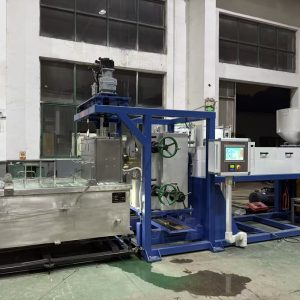
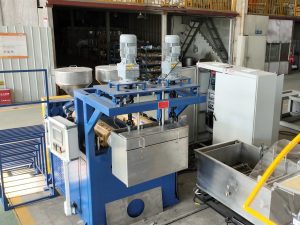
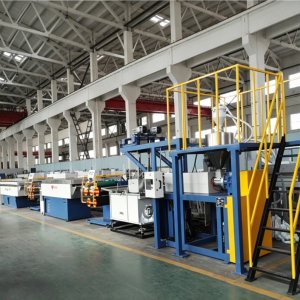
A PP monofilament yarn line is a single continuous process. Whatever the manufacturer calls it, the sections follow a fixed logic. Each one must be right, because the quality of any stage depends on the stability of the one before it.
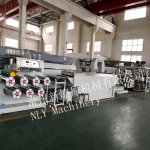
A complete PP monofilament yarn line runs these stages in order:
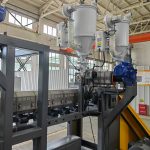
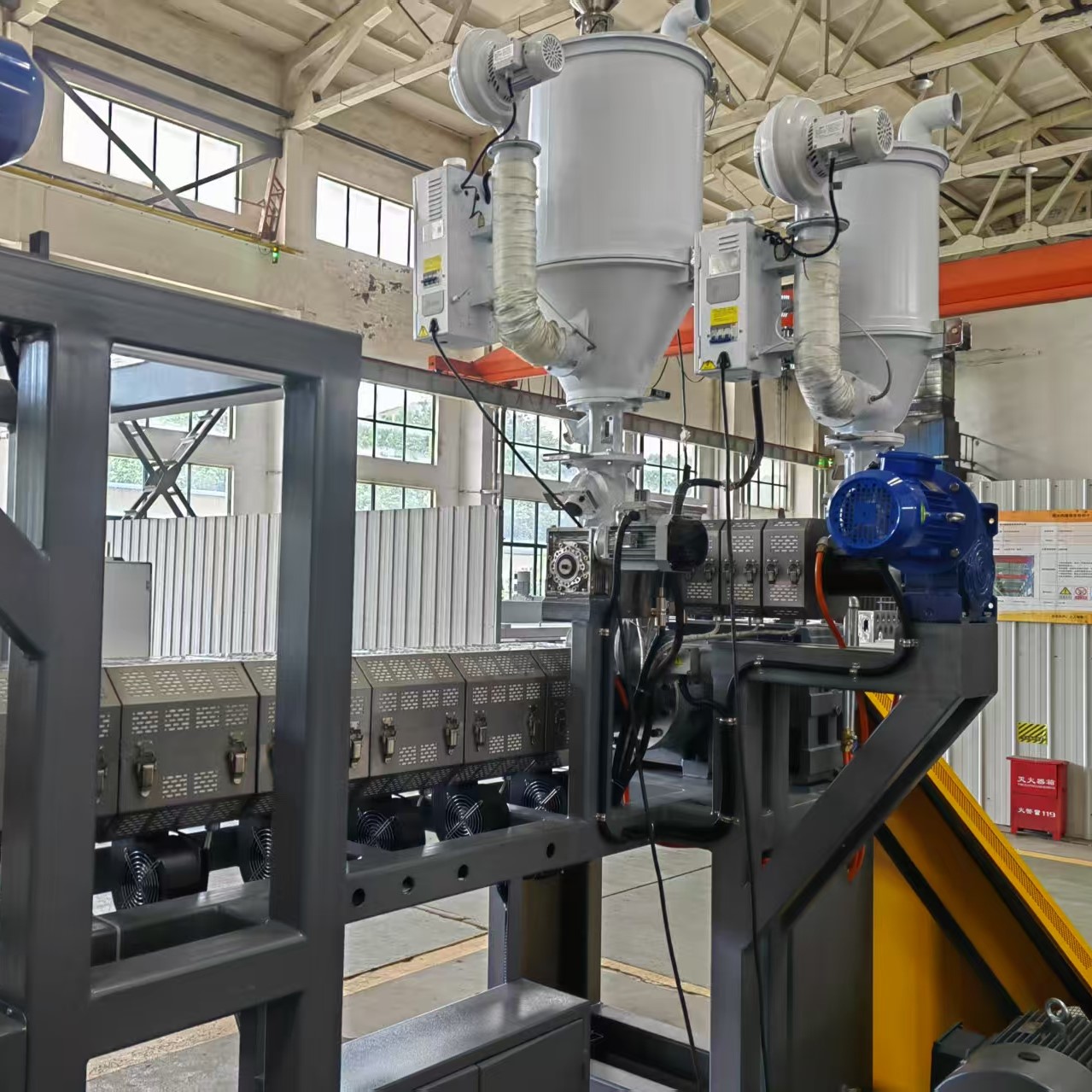
Resin dryer and hopper feeding
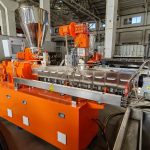
Single-screw extruder
Gear melt pump (metering)
Spinneret die
Water quench bath
Primary draw stand (godets)
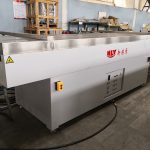
Hot-water bath or hot-air oven (drawing)
Secondary draw stand(s)
Heat-setting / annealing oven
Oiling (optional) and automatic winding
Let’s look at the parameters that matter at each.
Extruder
For PP, a single-screw extruder with a high L/D ratio is the standard. Most industrial PP monofilament lines run a screw of 28:1 to 33:1, with NLY’s PP yarn machines built at 30:1–33:1 (see the PP monofilament making machine for a working example with a 30:1 screw).
The longer barrel gives more melting and homogenization length, which matters for PP because the melt must be uniform before it ever reaches the die. A barrel temperature profile of 200–250°C is typical for monofilament-grade resin (adjust to your MFI). Keep zone-to-zone differences moderate and avoid dead zones where melt can sit and degrade.
Gear Melt Pump
Directly behind the die, a gear melt pump does the precise metering. It decouples throughput from screw speed, so output stays constant even if feed or viscosity fluctuates. For a product where diameter tolerance is the whole game, a melt pump is not optional — it is the difference between consistent denier and drift.
Spinneret Die
The spinneret determines how many strands the line produces and their base shape. Each strand gets its own orifice. Number of holes is chosen to match your target output and winder capacity — a fine-yarn machine might carry 168–300+ holes, while a heavier line runs fewer, larger orifices. Hole geometry and surface finish directly affect surface smoothness and the risk of breakages from melt irregularities.
The strand that exits the die is still soft. It has not yet been oriented, so its diameter and properties are not final.
Water Quench Bath
The extruded strand drops into a water quench bath, typically held around 25–35°C for PP. Quenching freezes the melt into a solid, semi-crystalline form before drawing. Cooling rate and bath temperature strongly influence shrinkage, diameter stability, and the orientation you can achieve downstream.
Keep the bath temperature steady. Fluctuating quench temperature is one of the quietest causes of diameter variation and ovality.
Multi-Stage Hot Drawing
Drawing is where the yarn gains its strength. The quenched strand is pulled through one or more hot-water baths or hot-air ovens between draw stands running at increasing speeds. The speed ratio between stands sets the draw ratio — the amount the yarn is stretched.
For PP monofilament, industrial draw ratios sit around 1:5 to 1:8, with draw temperatures around 110–160°C (a hot-air draw oven for PP typically runs 120–160°C, with a practical working window near 130–150°C). Orientation during drawing raises tenacity while controlling elongation and shrinkage.
The relationship matters more than any single number: push the draw ratio too high at too low a temperature and you get breaks; run it too low and you give up strength and stiffness you paid for. The engineering of speed synchronization and temperature control across stages is exactly what separates a capable process. See our monofilament drawing and orientation guide for the full engineering detail.
Heat-Setting (Annealing)
After drawing, the yarn passes through a heat-setting or annealing oven. This relaxes internal stress and locks the dimensions, reducing shrinkage in the finished yarn. For outdoor and filtration end uses — where the yarn must hold its geometry under load and temperature — heat treating is what stops a net or cloth from distorting later.
Oiling and Winding
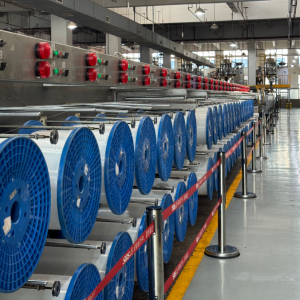
The final stages apply optional finish oil for downstream handling (knitting, weaving, braiding) and wind the yarn onto spools. Automatic winding must keep tension consistent from the start of a spool to the end. Uneven tension during winding shows up later as package density problems and handling faults, even if the yarn itself is sound.
⚠️ Warning: Do not buy a line that skips a dedicated heat-setting stage or a gear melt pump in the name of cost. On PP monofilament, both are central to dimensional stability and consistency. Removing them moves the problem downstream to your scrap rate.
Process Parameters at a Glance
The table below summarizes a representative PP monofilament yarn process window. Treat these as working ranges to validate against your resin grade and target diameter — not as universal absolutes.
Parameter | Typical range | Why it matters |
|---|---|---|
Extruder L/D ratio | 28:1 – 33:1 | Enough melting/homogenization length for stable melt |
Melt/extrusion temperature | 200 – 250°C | Melt homogeneity; too high degrades PP |
Quench bath temperature | 25 – 35°C | Controls crystallization, shrinkage, diameter |
Draw temperature | 110 – 160°C | Sets orientation window; too low risks breaks |
Draw ratio | 1:5 – 1:8 | Balances tenacity vs. elongation vs. break risk |
Resin MFI | 2 – 12 g/10 min | Defines the processing temperature window |
Finished denier tolerance | ≈ ±5% | Customer-facing consistency spec |
Quality Control: What to Measure and Test
Consistency is the product. Most complaints about PP monofilament yarn are not about the material being wrong — they are about the material being inconsistent. Focus your QC on the metrics that customers actually inspect:
Linear density / denier — target tolerance around ±5%.
Tensile strength / tenacity — the draw process must deliver stable strength run-to-run.
Elongation at break — a balance point set by draw ratio and heat-setting.
Diameter consistency and evenness — measured as mass/length variation along the strand.
Shrinkage — controlled by heat-setting quality.
Surface cleanliness — free of contamination, hairiness, and finish-oil soiling.
Test methods align with standard textile and polyolefin practice, including tensile/elongation testing (ISO 2062) and polyolefin monofilament specification (ASTM D3218). Your line supplier should be able to confirm how their QC instrumentation maps to these.
Common Defects and Their Causes
No line runs flawlessly forever. The value is in diagnosing faults fast:
Symptom | Likely cause | Countermeasure |
|---|---|---|
Diameter variation | Unstable melt temperature, uneven quench cooling | Stabilize temperature profile, hold quench bath steady |
Strand breakage | Melt instability, spinneret blockage, excessive draw ratio | Clean spinneret assembly, stabilize melt, optimize draw ratio |
Ovality / uneven shape | Uneven cooling, draw-speed mismatch | Balance quench, synchronize draw stand speeds |
Poor surface / contamination | Impure feed, finish-oil contamination | Raw-material QC, clean feed, filter maintenance |
Where PP Monofilament Yarn Is Used
Demand for PP monofilament yarn spans several technical textile and industrial end uses, and each one stresses a different property:
Agriculture — shade nets, anti-bird nets, anti-hail nets, greenhouse screening, crop protection.
Marine and industrial — ropes, twines, mooring and hauling lines, fishing and aquatic nets.
Geotechnical and construction — geotextiles, woven geo-meshes, macro fibers, webbings.
Filtration — filter cloths and meshes, filter press cloths, precision woven filter fabrics where clean openings and easy surface cleaning matter.
General textiles — industrial fabrics, conveyor and safety webbing, sewing threads, curtains and tapestries.
For heavier, higher-tenacity geotechnical outputs, a purpose-built configuration like the high-tenacity geotextile PP line is engineered for the bigger deniers and tighter tensile requirements those products demand.
Pro Tip: Define your lead application before you size the line. Producing fine 0.15 mm filter yarn and heavy 1000+ denier geotextile yarn are genuinely different machines — different screw, different spinneret, different draw and winder setup. Match the line to the end use, not the other way around.
How to Evaluate a PP Monofilament Yarn Line Before You Buy
A PP monofilament yarn line is a multi-year capital decision. Slow down, build an evaluation framework, and apply the same discipline you’d expect from the machine.
Do Your Needs Assessment First
Before comparing quotes, write down your requirements as numbers:
Target diameter / denier range you must produce.
Output in kg/h (and the corresponding winding/spindle count).
Resin grade (MFI) and whether you plan to run recycled material.
Quality targets — denier tolerance, tenacity, elongation, shrinkage you must hold.
Utilities available — power, cooling water, compressed air.
End product — net, rope, geotextile, filter cloth — and how strict its specs are.
Answering these first stops you from comparing machines that aren’t even in the same category.
Must-Have Criteria
Screw and L/D matched to PP (28:1–33:1) with wear-resistant construction.
Gear melt pump for stable metering.
Multi-stage drawing with speed-synchronized draw stands and dedicated heat-setting/annealing.
Quality instrumentation aligned to ISO/ASTM methods.
Automation/PLC with process monitoring and consistent winding.
Red Flags to Watch For
A line that advises skipping heat-setting or the melt pump.
No clear answers on energy consumption per kilogram (kWh/kg).
Unspecified spare-parts lead times or after-sales response.
Certification or experience claims without evidence.
A quote based on your maximum output rather than the stable output you’ll actually run — oversizing raises energy and capex for no benefit.
Get the Process Right, then the Price
When you compare suppliers, weigh long-term reliability against sticker price. Total cost of ownership includes energy, scrap rate, maintenance, downtime, and spare parts — not just the invoice. Need help framing those costs? Our monofilament extrusion line cost factors guide walks through the variables that move your quote and your TCO.
Next Steps
You now have the framework: understand the material, map the line section by section, lock down the process parameters, hold the quality metrics, and evaluate suppliers against clear criteria. If you’ve defined your target diameter, output, and end use, you’re ready to talk configuration.
Responsible line suppliers will spec the machine around your numbers — screw diameter, stretch stages, winder count — not push a one-size-fits-all unit. Reach out to discuss a custom line layout for your PP monofilament yarn requirements, a technical specification audit, or a Factory Acceptance Test (FAT) sample run before you commit. A line like the 0.15 mm PP monofilament yarn machine is a good reference point for what a purpose-built PP yarn line looks like in practice.