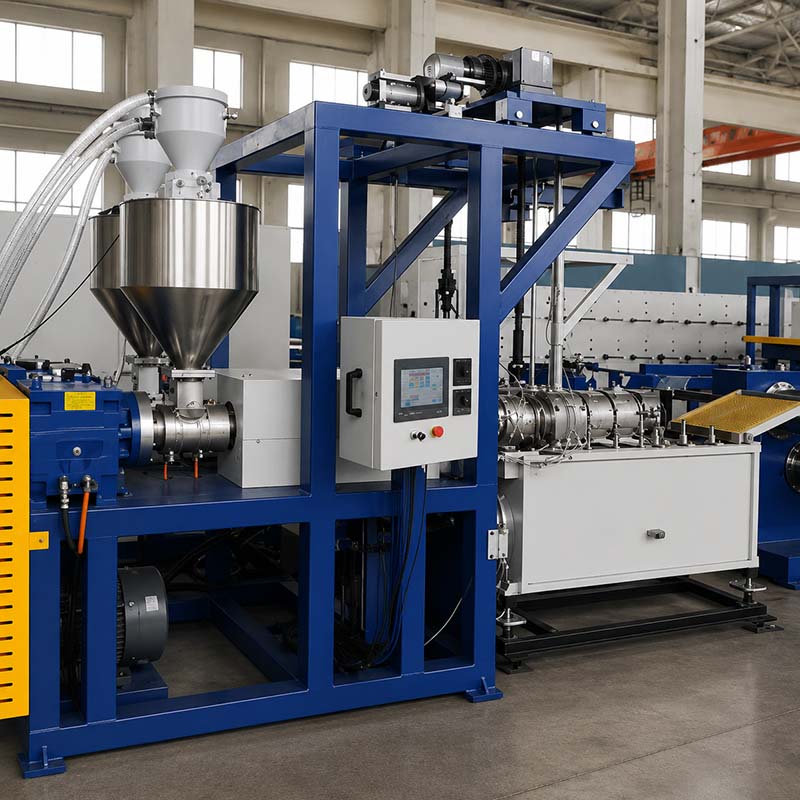
If you produce industrial monofilament (for zippers, brush bristles, fishing nets, or ropes), you already know the pain: a small instability in melt delivery upstream can become scrap downstream—diameter variation, ovality, bubbles, or a surface finish that doesn’t pass inspection.
A single-screw extruder is the workhorse that turns solid resin into a stable, uniform melt and pushes it through the die. But “it melts plastic” is not a useful explanation when you’re troubleshooting line stability.
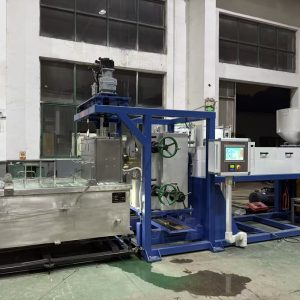
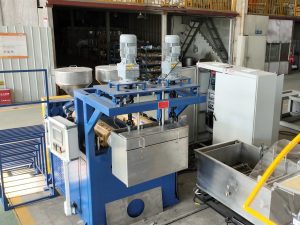
This article breaks down the single screw extruder working principle in a way that’s practical for single screw extruder for filament production in industrial monofilament lines: what happens in each zone, what each component is doing, and what to watch when diameter starts drifting.
Quick context: single-screw vs twin-screw for monofilament
Most industrial monofilament lines use single-screw extruders because the job is usually consistent melting + stable pumping of a relatively clean, well-defined formulation.
Here’s a simple comparison to orient the decision:
Criteria | Single-screw extruder | Twin-screw extruder |
|---|---|---|
Best at | Melting and pumping a stable formulation continuously | Intensive mixing/compounding, dispersing additives, processing difficult blends |
Typical monofilament role | Main extruder feeding screen pack/die (often with melt pump) | Used when you must compound inline (high filler/additive load, tough recyclate variability) |
Output stability approach | Stable feed + stable temperature profile + filtration + optional melt pump | Stable feeding plus stronger mixing; still needs filtration and good controls |
Complexity and maintenance | Generally simpler (fewer rotating elements) | More complex; more wear parts and configuration variables |
When it’s worth it | When the formulation is consistent and you want robust, repeatable output | When material variability or mixing demands dominate the process risks |
Key Takeaway: For monofilament diameter stability, the question is often less “single vs twin” and more “how stable is your melt delivery to the die”—and how well you control pressure, temperature, filtration, and downstream draw.
The extruder’s real job in monofilament and filament production
In a monofilament line, the extruder section is doing five jobs at once:
Feed resin consistently (pellets, granules, or regrind blend)
Melt it fully (no unmelted particles, no cold streaks)
Homogenize temperature and composition (so viscosity doesn’t swing)
Build pressure to push melt through screens and die
Meter melt flow in a stable way so the die sees a steady supply
If any of those five becomes unstable, the filament has to “absorb” the instability somewhere—often as diameter variation.
For a monofilament-specific breakdown of the extruder section (including filtration and pressure control), see NLY’s reference guide on the plastic monofilament extruder working principle.
Main parts of a single-screw extruder (and why each exists)
A basic single-screw extruder looks straightforward, but each component exists to control one failure mode.
Hopper and feed throat
The hopper holds resin. The feed throat is the entry region where solids begin to be conveyed.
Inconsistent feeding (bridging, rat-holing, variable bulk density from regrind) can show up later as pressure oscillation and output surging.
Screw and barrel
The screw rotates inside the barrel. Together they convey solids forward, melt them, and pump the melt toward the die.
Think of the screw as doing two jobs:
a conveyor for solids early on
a viscous pump for melt later on
Heating zones (and sometimes barrel cooling)
Barrel heaters establish a temperature profile. Cooling (when present) helps prevent overheating and improves stability.
In practice, stability is less about “high temperature” and more about consistent temperature—because viscosity changes with temperature, and viscosity changes show up as flow changes.
Adapter, breaker plate, and screen pack / screen changer
Before the melt reaches the die, many lines include:
an adapter (connects barrel to downstream components)
a breaker plate (supports screens and helps stabilize flow)
a screen pack (filters contamination) or a screen changer (lets you change screens without stopping)
Filtration is critical in industrial production because contamination and gels can create surface defects or die build-up. But filtration also adds resistance—and resistance changes over time as screens load.
If you’re new to this topic, “screen pack and screen changer in extrusion” simply means: screens filter the melt, and a screen changer lets you replace them without a full shutdown—important for stable monofilament runs.
Die
The die shapes the melt into the initial filament diameter (before draw). In monofilament, the die is the start of the geometry, not the end of the story—final diameter is typically controlled by drawdown/draw ratio and downstream tension.
Single screw extruder working principle: what happens in the barrel
Most general-purpose screws are described in three functional zones—feed zone compression zone metering zone—because the geometry changes along the screw length to match what the polymer needs at each stage.
1) Feed zone: solids conveying starts here
The feed zone is where the screw flights pick up solid resin and begin moving it forward.
What can go wrong here in monofilament production:
bridging or inconsistent feed from the hopper
resin that becomes sticky too early (can reduce solids conveying efficiency)
inconsistent bulk density (especially with variable regrind)
Those issues can propagate downstream as unstable output.
2) Compression (transition) zone: melting and pressure build-up
In the transition zone, the screw channel depth reduces. The resin compacts, pressure rises, and melting accelerates.
Melting isn’t only “heater bands did it.” A major contributor is shear/viscous heating as melt forms and is worked.
⚠️ Warning: If melting is unstable (for example, partial melting that comes and goes), you can see pressure oscillation that looks like a controls problem—but the root cause is mechanical/thermal behavior inside the screw.
3) Metering zone: stabilize the melt before filtration and the die
In the metering zone, the polymer should be fully molten and reasonably uniform.
This is where you want “boring” behavior:
steady melt temperature
steady head pressure trend
steady motor load
Because once the melt leaves the extruder, your downstream equipment (cooling bath, haul-off, draw, winder) has limited ability to correct upstream instability.
For a monofilament-oriented overview of how the extruder fits into the full line, NLY’s plastic monofilament extrusion line guide is a useful reference.
Filtration and pressure control: why they matter for diameter stability
Screen pack loading is a “hidden variable”
Screens catch contamination—but as they load, resistance increases. That often shows up as:
rising head pressure over time
more pressure noise
eventually, unstable output if the system is pushed near limits
A screen changer helps you manage this without frequent shutdowns, but you still need a process to track pressure trend and change screens before instability becomes scrap.
Pressure measurement tells you what the melt is doing
You can’t see inside the barrel during production. Pressure is one of the best proxies you have.
Plastics Technology’s troubleshooting guide notes that flow surging in single-screw extruders is often tied to issues in the solids conveying section and temperature control; their article on Troubleshooting Flow Surging in Single-Screw Extruders is a solid starting point when output becomes periodic.
For a more technical overview of mechanisms and patterns, the SPE Extrusion Division’s Extruder Surging overview (PDF) is a helpful reference.
Why extruder surging causes filament diameter variation
A monofilament line is a chain of processes. The filament diameter is influenced by:
how much melt exits the die per unit time
how fast the filament is pulled (haul-off/draw)
how quickly it solidifies (cooling)
If the extruder output pulses, the downstream draw system often can’t “average it out” perfectly—so you see a repeating diameter pattern.
Common surging triggers in real production
These are common extruder surging causes behind periodic instability:
inconsistent feed (bridging, bulk density swings)
temperature control issues in the feed/early barrel zones
screen pack restriction changing over time
melt temperature non-uniformity
Pro Tip: When diameter starts “breathing” (cyclic thick-thin), check whether the cycle time matches a process variable you can observe—screen loading trend, screw speed oscillation, feed interruptions, or cooling changes.
Practical checklist: what to watch on the panel
When you’re running an industrial monofilament line, these signals usually tell you more than the setpoints:
Head/melt pressure trend: stable, rising slowly (screen loading), or oscillating?
Melt temperature stability: drifting or stable?
Motor load (amps/torque): drifting upward (restriction/wear), oscillating (instability), or steady?
Screw speed stability: consistent or hunting?
Screen change interval: getting shorter over time (contamination, degradation, wrong screen strategy)?
If you want a broader, step-by-step view that ties the extruder to downstream steps, NLY’s Monofilament extrusion process step by step provides that full-line context.
Common monofilament defects and what they often mean upstream
This is not a substitute for a controlled troubleshooting process, but it helps you form a first hypothesis.
Diameter variation and ovality
Often linked to one (or a combination) of:
unstable extruder output (surging)
melt temperature drift (viscosity changes)
puller/haul-off speed variation
unstable cooling conditions (especially early quench)
Bubbles or voids
Often linked to:
moisture/volatiles in the resin (especially with hygroscopic polymers like nylon or PET)
inadequate drying practices or inconsistent dryer performance
overheating that drives off volatiles
Rough surface or melt-fracture-like texture
Often linked to:
excessive shear rate (too fast for the die geometry/material)
die temperature too low relative to the melt flow behavior
contamination or build-up on the die lip
For general background on extrusion surface defects and mitigation, EdTech Books’ section on Extrusion Problems and Troubleshooting explains how shear and die conditions relate to melt fracture and sharkskin-type defects.
Where NLY fits (without turning this into a sales pitch)
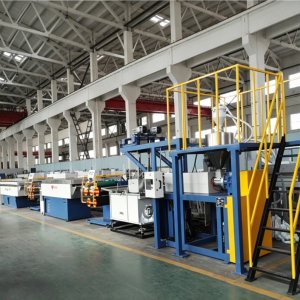
Changzhou New Liaoyuan Machinery (NLY) builds complete monofilament extrusion lines and focuses heavily on process stability—the practical side of diameter control, uptime, and repeatable operation.
If you’re building internal training materials or standardizing shift-to-shift setup, pairing this kind of mechanism understanding with a documented start-up/shutdown SOP typically pays back quickly in reduced scrap and faster recovery.
Next steps
If you’re troubleshooting instability—or planning a new industrial monofilament line—start by writing down three things:
Your resin and condition (e.g., PA/PET/PP/PE; virgin/regrind blend; drying method)
Target filament diameter range and surface requirements
The “signature” of the problem (steady drift vs cyclic surging; when it starts; what changes fix it)
Then you can request a line configuration and commissioning plan tailored to your product. If you want, you can contact NLY via the main site and ask for a proposed configuration plus a practical sample/FAT plan based on your material and target diameter.
FAQ
Is a melt pump required for monofilament extrusion?
Not always. A melt pump (gear pump) is often used when you need tighter control of flow to the die or when you want to decouple output stability from screw pressure fluctuations. Whether it’s worth it depends on your diameter tolerance requirements and how stable your upstream feeding and filtration are.
What’s the fastest way to diagnose surging?
Start with what you can observe: head pressure oscillation pattern, feed consistency (bridging), and whether the feed section or early barrel zones are running too hot. Plastics Technology’s troubleshooting approach is a practical checklist: see their article “Troubleshooting Flow Surging in Single-Screw Extruders.”
Why do screens affect output stability?
As a screen pack loads with contamination, flow resistance increases. That changes head pressure and can destabilize flow if the system is near its operating limits. Monitoring pressure trend and having a clear screen-change strategy is part of stable production.
Does the die determine final filament diameter?
The die establishes the initial shape and size, but final diameter is usually controlled by downstream draw and cooling conditions. That’s why stable melt delivery and stable haul-off/draw control work together.