When a plant team says “we need high quality monofilament,” they usually don’t mean “the average diameter looks right on one sample.” They mean the line runs stably, the strand holds spec over time, and downstream handling doesn’t turn into scrap, breaks, or customer claims.
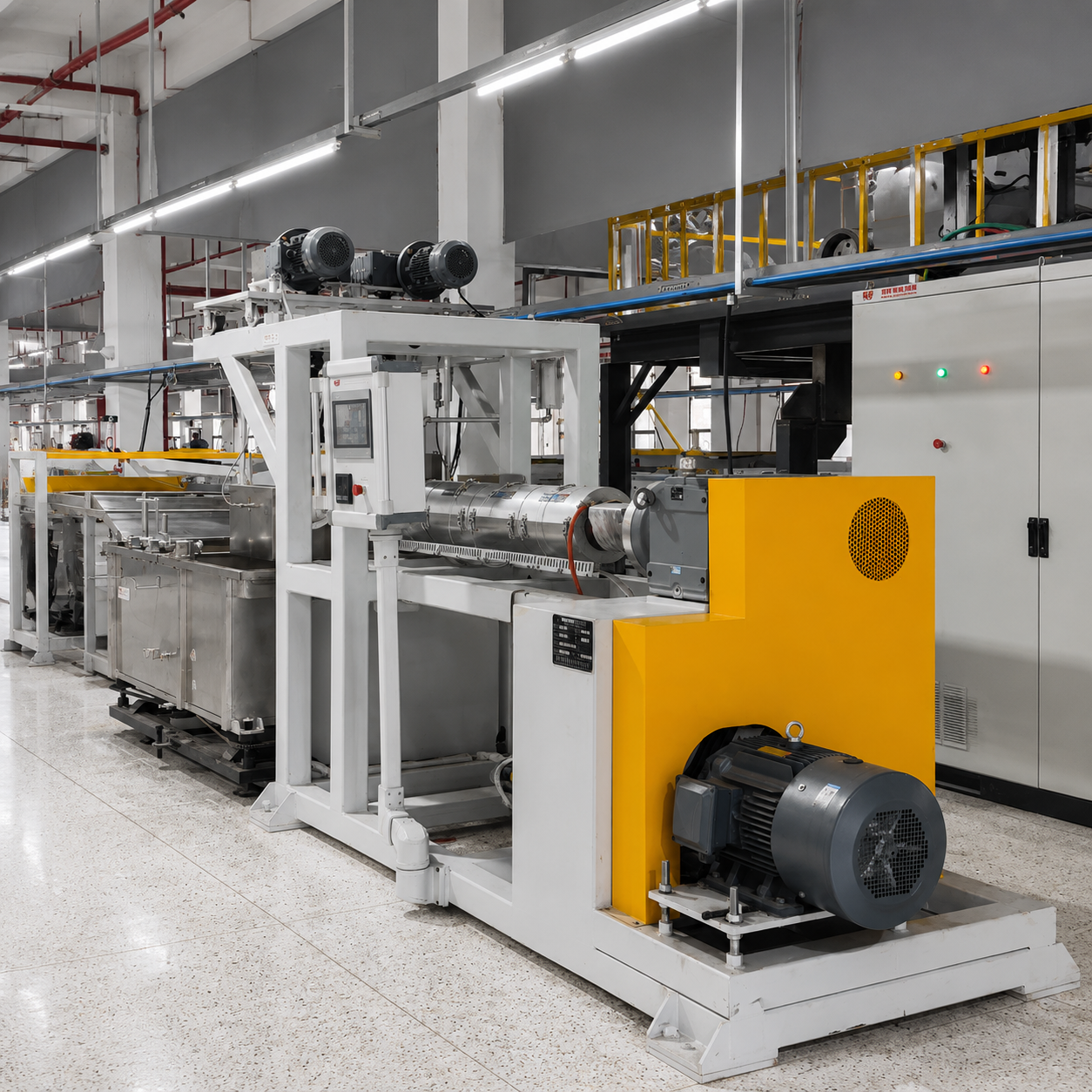
This article defines what high-quality monofilament looks like in measurable terms, then explains the monofilament extrusion process that produces it—step by step, with a focus on what each section of the line actually controls.
What is “high quality monofilament” (a practical definition)
High quality monofilament is a single, solid filament that stays within an agreed spec for:
Geometry: diameter tolerance and low ovality (roundness)
Surface condition: clean surface, low gels/specks, minimal scratches/marks
Mechanical behavior: tensile strength and elongation in range
Dimensional stability: controlled shrinkage after heat exposure / storage
Usability: stable package build (winds and unwinds without trouble) and consistency across spools/batches
NLY summarizes these “what good looks like” outcomes clearly in its explainer on practical monofilament quality metrics.
How monofilament quality is measured (so “good” is not subjective)
If you want quality to be repeatable, you need acceptance criteria that are easy to verify.
Diameter tolerance and ovality: measure stability, not just an average
A good spec doesn’t only state the target diameter. It also forces agreement on monofilament diameter tolerance and roundness criteria, including:
where diameter is measured (after which stage)
how often it’s measured (by length/time)
whether the metric is average-only or includes variation limits
Pro Tip: When a line “looks stable” but customers still complain, the issue is often variation over time (drift, oscillation) rather than the average value.
Ovality (roundness): why “out-of-round” becomes a downstream problem
Ovality (sometimes written as monofilament ovality in specifications) is one reason a strand that passes a quick caliper check still runs badly in drawing or unwinding. If the cross-section isn’t consistently round, tension and traction behavior can vary.
Surface condition: defects that become weak spots
For many applications, the practical surface checklist is simple: avoid scratches, contamination, and melt defects (gels/specks) that create stress concentrators.
Mechanical properties: strength and elongation are a “recipe,” not a single knob
Strength and elongation come from the material and the drawing/heat-setting recipe. In practice, plants care about whether the strand behaves the same across shifts, lots, and spool positions—not whether a single test specimen looks great.
The monofilament extrusion process (from pellets to spools)
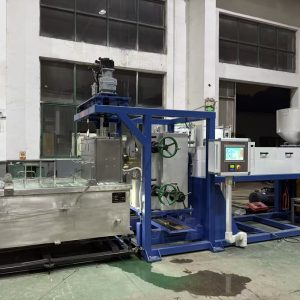
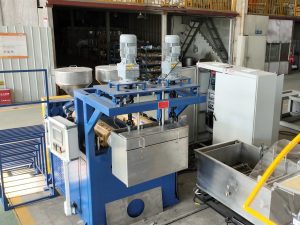
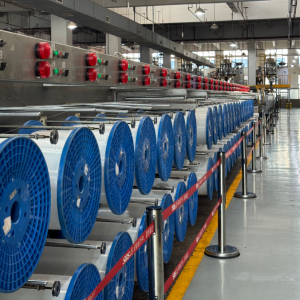
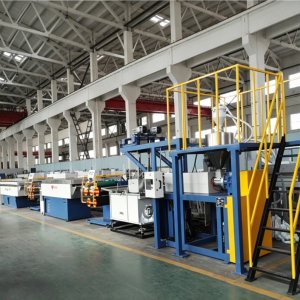
A modern monofilament line is a chain of control zones. Each zone has a different job, and trying to fix quality by adjusting the last zone (winding) is one of the fastest ways to waste production time.
For a full breakdown of the steps, see NLY’s monofilament extrusion process step by step. Here’s the quality-focused version.
1) Material conditioning: drying and feeding discipline
Some polymers—especially PA (nylon) and PET—are moisture-sensitive.
If moisture or volatiles enter the melt stream, you may see bubbles/voids, unstable flow, and weak spots that later look like “mystery breaks.”
Key controls:
drying method and capacity vs throughput
stable feeding (avoid bridging, segregation, inconsistent regrind ratios)
2) Extrusion: deliver a stable, clean melt
The extruder’s job is not only to melt resin. It must deliver a uniform melt at stable temperature and pressure.
A useful way to think about quality is: if the melt delivery is unstable, every downstream zone is forced to “compensate,” and quality becomes unpredictable.
3) Filtration and die: protect cleanliness and set initial geometry
Melt filtration protects the strand from contamination and gels. The die (spinneret) sets the initial geometry, but it does not guarantee final quality on its own.
If you’re fighting specks, gels, or unexplained weak spots, filtration suitability and die cleanliness are usually worth checking early.
4) Quench / cooling: lock in shape and roundness
Cooling is where the strand solidifies and shape is “frozen.” For diameter stability and low ovality, quench symmetry matters.
Common stability killers include turbulence, drifting water temperature/level, and a strand path that runs off-center.
5) Drawing (stretching): set orientation and mechanical behavior
Drawing (often discussed as the monofilament drawing process) is where strength/stiffness/elongation are created by controlled stretching (speed ratios) within a workable temperature window.
If the draw recipe is too aggressive for the strand quality coming out of cooling, breaks and property variation follow.
6) Annealing / heat setting: reduce stress and control shrinkage
Heat setting stabilizes the strand under tension and helps control shrinkage and long-term dimensional behavior.
7) Winding: package build and tension history
Winding can ruin good filament, but it usually can’t fix bad filament.
If you see tangles, poor unwind behavior, or damaged surface from handling, winding and traverse setup matter. If you see diameter drift and weak spots, it’s usually upstream.
Which process stage controls which quality outcome
If you only take one idea from this article, make it this: quality is controlled by loops, not single settings.
NLY frames diameter as a mass-flow vs take-off ratio in its guide to stable diameter control loop troubleshooting.
Here’s the simplified map:
Bubbles/voids, brittle strand → start at drying + feeding (especially PA/PET)
Diameter fluctuation / drift → confirm melt stability, then quench stability, then speed synchronization
Ovality / out-of-round → look for asymmetric cooling, off-center strand path, contact while soft
Gels/black specks → contamination control, filtration, die build-up / cleaning
Frequent breaks during drawing → quench stability + draw ratio/temperature window + traction/slip
High shrinkage → heat-setting recipe and tension control
For a system-level overview of how these zones connect, see how a monofilament extrusion line works.
Common defects and what they usually mean upstream
This section is intentionally short. The goal is to help you avoid chasing symptoms.
Diameter variation and ovality
Often linked to unstable melt delivery or an unstable quench zone (turbulence, drifting water temperature/level, misalignment). NLY’s factors that affect monofilament quality is a useful symptom-to-upstream map.
Bubbles or voids
Very often a resin conditioning problem (moisture/volatiles) or a thermal stability problem.
Rough surface or melt fracture
Can be shear-rate related (throughput vs die geometry vs temperature profile) and sometimes worsened by contamination or die deposits.
Low strength or unstable elongation
Usually a draw/heat-setting recipe problem—or an upstream stability problem that makes a stable recipe impossible.
A buyer-friendly checklist: how to specify “high quality” to a supplier
If you’re requesting quotes or comparing suppliers, the simplest way to get better answers is to provide a one-page spec sheet.
Include:
polymer family (PA / PET / PP / HDPE) and any recycled-content requirements
target diameter range and diameter tolerance definition (average vs variation)
ovality / roundness requirement (and how it will be verified)
surface requirements (what defects are unacceptable)
mechanical targets (strength + elongation range) and test conditions
shrinkage expectations (after heat exposure / storage)
output target and how stability will be judged (minutes/hours of steady run)
what defects you are currently fighting (scrap modes)
Next steps (if you want to tighten quality without guessing)
If you want a line configuration or a practical process checklist for your polymer and diameter range, NLY can help you map the control zones (drying → melt stability → quench → drawing → heat-setting → winding) and define what needs to be measured at each stage.
Start with NLY’s monofilament extrusion machine options and share your polymer, diameter range, output target, and main defect modes so the recommended configuration is grounded in your process reality.
FAQ
What is the most important metric for high-quality monofilament?
Usually it’s geometry stability over time (diameter tolerance plus low ovality). Even if strength is acceptable, unstable geometry tends to create breaks, handling problems, and downstream rejects.
Which process stage most strongly affects diameter stability?
Diameter stability is primarily a balance between melt delivery (mass flow) and take-off speed, and it’s heavily influenced by the quench/cooling zone where shape is locked in.
Why does good average diameter still produce scrap?
Because variation over time, ovality, surface defects, or weak spots can cause breaks and rejects even when the average diameter is on target.
Do all polymers behave the same in monofilament production?
No. Moisture sensitivity (especially for PA and PET), crystallization behavior, and the workable drawing/heat-setting window vary by polymer family. Your quality plan should reflect the specific polymer and the end-use.