Nylon filament is a synthetic polymer fiber known across global manufacturing for its high tensile strength, exceptional abrasion resistance, and flex fatigue durability. In industrial plastic manufacturing, the term nylon filament primarily refers to nylon monofilament—a single, continuous strand of extruded polyamide (PA) resin engineered with a uniform, solid cross-section.
Unlike spun multifilament yarns made of dozens of twisted micro-fibers, or spooled 3D-printing filaments designed for fused deposition modeling (FDM), industrial nylon monofilament is produced via high-precision melt spinning and multi-stage drawing. It serves as the core structural component in zipper elements, industrial brushes, commercial fishing nets, paper machine clothing, and technical textiles.
Understanding what nylon filament is requires analyzing its molecular grades, mechanical and physical properties, end-use performance requirements, and the thermal extrusion parameters needed to manufacture it with strict diameter tolerances.
What is Nylon Monofilament? Monofilament vs. Multifilament vs. 3D Printing Filament
To evaluate nylon filament for manufacturing applications, engineers and plant managers must distinguish between three distinct product categories that are frequently confused in commercial literature:
1. Nylon Monofilament
A single, continuous, solid-core fiber produced by extruding molten polyamide through precision spinneret dies. Ranging in diameter from 0.08 mm to 3.00 mm, monofilament exhibits directional rigidity, a smooth non-porous surface, low fluid drag, and high burst strength.
2. Nylon Multifilament Yarn
A bundle composed of multiple fine nylon micro-filaments (often 20 to 200 individual strands) twisted or bonded together. Multifilament yarn offers high flexibility, softness, and drape, making it suitable for apparel textiles, climbing ropes, and woven fabrics rather than rigid structural components.
3. 3D Printing Nylon Filament (FDM)
A thick plastic feedstock line (typically 1.75 mm or 2.85 mm) spooled for additive manufacturing extruders. While chemically composed of polyamide resins, FDM filament is formulated for layer-to-layer melt adhesion at low speeds, whereas industrial monofilament is drawn and heat-set at high linear speeds (up to 100–800 m/min) to achieve high crystalline orientation and tensile tenacity.
Feature / Property | Industrial Nylon Monofilament | Nylon Multifilament Yarn | 3D Printing FDM Filament |
|---|---|---|---|
Structure | Single solid continuous strand | Multiple twisted micro-strands | Solid feedstock filament |
Typical Diameter | 0.08 mm – 3.00 mm | Individual fibers < 0.02 mm | 1.75 mm / 2.85 mm |
Primary Tensile Mechanism | High molecular orientation via orientation drawing | Fiber-to-fiber inter-friction & twist | Isotropic melt cohesion |
Surface Friction | Extremely smooth, low drag | Soft, textured, high surface area | Matte or glossy layer lines |
Primary Industrial Uses | Zippers, brushes, nets, technical mesh, trimmer line | Apparel, webbing, industrial sewing thread | Rapid prototyping, functional parts |
Comparing Polyamide Grades: PA6 vs. PA66 vs. PA12
The chemical backbone of nylon consists of repeating polyamide amide (-CO-NH-) linkages. The specific spacing of carbon atoms between these amide groups defines the polyamide grade, directly influencing the filament’s melting point, moisture absorption rate, tensile modulus, and chemical resistance.
Key Takeaway: Selection of the correct polyamide grade is the single most important decision in nylon monofilament manufacturing. PA6 provides toughness and economical processing; PA66 delivers maximum heat resistance and strength; PA12 offers superior dimensional stability in wet environments.
Item | Detail |
|---|---|
PA6 Chemical Structure | [ -NH-(CH₂)₅-CO- ]ₙ (Single monomer: Caprolactam) |
PA66 Chemical Structure | [ -NH-(CH₂)₆-NH-CO-(CH₂)₄-CO- ]ₙ (Dual monomer: Hexamethylenediamine + Adipic Acid) |
PA12 Chemical Structure | [ -NH-(CH₂)₁₁-CO- ]ₙ (Single monomer: Laurolactam) |
Polyamide 6 (PA6 / Nylon 6)
Synthesized via the ring-opening polymerization of caprolactam, PA6 features 6 carbon atoms in its repeating unit. It is the most widely processed nylon resin due to its excellent impact strength, high wear resistance, easy melt processing, and cost-efficiency. PA6 monofilaments process at lower melt temperatures (240°C–270°C) and exhibit high elastic recovery, making them ideal for brush bristles, Velcro hooks, and general-purpose netting.
Polyamide 66 (PA66 / Nylon 66)
Formed by the polycondensation of hexamethylenediamine and adipic acid, PA66 contains two 6-carbon building blocks. The symmetrical polymer chain allows denser intermolecular hydrogen bonding, resulting in a higher melting point (255°C–265°C), superior mechanical stiffness, and greater thermal stability than PA6. PA66 monofilaments are specified for demanding applications such as high-speed zipper coil elements, automotive technical fabrics, and paper machine clothing.
Polyamide 12 (PA12 / Nylon 12)
Produced from laurolactam, PA12 features a long 12-carbon hydrocarbon chain separating its amide groups. This lower density of amide bonds dramatically reduces its polarity, giving PA12 the lowest 24-hour water absorption (~0.1%–0.25%) among all industrial polyamides. While PA12 has a lower melting point (175°C–180°C) and lower tensile strength than PA6/PA66, its immunity to moisture-induced dimensional changes makes it the premier choice for precision fluid lines, outdoor commercial fishing gear, and chemical-resistant industrial filter fabrics.
For a broader evaluation of resin selection across monofilament production, consult our engineering guide to choosing plastic materials for monofilament production.
Engineering Property Comparison Matrix
Property (ASTM / DIN Standard) | PA6 (Nylon 6) | PA66 (Nylon 66) | PA12 (Nylon 12) |
|---|---|---|---|
Density (g/cm³) | 1.13 – 1.14 | 1.14 – 1.15 | 1.01 – 1.02 |
Melting Point (°C) | 220°C – 225°C | 255°C – 265°C | 175°C – 180°C |
Tensile Strength (Oriented, MPa) | 500 – 750 MPa | 600 – 850 MPa | 350 – 550 MPa |
Tenacity (cN/dtex) | 5.5 – 7.0 cN/dtex | 6.5 – 8.0 cN/dtex | 4.0 – 5.5 cN/dtex |
Elongation at Break (%) | 25% – 35% | 20% – 30% | 30% – 45% |
24h Water Absorption (ASTM D570) | 1.2% – 1.8% | 1.2% – 1.5% | 0.10% – 0.25% |
Saturated Water Absorption (%) | ~8.5% | ~8.0% | ~1.5% |
Dry Heat Shrinkage (150°C × 15 min) | ≤ 3.5% | ≤ 2.5% | ≤ 2.0% |
Extrusion Melt Temperature (°C) | 240°C – 270°C | 275°C – 300°C | 200°C – 240°C |
Core Mechanical & Physical Properties of Nylon Monofilament
Nylon monofilament’s commercial utility across industrial sectors stems from four inherent physical and mechanical characteristics:
1. High Tensile Strength & Elastic Toughness
Unoriented extruded nylon resin has modest mechanical strength. However, during monofilament processing, the strand undergoes controlled longitudinal stretching (drawing) at elevated temperatures. This mechanical orientation aligns the amorphous polymer chains parallel to the filament axis, forming tightly packed crystalline domains. Tensile strengths reach 500 to 850 MPa, allowing thin monofilaments to withstand immense shock loads and continuous cyclic fatigue without snapping.
2. Exceptional Abrasion Resistance & Low Friction
Nylon possesses one of the lowest coefficients of surface friction among engineering thermoplastics, combined with self-lubricating properties. When exposed to repeated dynamic contact—such as brush bristles scrubbing metal surfaces or zipper elements meshing millions of times—nylon monofilament resists surface flaking, fibrillation, and abrasive wear far better than polyester (PET) or polypropylene (PP).
3. Chemical & Hydrocarbon Resistance
Polyamide monofilaments demonstrate outstanding resistance to non-polar solvents, hydraulic fluids, motor oils, fuels, grease, alkalis, and aromatic hydrocarbons. However, polyamides are susceptible to degradation from strong mineral acids (such as sulfuric or hydrochloric acid) and concentrated oxidizing agents.
4. Hygroscopic Behavior & Moisture Sensitivity
All polyamides absorb atmospheric moisture due to polar amide groups forming hydrogen bonds with water molecules. Water acts as a natural plasticizer within nylon:
Dry Condition (As-Extruded): High tensile stiffness, higher modulus, lower impact strength.
Conditioned / Wet State: Absorbed moisture increases flexibility, impact resistance, and elongation, but decreases tensile modulus and yield strength by 15%–30%.
⚠️ Warning: Processing un-dried nylon resin causes severe hydrolytic degradation inside the extruder barrel. Water vapor breaks polymer chains at elevated temperatures, leading to molecular weight loss, brittle filaments, surface melt bubbles, and erratic diameter variation.
Key Industrial Applications of Nylon Monofilament
Precision manufacturing industries utilize nylon monofilament based on specific diameter, stiffness, and chemical criteria:
Nylon Monofilament Applications
Zipper Element Coil (0.15mm – 0.50mm) → Requires pitch consistency & high modulus
Industrial & Abrasive Brushes → Requires bend recovery & wear resistance
Commercial Fishing Line & Nets → Requires knot tenacity & dynamic energy absorption
Technical Fabrics & PMC Mesh → Requires chemical stability & dimensional control
Zipper Element Coils (0.15 mm – 0.50 mm)
Continuous nylon monofilament is precision-wound into spiral coil elements for textile zippers. PA6 and PA66 are preferred for their lateral stiffness, thermal stability during garment ironing, and color-dyeing versatility. For manufacturers establishing high-output production lines, detailed machine requirements are covered in our guide on selecting a plastic extruder for zipper monofilaments.
Industrial Brushes & Abrasive Bristles (0.10 mm – 1.50 mm)
Nylon monofilament is the industry benchmark for strip brushes, toothbrush bristles, street sweepers, and abrasive industrial rotary brushes (often impregnated with silicon carbide or diamond grit). Its high bend recovery ensures that bristles return to their straight orientation after bending thousands of times.
Commercial Fishing Line & Fishing Nets
Nylon monofilament revolutionised commercial fishing due to its high breaking tenacity, transparency in water, knot strength, and energy-absorbing stretch that prevents line snapping under sudden load spikes.
Technical Fabrics & Paper Machine Clothing (PMC)
In paper manufacturing mills, large endless woven belts made from PA66 and PA12 monofilaments convey wet paper pulp through pressing and drying sections. Nylon monofilaments withstand high mechanical pressure, chemical wash cycles, and continuous hot humid environments without delaminating.
How Nylon Monofilament is Manufactured: Extrusion Process & Parameters
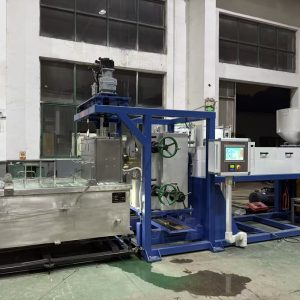
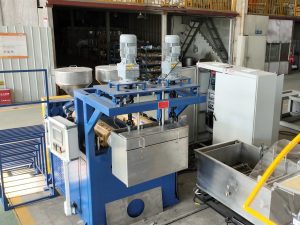
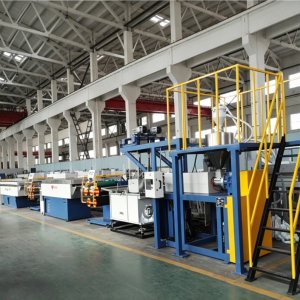
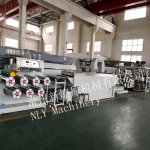
Manufacturing nylon monofilament requires an integrated, multi-stage melt extrusion and stretching line designed to handle the specific rheological behavior of polyamide resins.
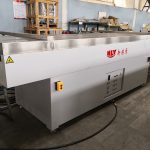
Resin Drying → Extruder & Melt Pump → Spinneret Die → Quench Water Bath
[Winder Spools] <– [Heat Setting Oven] <– [Multi-Stage Drawing] <——
The process follows six sequential operational stages:
Step 1: Resin Dehumidification Drying
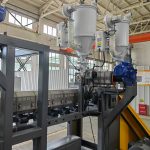
Prior to extrusion, nylon pellets must be dried in a desiccant dehumidifying dryer until moisture levels drop below 0.05% (500 ppm), using dry air with a dew point below -40°C. Standard hot-air drying is insufficient for hygroscopic polyamides.
Step 2: Melt Extrusion & Precision Metering
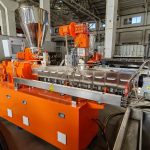
Dried pellets feed into a single-screw extruder featuring an L/D ratio of 28:1 to 32:1 equipped with barrier flights and mixing elements. Precise temperature zoning ensures homogeneous melting without thermal degradation:
PA6 Temperature Profile: 230°C (Feed) → 250°C (Transition) → 265°C (Metering & Die)
PA66 Temperature Profile: 260°C (Feed) → 280°C (Transition) → 295°C (Metering & Die)
A high-precision gear melt pump is installed before the spinneret die to eliminate pressure fluctuations, delivering a constant volumetric flow rate to guarantee consistent filament mass.
Step 3: Quenching (Water Bath Conditioning)
Molten polymer strands exit the spinneret orifice and enter a temperature-controlled water quench bath (20°C–40°C). Rapid cooling freezes the polymer in an amorphous, ductile state, preventing premature crystallization that would impede downstream stretching.
Step 4: Multi-Stage Drawing (Orientation)
The quenched strands pass through heated water tanks (80°C–95°C) or hot-air drawing ovens positioned between Godet roller units running at differential speeds. The total draw ratio (3.5:1 to 5.5:1) stretches the filament, aligning polymer chains to establish high tensile strength and tenacity.
Step 5: Thermal Heat Setting & Relaxation
To prevent high dry-heat shrinkage when the finished monofilament encounters heat during downstream weaving or dyeing, the drawn filament enters a hot-air heat-setting oven (140°C–180°C). Controlled speed relaxation (2%–5%) relieves internal stresses and locks in dimensional stability.
Step 6: Precision Tension Winding
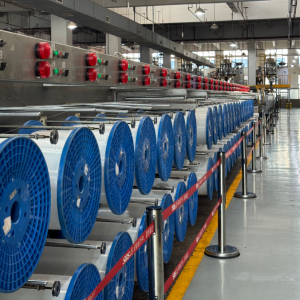
Finally, individual monofilament strands are wound onto spools or beams using constant-tension winders to prevent pitch distortion or spool crushing.
To review complete line schematics, consult our walkthrough on the step-by-step monofilament extrusion process.
Quality Control & Operational Risk Mitigation
Plant operators producing industrial nylon monofilament must manage three critical quality variables:
Pro Tip: In-line laser diameter gauges installed immediately after the heat-setting stage provide real-time closed-loop feedback to the haul-off Godet rolls and melt pump, maintaining strict diameter tolerances within ±0.003 mm to ±0.005 mm.
Diameter Variation & Ovality: Caused by melt temperature fluctuations, die swell instability, or haul-off speed hunting. Maintaining stable melt pressure via a gear pump and precise quench bath level control is essential. Detailed troubleshooting steps are outlined in our guide on achieving stable diameter tolerances in monofilament production.
Internal Voids & Bubbles: Directly caused by wet resin entering the extruder. If bubbles appear in extruded strands, verify the dryer dew point (-40°C) and check for barrel feed-throat cooling leaks.
Thermal Degradation & Discoloration: Polyamide resins left stagnant in extruder dead zones oxidize quickly, causing yellowing and black specks. Purging barrels with high-viscosity purge resin during shutdowns prevents carbon build-up.
Summary & Technical Extrusion Next Steps
Nylon filament is a versatile, high-tenacity engineering material whose performance depends on matching the right polyamide grade (PA6, PA66, PA12) to the end-use mechanical environment. Achieving consistent tensile strength, flex recovery, and tight diameter tolerances requires precision extrusion machinery capable of exact thermal control, uniform melt metering, and stable multi-stage drawing.
As a specialized manufacturer of plastic extrusion machinery with over 30 years of industrial experience, Changzhou New Liaoyuan Machinery Co., Ltd. (NLY) designs and builds complete, turnkey nylon monofilament extrusion lines engineered for high output and long-term production stability.
If you are expanding plant capacity or optimizing nylon monofilament quality, contact our engineering team to review customized line configurations, spinneret die options, and trial testing specifications.