In synthetic brush filament manufacturing, extruding polyamide (nylon) bristles is significantly more technically demanding than processing commodity polyolefins like polyethylene (PE) or polypropylene (PP). Polyamide resins—including PA6, PA66, and PA612—exhibit sharp melting points, low melt viscosity, high thermal sensitivity, and extreme hygroscopicity. For plant managers, process engineers, and technical directors evaluating a new nylon bristle extrusion machine, selecting the wrong line configuration often leads to severe operational bottlenecks: erratic diameter surging, filament ovality, poor bend recovery, and frequent line breaks during high-ratio drawing.
Achieving tight diameter tolerances (±0.002 mm) and superior bend recovery across millions of continuous meters requires an integrated, purpose-engineered extrusion line. This guide provides a complete technical evaluation framework for capital equipment buyers. It breaks down the polymer physics of polyamide processing, step-by-step extrusion line architecture, machinery sizing matrices, and critical red flags to avoid when selecting an equipment supplier.
Why Nylon (PA6, PA66, PA612) Extrusion Demands Specialized Line Engineering
Unlike commodity polymers that tolerate wider processing windows, nylon polymers behave with extreme sensitivity to moisture, temperature fluctuations, and shear stress. Understanding these material characteristics explains why standard monofilament extruders fail when adapted for high-grade brush bristles.
Polymer Rheology & Hygroscopic Behavior
Polyamide is inherently hygroscopic. Unprocessed nylon pellets readily absorb ambient atmospheric moisture. When damp resin enters the extruder barrel, the combined heat and mechanical shear trigger rapid hydrolytic degradation. Moisture breaks the long-chain polymer bonds, permanently reducing molecular weight and intrinsic viscosity.
The operational consequences on the plant floor are immediate:
Melt Instability & Surging: Fluctuating melt pressure causes uneven volumetric output at the spinneret die, resulting in periodic thick and thin spots along the filament.
Surface Defect & Bubbling: Trapped moisture vaporizes into steam micro-voids, creating surface roughness, internal voiding, and weak points.
Filament Breakage: Weakened molecular chains cannot withstand the high mechanical stresses required during secondary orientation in the hot drawing ovens.
The Critical Role of Closed-Loop Dehumidification Drying
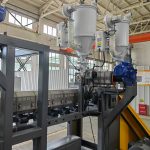
Standard hot-air hopper dryers are completely inadequate for polyamide processing because they merely circulate warm, humid ambient air. A high-performance nylon bristle production line must integrate a dedicated closed-loop desiccant dehumidification drying system.
Key Takeaway: Prior to entering the extruder hopper, nylon polymer pellets must be dried until moisture content drops below 0.05% by weight (ideally < 0.03% for PA66). The dehumidifier must deliver a continuous dry air stream with a dew point of -40°C or lower.
Properly dried resin maintains molecular weight, stabilizes melt viscosity, and ensures that the physical properties engineered into the virgin polymer are fully realized in the finished bristle.
Melt Pump Pressure Stabilization & Diameter Tolerance Control
Because nylon exhibits a sharp melting point and low melt viscosity when molten, single-screw rotation alone cannot maintain 100% pulse-free delivery to the die. Minor pressure fluctuations at the screw tip translate directly into diameter variation on the finished spool.
To achieve strict diameter tolerances (as tight as ±0.002 mm for toothbrush and cosmetic bristles), top-tier lines incorporate a high-precision positive-displacement gear melt pump between the extruder barrel and the spinneret die head. The melt pump acts as a metering shield, dampening upstream pressure pulses from the screw and delivering a continuous, volumetrically precise polymer flow to the spinning die.
Step-by-Step Architecture of a High-Performance Nylon Bristle Extrusion Line
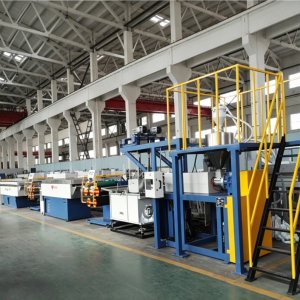
A complete nylon bristle production line operates as a continuous, multi-stage thermo-mechanical system. Each stage plays a vital role in establishing the final physical, dimensional, and mechanical characteristics of the filament.
Polymer Pellets → Dehumidification Dryer → Single-Screw Extruder → Melt Pump → Spinneret Die → Quenching Water Bath → 1st Stage Hot Drawing → 2nd Stage Hot Air Oven → Gear Crimper → Antistatic Oiling → Heat Setting Oven → Automatic Winder
Stage 1: Dehumidification Dryer & Single-Screw Extruder
After resin preparation in the desiccant dryer, polymer pellets are fed under vacuum or sealed nitrogen blanketing into the extruder hopper.
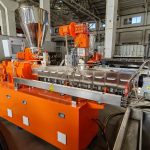
Screw L/D Ratio: The extruder must feature a single screw with a length-to-diameter (L/D) ratio of 30:1 to 32:1. Short screws (< 28:1 L/D) fail to achieve complete, uniform melting without localized overheating.
Barrier Screw Geometry: A barrier screw design separates unmolten solid pellets from the liquid polymer melt channel, ensuring optimal plasticization and uniform temperature distribution.
Barrel Heating & Bimetallic Lining: Precision ceramic heating bands divided into 5 to 7 independent PID temperature control zones maintain precise thermal gradients along the barrel. A bimetallic barrel liner protects against abrasive wear when processing modified or filled nylon formulations.
Stage 2: Precision Melt Pump, Spinneret Die, & Water Quenching Bath
The plasticized polymer passes through a continuous screen changer and the melt pump into the spinneret die head.
Spinneret Capillary Design: The die plate features hundreds of micro-machined capillaries engineered with precise land lengths to prevent melt fracture and swollen extrudate (die swell).
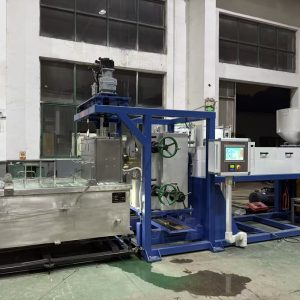
Quenching Tank: Extruded molten strands enter a temperature-controlled stainless steel water quenching bath immediately after exiting the die. Rapid water cooling prevents premature crystallization, locking the polymer into an amorphous state optimal for subsequent cold/warm stretching. Water bath temperature is maintained precisely between 20°C and 30°C to ensure roundness and surface clarity.
Stage 3: Multi-Stage Orientation (Hot Water & Hot Air Stretching)
Quenched nylon filaments possess high elongation but low tensile strength and poor bend recovery. Mechanical stretching (drawing) aligns the unoriented polymer chains along the longitudinal axis, dramatically increasing tensile strength, stiffness, and elastic memory.
To prevent sudden filament necking and breakage, drawing is executed across two sequential thermal stages:
Primary Drawing (Hot Water / Steam Tank): Filaments pass through a hot water or steam bath held at 80°C to 95°C between primary and secondary haul-off godet roll stands. Here, filaments undergo an initial draw ratio of 3.0:1 to 4.0:1.
Secondary Drawing (Hot Air Oven): Filaments enter a high-velocity hot air stretching oven operating at 160°C to 220°C for final orientation. The cumulative draw ratio reaches between 4.5:1 and 5.2:1 depending on whether the application demands high flexibility or extreme stiffness.
Pro Tip: Godet roll stands must feature heavy-duty ground steel rolls driven by individual servo motors with synchronization control. Speed differentials between godet stands dictate the exact draw ratio with 0.1% accuracy.
Stage 4: Inline Gear Crimping, Antistatic Oiling, & Heat Setting (Annealing)
For applications such as technical scrubbing brushes, street sweeper brooms, and industrial cleaning tools, bristles require a wave or zigzag crimp to enhance brush density, water retention, and scrubbing coverage.
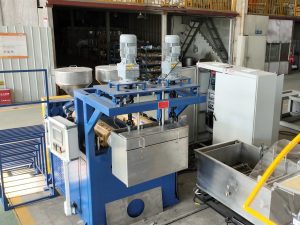
Gear Crimper: Heated intermeshing crimping gears impart precise, uniform crimp wave frequency and amplitude to the passing filament bundle.
Antistatic Oiling Unit: An integrated oiling roller applies a thin coating of specialized antistatic lubricant, eliminating static charge accumulation that causes bristles to cling or splay during high-speed downstream cutting and tufting.
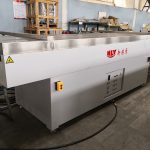
Heat Setting Oven: Drawn and crimped filaments pass through a final heat-setting (annealing) oven. This thermal treatment relieves internal mechanical stresses induced during drawing, locking in the final dimensions, stabilizing crimp retention, and reducing post-process thermal shrinkage to below 3% at 100°C.
Stage 5: Constant-Tension Automatic Winding
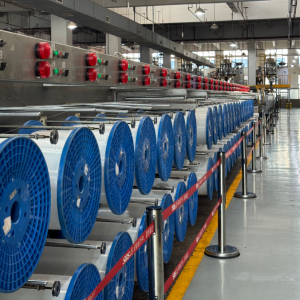
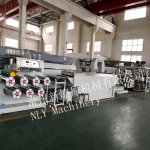
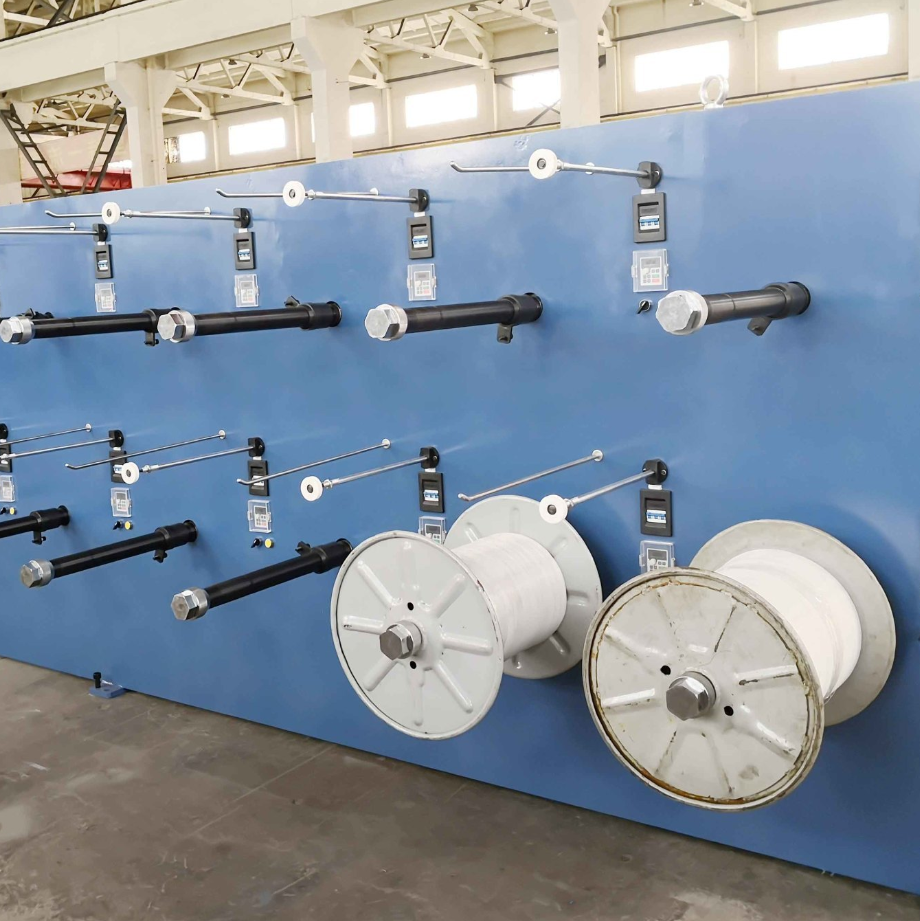
The finished nylon monofilament is wound onto precision spools or paper tubes across a multi-spindle take-up winder (typically 36 to 72 spindles per line). Precision traverse motion and automatic tension feedback prevent overlapping, filament crushing, or uneven spool density, ensuring smooth unwinding during brush manufacturing.
For a detailed walkthrough of equipment layouts and process mechanics across different polymer types, consult the brush filament extrusion machine configuration guide.
Equipment Sizing & Configuration Matrix: Matching Output to Application
Selecting the correct extruder screw diameter, motor power rating, and line layout depends directly on the target bristle diameter, annual production volume, and specific application requirements.
The matrix below illustrates standard technical configurations for industrial nylon bristle extrusion lines:
Specification Parameter | Fine / Precision Line | Standard Industrial Line | Heavy Duty / Sweeper Line |
|---|---|---|---|
Primary Applications | Toothbrushes, cosmetic brushes, fine paintbrushes | General cleaning brushes, abrasive tools, zipper filaments | Street sweepers, airport runway brooms, industrial scrubbers |
Target Bristle Diameter | 0.05 mm – 0.25 mm | 0.15 mm – 1.20 mm | 1.00 mm – 3.00 mm |
Extruder Screw Diameter | 65 mm (L/D 30:1) | 75 mm / 80 mm (L/D 30:1) | 90 mm / 110 mm (L/D 32:1) |
Output Capacity | 35 – 50 kg/h | 80 – 120 kg/h | 120 – 150+ kg/h |
Total Heating Power | 80 kW – 90 kW | 90 kW – 150 kW | 150 kW – 170 kW |
Winder Spindle Count | 48 – 72 Spindles | 36 – 48 Spindles | 24 – 36 Heavy Spindles |
Overall Line Dimensions | 20 m × 2.0 m × 2.2 m | 25 m × 2.5 m × 2.5 m | 30 m × 3.0 m × 2.8 m |
For manufacturers producing specialized technical tools—such as abrasive nylon bristles filled with silicon carbide or diamond grit—machinery specs must also accommodate side-feeder metering and wear-resistant bimetallic screws. You can review specialized configurations in this guide to abrasive brush filament line technology.
Key Technical Evaluation Criteria & Red Flags When Selecting a Machinery Supplier
Investing in a capital extrusion line represents a multi-decade decision. During supplier technical reviews, look beyond initial price quotes and audit the engineering substance of the proposed machinery.
Engineering Review Checklist
Extruder L/D Ratio (≥ 30:1 required for polyamide)
Closed-Loop Dehumidifier Included? (Dew point -40°C)
Positive Displacement Melt Pump Integrated?
Godet Rollers (Individually driven servo rolls vs. shared mechanical chain)
Multi-Stage Drawing (Separate hot water + hot air thermal zones)
Heat-Setting Annealing Capacity
L/D Ratio & Barrier Screw Geometry
Never accept standard polyolefin screws (e.g., 25:1 or 28:1 L/D ratios) for nylon processing. Polyamide requires an L/D ratio of at least 30:1 to provide adequate residence time for homogenous melting without forcing excessive barrel temperatures that degrade polymer chains. Ensure the supplier provides a documented barrier screw profile specifically flighted for low-viscosity resins.
Temperature Zone Control & Heated Godet Rollers
Barrel Heating Precision: Verify that each barrel zone uses solid-state relays (SSR) or SCR power controllers paired with PID temperature controllers capable of maintaining temperature within ±1.0°C.
Godet Roller Drive Systems: Cheap extrusion lines use a single AC motor connected to godet rolls via mechanical chain and gear drives. Over time, mechanical backlash introduces speed micro-variations that cause periodic filament thickness fluctuations. Insist on individual direct-drive AC servo motors for each godet stand, synchronized electronically through a central PLC system.
Red Flags to Avoid When Evaluating Vendors
⚠️ Warning: Be alert to these common cost-cutting engineering compromises in supplier quotes:
Replacing Desiccant Dryers with Standard Hot-Air Dryers: A vendor omitting a dew-point desiccant dryer is setting your plant up for chronic moisture degradation and high scrap rates.
Omitting the Melt Pump: Omitting a gear melt pump makes it virtually impossible to maintain a ±0.002 mm diameter tolerance on fine bristle gauges.
Unheated Draw Godets or Abbreviated Oven Lengths: Short draw ovens or unheated godets force cold drawing, introducing high residual internal stresses that cause bristles to curl or lose crimp memory after cutting.
Standard Nitrocarburized Barrel Liners: Processing nylon—especially glass-filled, abrasive grit-filled, or flame-retardant formulations—demands bimetallic barrel liners. Standard nitrocarburized steel wears rapidly under high shear, expanding clearance and destroying extrusion pressure stability.
To gain a foundational understanding of underlying physical drawing and heating principles across various monofilament lines, read this overview on monofilament extrusion working principle.
Total Cost of Ownership (TCO) & Energy Optimization Strategies
Capital cost accounts for only a fraction of an extrusion line’s lifetime expense. Electrical power consumption, raw material yield, and unplanned downtime dominate operating costs over a 10-year horizon.
Energy Efficiency Engineering
Extruding nylon requires substantial heat input during drying, melting, and multi-stage hot orientation, followed by active chilling in the quench tank. Modern line engineering reduces kilowatt-hour consumption per kilogram of finished bristle through several energy recovery mechanisms:
Infrared & Ceramic Barrel Insulation: Custom thermal insulation jackets fitted over extruder barrel heating zones reduce radiation heat loss into the plant floor by up to 30%, lowering ambient HVAC loading and extruder power consumption.
Variable Frequency & Servo Drives: Utilizing IE4 premium efficiency motors paired with frequency inverters across extruder drives and godet rollers reduces electrical power consumption by 15% to 25% compared to legacy fixed-speed systems.
Closed-Loop Heat Exchangers: Recovering thermal energy from hot air draw ovens to preheat incoming dry air streams significantly cuts process heating demands.
Scrap Reduction & Quality Yield
Line startup, color transitions, and material changes generate non-conforming filament scrap. Incorporating a hydraulic continuous screen changer allows filter screen swaps without stopping polymer flow or breaking filaments, keeping line uptime high and reducing purge scrap by up to 80% during long production runs.
Frequently Asked Questions (FAQ)
What is the ideal draw ratio for PA6 vs PA66 brush filaments?
For PA6 brush filaments, a cumulative draw ratio of 4.2:1 to 4.8:1 provides excellent bend recovery and balanced toughness. PA66, possessing higher intermolecular hydrogen bonding and crystalline stiffness, can be drawn between 4.5:1 and 5.2:1 to maximize tensile strength and stiffness for heavy industrial scrubbing applications.
How do you prevent diameter surging and ovality during nylon extrusion?
Diameter surging is prevented by combining thorough desiccant drying (< 0.05% moisture), a 30:1 L/D barrier screw, and a gear melt pump for steady volumetric metering. Filament ovality is controlled by optimizing the water quenching bath temperature (20°C–30°C) and ensuring uniform water flow and precise guide alignment as molten strands enter the bath.
Can a single nylon bristle extrusion machine handle both straight and crimped bristles?
Yes. The line is configured with an in-line gear crimper positioned between the secondary drawing oven and the heat-setting oven. When producing straight bristles, the crimping gears are mechanically disengaged or bypassed, allowing the filament bundle to pass directly into the heat-setting oven and take-up winder.
Next Steps: Request a Custom Line Configuration Proposal
Designing a high-yield, stable nylon bristle extrusion line requires matching machinery specifications to your exact resin formulations, bristle diameter ranges, and target output metrics.
At Changzhou New Liaoyuan Machinery Co., Ltd. (NLY), our engineering team brings over 30 years of specialized experience in designing and manufacturing complete plastic monofilament extrusion machinery. Every line is custom-engineered to meet rigorous ISO 9001 and CE quality standards, backed by turnkey installation, operator training, and comprehensive spare parts support across global manufacturing facilities.
For further technical insights into raw material selection, thermal controls, and crimp mechanics, review our technical guide to nylon brush filament production.
Ready to evaluate a new extrusion line or upgrade your plant capacity?
Contact NLY’s engineering team today to receive a custom line layout proposal, detailed technical specification sheet, or schedule a Factory Acceptance Test (FAT) sample run using your raw materials.