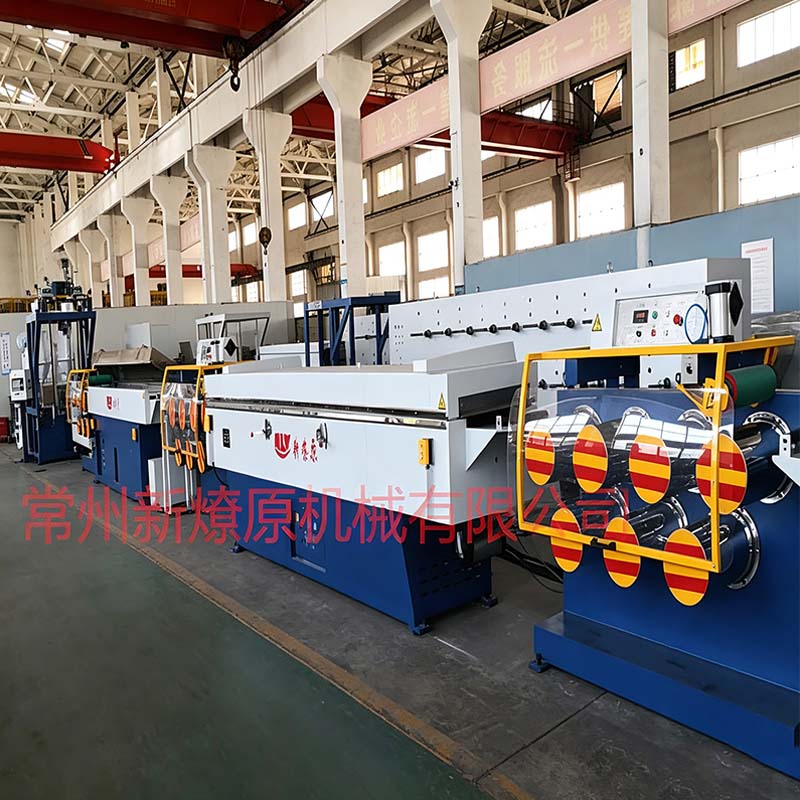
Industrial mesh products—ranging from high-precision screen printing mesh and liquid filtration filter cloth to paper-machine clothing (PMC) and heavy-duty conveyor belts—demand extraordinary performance from single synthetic strands. Unlike standard monofilaments used in agricultural shade nets or commercial bristles, industrial mesh monofilament must satisfy strict mechanical tolerances. A diameter variance of just 2 microns across a 50-kilometer yarn package can lead to aperture skewing, non-uniform micron ratings, and disastrous tension streaks during high-speed loom weaving.
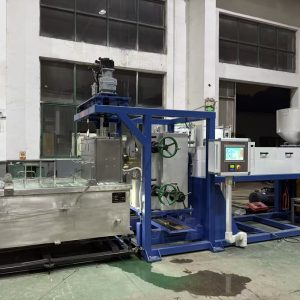
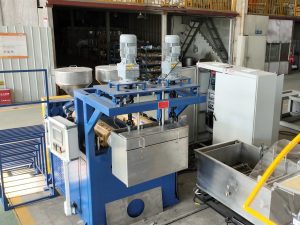
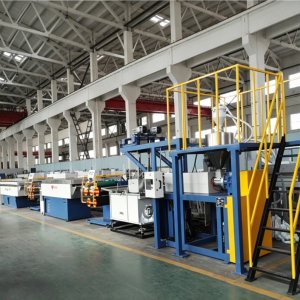
Producing this high-tenacity, low-shrinkage yarn requires a specialized monofilament extrusion machine for industrial mesh. The extrusion process transforms raw polymer resins—primarily polyester (PET), polyamide 66 (PA66), polyamide 6 (PA6), and polypropylene (PP)—into continuous, highly oriented filaments with uniform cross-sectional geometry.
This technical engineering guide breaks down the continuous, multi-stage mechanics of an industrial mesh monofilament extrusion line, detailing temperature profiles, multi-stage draw ratios, annealing relaxation parameters, and key troubleshooting protocols.
The 7 Core Stages of an Industrial Mesh Monofilament Extrusion Line
Manufacturing monofilament for technical weaving is not a simple single-pass thermal melt process. It is a tightly synchronized, multi-zone thermal and mechanical transformation. Understanding how each station operates enables plant managers and process engineers to eliminate yarn instability at the source.
Engineers interested in full plant layouts can consult our step-by-step monofilament extrusion process guide for standard baseline line sequences.
Polymer Drying → Single-Screw Extrusion & Melt Metering → Water Quench Bath →
First-Stage Hot Draw → Second-Stage Hot Orientation → Thermal Annealing → Torque Winding
Stage 1: Closed-Loop Resinous Drying & Polymer Preparation
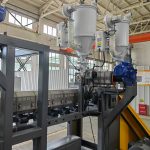
Polymer moisture is the primary cause of molecular chain degradation in monofilament extrusion. Hygroscopic polymers like PET and PA66 absorb atmospheric moisture rapidly. If fed directly into a heated barrel, water molecules trigger hydrolytic degradation (scission of ester or amide bonds), drastically reducing the resin’s intrinsic viscosity (IV) and ultimate tensile strength.
Polyester (PET): Requires a continuous closed-loop desiccant dehumidification system. Process air must maintain a continuous dew point of -40°C or lower at a drying temperature of 160°C to 180°C for a dwell time of 4 to 6 hours. Moisture levels must drop below 0.02% prior to hopper feeding.
Polyamide 66 (PA66): Highly moisture-sensitive; must be dried at 80°C to 100°C under vacuum or desiccant airflow until moisture content is below 0.05%.
Polypropylene (PP): Non-hygroscopic; generally requires no pre-drying unless surface condensation is present.
Key Takeaway: Inadequate drying causes barrel melt surging, bubbling inside the extruded strand, and random filament breakage during downstream drawing.
Stage 2: Precision Melt Plasticization & Gear Pump Metering
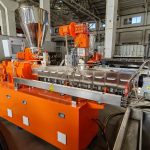
Once dried, the resin enters the extruder hopper. The heart of the industrial mesh monofilament extrusion process is a single-screw extruder designed specifically for high-pressure melt homogenization.
Screw Geometry & L/D Ratio: Lines use a single-screw barrel with a length-to-diameter (L/D) ratio of 30:1 to 33:1. The screw features a dedicated barrier flight design coupled with a Maddock mixing section to separate un-melted solid polymer chips from the homogeneous melt phase, preventing temperature gradients.
Positive-Displacement Gear Melt Pump: Positioned between the barrel tip and the spin pack, a positive-displacement gear melt pump isolates the die head from pressure fluctuations caused by screw rotation or raw resin bulk density changes. The gear pump delivers a volumetric melt output with stability within ±0.5%, which is vital for maintaining tight yarn diameter tolerances.
High-Mesh Spin Pack Filtration: Before entering the spinneret plate, molten polymer passes through multi-layer stainless steel filter packs (typically 200 to 325 mesh). This removes micro-gels and foreign particulate matter that would otherwise create stress-concentration points or strand breaks in fine filaments (0.08mm to 0.30mm).
Stage 3: Spinneret Extrusion & Laminar Quench Bath Cooling
The melt is extruded through custom-machined spinneret plates featuring precision capillary orifices. Upon exiting the die, the molten polymer capillaries enter a liquid quench bath to rapidly freeze the amorphous polymer structure before uncontrolled crystallization occurs.
Die Swell Management: As polymer melt exits the spinneret capillary, it expands—a phenomenon known as die swell (extrudate swell). Precision capillary L/D design (typically 4:1 to 6:1 capillary length-to-diameter) minimizes melt elasticity relaxation.
Quench Water Temperature & Flow Dynamics: Quench bath water is held at 30°C to 50°C. Crucially, water entry must be controlled via laminar overflow channels. Turbulent water movement creates surface ripples that cause diameter waviness and cross-sectional ovality along the monofilament strands.
Stage 4: Multi-Stage Hot Orientation (Stretching & Molecular Realignment)
As monofilament exits the quench bath, its polymer chains are completely unoriented, resulting in low tensile strength and high elongation. To convert this weak strand into a high-tenacity industrial mesh yarn, the monofilament undergoes multi-stage orientation across heated godet roll units.
The draw ratio (DR) represents the speed differential between consecutive godet rollers:
Draw Ratio (DR) = Surface Speed of Downstream Godet Roll/Surface Speed of Upstream Godet Roll
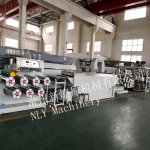
First-Stage Hot-Water Draw: Monofilament passes through a hot water bath maintained at 80°C to 95°C (above the glass transition temperature T g of PET and PA). The strands are stretched at a draw ratio of 1:2.5 to 1:3.5.
Second-Stage Hot-Air / Steam Orientation: The monofilament enters a secondary hot-air oven or high-pressure steam chamber operating at 140°C to 190°C. Here, a second stretch is applied, bringing the total draw ratio to 1:4.8 to 1:6.2.
This extreme mechanical stretching aligns the semi-crystalline polymer chains parallel to the filament axis, raising tensile strength up to 6.5 to 7.5 cN/dtex.
Stage 5: Thermal Annealing & Controlled Strain Relaxation
Extremely oriented monofilament possesses high internal residual stress. If wound directly onto spools without thermal stabilization, the yarn will exhibit severe shrinkage when exposed to heat during downstream mesh finishing or coating.
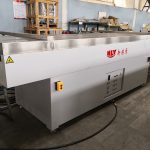
Annealing Chambers & Hot Godets: Monofilaments pass through a dedicated thermal annealing oven or over heated godet rolls maintained at 180°C to 220°C for PET or 170°C to 200°C for PA66.
Controlled Over-Feed (Relaxation Ratio): The downstream godet roller is driven slightly slower than the annealing godet (an over-feed ratio of 1.0% to 3.5%). This controlled relaxation allows polymer chains to relieve internal lattice strain while locking in crystalline stability. The resulting filament achieves hot-water shrinkage rates of < 1.5% at 180°C.
Stage 6: Inline Laser Diameter Monitoring & Closed-Loop Feedback
To guarantee that yarn meets strict monofilament diameter tolerance for screen printing mesh and filter cloth, continuous quality measurement is integrated inline.
Dual-axis laser micrometers scan every individual strand immediately following the annealing stage. If diameter drift occurs due to minor ambient temperature shifts or haul-off speed changes, the closed-loop control system dynamically adjusts the gear pump speed or godet roll velocity in real time to maintain a target diameter within ±0.005 mm.
Stage 7: Constant-Tension Torque Spool Winding
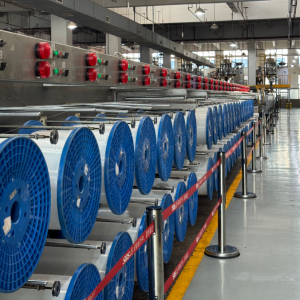
The final stage requires winding dozens of parallel monofilaments onto precision spools or paper tubes without imparting uneven winding tension.
Individual spindle winders equipped with electronic torque control or servo-driven tension arms maintain a constant winding force (typically 20 to 150 grams of tension depending on yarn decitex). Uniform winding density prevents spool crushing, edge slumping, and tension variations during high-speed warping on weaving looms.
Resin Drying
Extrusion
Quenching
Orientation
Annealing
Monitoring
Winding
MONOFILAMENT EXTRUSION LINE PROCESS STAGES : Dew point ≤ -40°C, moisture < 0.02% (PET / PA66) : 30:1 L/D single screw + gear melt pump (±0.5% volumetric) : Laminar water bath (30°C–50°C) to freeze amorphous structure : Multi-stage hot draw (1:4.8–1:6.2 total ratio) for high tenacity : Thermal heat-setting (180°C–220°C) with 1–3.5% relaxation : Dual-axis inline laser micrometer feedback (±0.005mm) : Servo torque winders for constant-tension bobbin packages
Polymer-Specific Processing Parameters: PET vs. PA66 vs. PP Mesh Filaments
Selecting the correct resin formulation and calibrating line parameters to match polymer rheology is vital for industrial mesh production. The table below outlines standard operating windows used by experienced process engineers on NLY industrial monofilament extrusion machinery.
Processing Parameter | Polyester (PET) Industrial Mesh | Polyamide 66 (PA66) Filter Mesh | Polypropylene (PP) Heavy Mesh |
|---|---|---|---|
Primary End Application | Screen printing mesh, paper clothing, liquid filter cloth | Abrasive filter mesh, sieves, automotive fuel filters | Geotextile mesh, chemical filter fabric, sludge dewatering |
Max Pre-Extrusion Moisture | < 0.02% (Dew Point ≤ -40°C) | < 0.05% (Vacuum / Desiccant) | No pre-drying required |
Extruder L/D Ratio | 30:1 – 33:1 Barrier Screw | 30:1 – 32:1 Mixing Screw | 28:1 – 30:1 Standard Screw |
Barrel Melt Temperature | 270°C – 295°C | 275°C – 295°C | 210°C – 250°C |
Quench Water Temp | 35°C – 50°C | 30°C – 45°C | 25°C – 40°C |
Stage 1 Draw Media & Temp | Water Bath (85°C – 95°C) | Water Bath (80°C – 90°C) | Hot Air / Plate (95°C – 115°C) |
Stage 2 Draw Media & Temp | Hot Air Oven (160°C – 190°C) | Hot Air / Steam (160°C – 185°C) | Hot Air Oven (120°C – 150°C) |
Total Line Draw Ratio | 1:4.8 – 1:6.2 | 1:4.5 – 1:5.8 | 1:5.0 – 1:7.0 |
Annealing Temp Range | 180°C – 220°C | 170°C – 200°C | 130°C – 150°C |
Target Tensile Strength | 6.0 – 7.5 cN/dtex | 5.5 – 7.0 cN/dtex | 5.0 – 6.5 cN/dtex |
Diameter Tolerance Range | ± 0.003 mm to ± 0.005 mm | ± 0.005 mm to ± 0.008 mm | ± 0.010 mm to ± 0.020 mm |
For specialized coarse geotextile monofilament processing, line specifications can be referenced via our guide on high-tenacity polypropylene geotextile and heavy mesh filament extrusion line setups.
Critical Quality Metrics for Downstream Mesh Weaving Consistency
When monofilament bobbins are loaded onto high-speed Rapier or Sulzer projectile looms, any imperfection in yarn quality translates immediately into weaving defects.
1. Coefficient of Variation (CV%) in Filament Diameter
In screen printing mesh (e.g., 100 mesh/cm to 165 mesh/cm), mesh aperture geometry dictates ink passage and image resolution. If monofilament diameter varies along its length, warp and weft intersections create irregular square apertures.
Engineering Target: Premium mesh monofilaments demand a Diameter CV% of < 0.8%.
Extrusion Control: Achieved by combining gear melt pump pressure regulation, stable quench bath overflow, and vibration-free godet roll bearings.
Pro Tip: Use dual-axis inline laser micrometers equipped with statistical process control (SPC) logging to flag out-of-spec bobbins prior to loom loading.
2. Tensile Modulus & Load-Elongation Uniformity
High-speed weaving looms subject warp monofilaments to severe dynamic tension peaks during shed opening and beat-up.
Uniform Tensile Modulus: Monofilament must exhibit high initial modulus (> 80 cN/dtex) to resist elongation under warping tension. If one bobbin exhibits higher elongation than adjacent strands, warp tension imbalance produces wavy fabric edges and non-uniform mesh thickness.
Controlled Elongation at Break: Typical target elongation at break for industrial mesh monofilaments is held tightly between 18% and 24%.
3. Residual Thermal Shrinkage & Heat-Setting Memory
Industrial filter cloths and screen printing fabrics undergo heat setting and calendering at temperatures reaching 170°C to 200°C to lock weave geometry and adjust air permeability.
If monofilament retains un-relaxed internal stress from the drawing stage, exposure to finishing heat triggers uncontrolled dimensional distortion, causing fabric bow and skew.
Shrinkage Benchmark: High-grade PET mesh monofilaments must maintain dry heat shrinkage below 1.5% at 180°C for 15 minutes.
Line Requirement: This requires multi-stage thermal annealing chambers with precise over-feed speed control on the final godet godet roll.
Troubleshooting Common Extrusion Defects in Mesh Filament Production
Even minor process shifts can disrupt yarn consistency. Use this engineering diagnostic table to identify and resolve common quality failures during production runs on your PET PA66 industrial filter mesh filament line.
Observed Defect | Root Cause in Extrusion Line | Immediate Engineering Correction |
|---|---|---|
Periodic Diameter Surging (“Waviness”) | Melt pressure pulsation from single screw or faulty gear pump speed control | Check gear pump pressure transducer; verify melt pump inlet pressure control loop (set to constant 3.0–5.0 MPa); clean spinneret. |
High Filament Breakage during Drawing | Resin hydrolytic degradation or un-filtered particulate contamination | Re-check dryer dew point (≤ -40°C); inspect filter pack screens; reduce first-stage draw ratio by 0.2–0.4. |
High Thermal Shrinkage in Finished Mesh | Insufficient annealing temperature or inadequate godet roll over-feed relaxation | Increase annealing oven / hot godet temperature by 10°C-15°C; increase godet relaxation over-feed from 1.5% to 2.5%. |
Cross-Sectional Ovality (Non-Round Filament) | Turbulent water flow in quench bath or uneven air knife drying | Adjust quench bath water inlet to laminar overflow baffle plate; align air knives to ensure uniform water removal without strand deflection. |
Surface Slubs & Micro-Gels | Screw thermal degradation or dead spots in melt pipe adapters | Flush barrel with purging compound; inspect melt pipes for dead zones; replace spin pack filtration screens. |
Uneven Bobbin Density / Spool Slumping | Winding tension drift or worn torque motor clutches | Calibrate electronic winding tension controllers; check spindle alignment; adjust torque curve settings based on bobbin package diameter. |
Selecting the Right Line Configuration for Industrial Mesh Applications
Engineers planning a new monofilament manufacturing facility or upgrading an existing production hall must match machine specifications to target mesh grades.
Fine Mesh Filaments (0.08 mm – 0.20 mm):
Ideal for screen printing mesh and fine air filter cloth (such as our specialized 0.13mm fine filter mesh monofilament line).
Requires 30:1 L/D single-screw extrusion, high-precision gear melt pumps, micro-hole spinneret plates (up to 200–400 holes per line), and dual-axis laser diameter monitoring.
Medium Mesh Filaments (0.20 mm – 0.50 mm):
Suited for liquid filtration bags, food processing conveyor belts, and architectural shade mesh.
Demands robust multi-stage hot-water and hot-air drawing ovens, high-power godet drives, and heat-setting annealing chambers capable of operating at 220°C.
Coarse Technical Filaments (0.50 mm – 1.50 mm):
Used in paper-machine clothing (PMC), heavy sludge dewatering belts, and structural geotextile fabrics.
Utilizes heavy-duty extrusion barrels, extended hot-air orientation ovens, and high-torque spindle winders.
For detailed machinery sizing, screw options, and custom engineering parameters, process engineers can explore a dedicated precision PET monofilament extrusion plant configuration.
⚠️ Warning: Never run high-viscosity PET mesh monofilaments on an extruder designed solely for low-density polyethylene (LDPE) or agricultural net filaments. Insufficient screw L/D ratios and unheated melt pumps will result in severe intrinsic viscosity drop and un-melted gel contamination.
FAQ: Engineering Guidance for Industrial Mesh Monofilament Extrusion
What is the ideal screw L/D ratio for extrusion of industrial mesh monofilaments?
A 30:1 to 33:1 single-screw extruder is recommended for PET, PA66, and PP industrial mesh filaments. The extended L/D ratio provides sufficient barrel residence time for thorough thermal plasticization, while barrier flights ensure uniform melt homogenization without thermal degradation.
Why is a gear melt pump mandatory for fine mesh monofilament lines?
Single-screw extruders inherently experience minor pressure fluctuations (surging) as screw flights rotate past the barrel feed port. A gear melt pump acts as a positive displacement metering device, absorbing upstream pressure spikes and delivering a constant volumetric melt flow to the spinneret head. This maintains filament diameter stability within ±0.005 mm.
How does thermal annealing prevent mesh fabric distortion during finishing?
During multi-stage drawing, polymer chains are stretched into high alignment, creating internal lattice strain. The thermal annealing stage re-heats the oriented monofilament while applying a controlled over-feed relaxation (1.0% to 3.5%). This allows polymer molecules to relieve internal strain and settle into stable crystalline domains, lowering thermal shrinkage to < 1.5% at 180°C.
What is the difference between hot-water drawing and hot-air drawing?
Hot-water drawing (typically 80°C to 95°C) provides rapid, highly uniform heat transfer ideal for the initial orientation stage of PET and PA filaments. Hot-air ovens or heated godets (140°C to 190°C) allow higher temperatures needed for second-stage high-draw orientation and heat setting without boiling water limits.
Engineering Consultation & Custom Line Sizing
Achieving high-tenacity, low-shrinkage industrial mesh monofilament requires perfect synergy between raw material preparation, extrusion screw design, multi-stage draw ratios, and thermal relaxation.
At Changzhou New Liaoyuan Machinery Co., Ltd. (NLY), we bring over 30 years of specialized manufacturing experience to custom-engineer turnkey monofilament extrusion plants tailored to your exact mesh weaving requirements.
Need to upgrade your production capacity or resolve diameter instability?
Request a customized monofilament line layout proposal.
Schedule a Factory Acceptance Test (FAT) trial run using your target polymer resin.
Contact NLY Extrusion Engineering Team to speak directly with an extrusion machine specialist today.