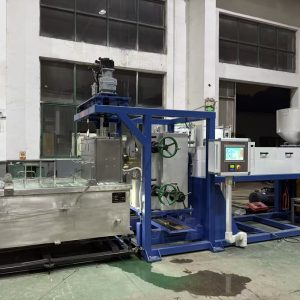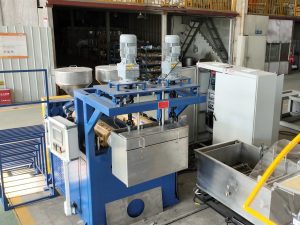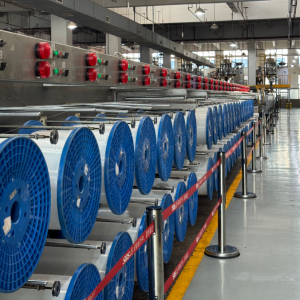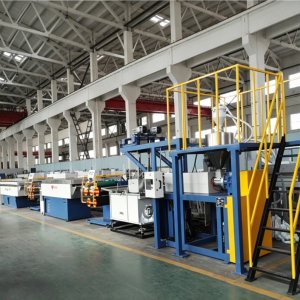
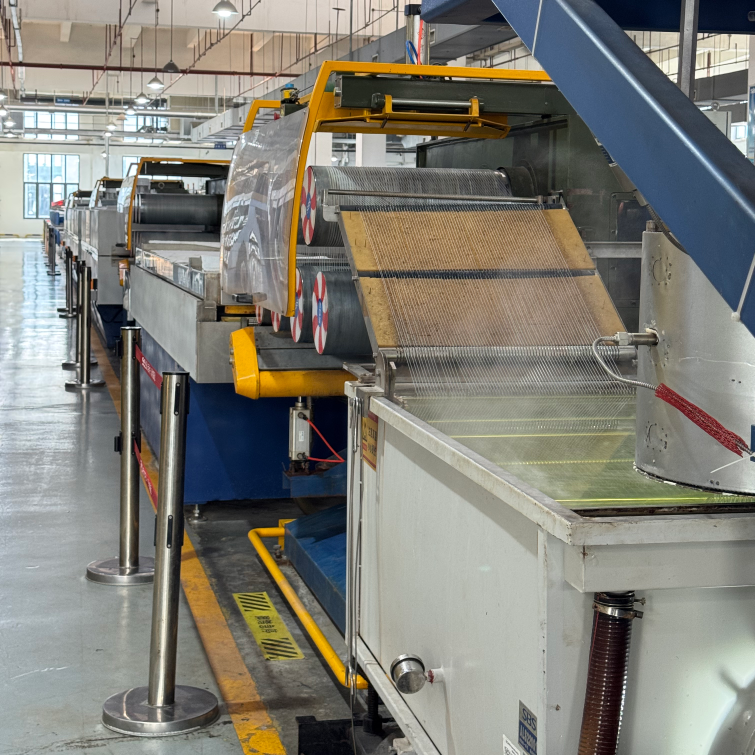
If you run a nylon (PA) zipper monofilament line, you’ve probably seen this pattern:
The extruder looks stable (melt temperature and pressure are normal).
The die is clean.
But diameter starts to drift, ovality creeps up, or the draw section becomes “nervous” (tension swings, breaks, re-threading).
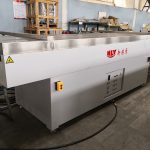
A lot of teams treat the cooling trough as a passive utility — just “a tank with water.” In reality, the cooling system is one of the most influential process stages in the whole line because it sets the filament’s geometry and internal structure before drawing amplifies every small variation.
This guide focuses on the open water bath (cooling trough) and explains how it influences “extruder performance” in practical terms: output stability, scrap rate, downtime, and drawability.
Nylon monofilament water bath cooling: why it drives stability
The cooling trough sits downstream of the die, but it can make the upstream process look good or bad.
Here’s the mental model:
The die creates a hot, soft strand.
The water bath freezes the outer skin and locks the shape.
The draw section stretches and orients the strand. Any tiny asymmetry from quenching becomes bigger — like pulling a small wrinkle into a long line.
So when people say “the extruder is unstable,” they’re often describing cooling-related symptoms:
changing drag forces on the strand
uneven cooling around the circumference
a moving solidification point (where the strand changes from melt-like to solid-like)
A melt-spinning overview from Austin Publishing Group notes that for a uniform filament, the quench tank should keep the spinneret-to-water distance constant, maintain water temperature within close limits, and avoid turbulent regions in the tank . Those principles carry over well to monofilament lines: you’re trying to make cooling repeatable and symmetric.
What happens to nylon monofilament between the die and the first godet
This section is the core of nylon monofilament diameter stability: you’re turning a hot, soft strand into a dimensionally stable filament that can be drawn without surprises.
Solidification (shape setting)
The strand exits the die and begins cooling immediately. Once a “skin” forms, the circular shape becomes harder to change.
So what: if the skin forms unevenly (one side cools faster), you get ovality and unstable downstream tension.
Structure development (crystallization and frozen-in stress)
Nylon is semi-crystalline. Cooling rate affects how the internal structure develops, and how much “frozen-in” stress the strand carries into drawing.
A broad review on melt-spun fibers explains how quenching, drawing, and annealing/heat-setting interact to stabilize structure and relax stresses.
So what: if cooling is too aggressive or inconsistent, you can end up with more internal stress and a narrower stable draw window.
Tension stability (the hidden amplifier)
The strand is pulled forward by downstream rolls. Any fluctuation in drag inside the trough turns into tension variation — and tension variation turns into diameter variation.
This is one reason “random” diameter problems often correlate with:
changing water level
flow changes
dirty filters
guides/rollers starting to stick
The four variables that make or break an open water bath
If you want the line to run calmly, these variables need to be controlled like process settings — not like utilities.
1) Monofilament quench bath temperature control
Bath temperature affects cooling rate, solidification point, and how consistent the heat transfer is from minute to minute.
What matters operationally:
Stability is usually more important than a specific setpoint.
Uniformity along the length matters (in long troughs, the first half can run warmer than the second).
Seasonal water variation is real; if your cooling water comes from a tower or city water, the “same” valve setting can mean different cooling.
Pro Tip: Treat water temperature like a recipe parameter. Record it per shift with line speed and diameter data. When problems appear, you’ll have a real trend instead of guesses.
2) Flow pattern and turbulence
For an open trough, you need enough circulation to prevent hot spots and keep water clean — but you want the strand to see a repeatable flow field.
If turbulence is uncontrolled, you can get:
variable drag force on the strand
inconsistent cooling around the circumference
occasional strand vibration
All of those show up as diameter scatter and ovality.
This lines up with the same principle: avoid turbulent regions for a uniform product (see Austin Publishing Group’s Melt Spinning of Polypropylene Fiber).
3) Strand entry, alignment, and die-to-water distance
The open trough has an “entry zone” where the strand hits the water surface.
If entry is inconsistent, you change:
the short air-cooling time before water contact
the initial cooling symmetry
the point where the strand becomes stiff enough to resist deformation
Practical causes of inconsistency:
water level drifting during operation
guides moving slightly
misalignment between die, trough centerline, and first godet
⚠️ Warning: When ovality appears suddenly, don’t only chase the die. First check whether the strand is entering the bath the same way as yesterday (same height, same angle, same water level, same guide position).
4) Residence time (bath length vs line speed)
“Residence time” is how long the strand stays in the bath.
If it’s too short for your diameter and line speed, the strand exits the bath still too warm/soft.
If it’s long and/or the bath is warm, structure can develop differently before drawing.
So what: if operators push speed up without adjusting cooling capacity, instability often shows up later as draw breaks or surface defects.
Defect patterns in zipper monofilament — and what they usually mean
Zipper monofilament is unforgiving because it’s sensitive to surface feel, appearance, and consistent dimensions.
Diameter drift (slow trend over minutes)
Often linked to:
bath temperature drifting
gradual filter loading changing circulation
water level drifting
gradual contamination changing heat transfer
First move:
verify bath temperature and water level at the same point in the trough
check whether circulation flow changed (pump speed, valve position, clogged strainer)
Monofilament ovality: turbulence and asymmetry
If you see ovality (not just diameter), the cooling system is a prime suspect.
Common cooling-related contributors:
uneven flow around the strand
misalignment causing the strand to run off-center
guides that force the strand against a wall-side current
Context: In NLY’s overview of quality variables, the quench bath temperature and flow symmetry are highlighted as major drivers of ovality and diameter stability (10 Factors That Affect Plastic Monofilament Quality).
First move:
re-center the strand path
reduce obvious turbulence sources near the strand
stabilize water temperature and flow before touching draw settings
Surface marks, haze, or “specks”
Cooling-section contributors often include:
dirty water / poor filtration
scaling on guides or rollers in the trough
strand contacting a guide or roller intermittently
First move:
check filtration and tank cleanliness
inspect submerged guides/rollers for scale or roughness
confirm the strand isn’t rubbing a surface under tension
Unstable drawing (breaks, necking, tension swings)
The draw section magnifies upstream variation. If the cooling trough creates a strand with uneven temperature or internal stress, the draw window shrinks.
If you’re troubleshooting draw instability, it helps to review how the drawing stage depends on consistent upstream conditions (Plastic Monofilament Drawing Machine: what it is and how to produce high-quality single filament).
First move:
stabilize cooling first (temperature + flow + alignment)
then adjust draw ratio/speeds once the strand is consistent
Practical checklist: stabilize the cooling trough in one shift
Use this as a simple “cooling section SOP” during startup and when scrap appears.
Water temperature: confirm setpoint and actual reading; confirm it’s stable over 15–30 minutes.
Water level: mark a reference level; keep it consistent.
Circulation: confirm pump running normally; strainers/filters not clogged.
Flow near strand: remove obvious turbulence sources (misdirected inlets, splashing, air entrainment).
Strand entry: confirm same height/angle, centered path, no touching.
Submerged guides/rollers: inspect for scale, roughness, or sticking.
Data discipline: record bath temp + line speed + diameter trend per shift.
If someone on the team is new to extrusion terminology, a quick refresher on the overall process helps align everyone on what happens where (What is plastic extrusion?).
FAQ
What water temperature should an open trough use for nylon monofilament?
There isn’t a single universal number because it depends on diameter, line speed, and upstream melt temperature. In practice, temperature stability and uniformity are the first priority. Start by setting a reasonable process window, then use diameter/ovality trends and draw stability to tune.
Should we increase water flow to “cool more”?
Only if the flow becomes more uniform at the strand. More flow that creates uncontrolled turbulence can make diameter variation and ovality worse.
Why does the defect appear after the bath if the cause is upstream?
Because the bath is where the strand becomes solid enough for defects to become visible. For nylon, upstream moisture or melt instability can show up as bubbles/voids, and the cooling section is often where operators first notice it.
Is ovality always a die problem?
No. Ovality can come from asymmetric cooling, misalignment, or changing strand entry conditions. It’s often faster to check bath symmetry and alignment before rebuilding a die.
Next steps
If you share your target diameter range, typical line speed, and a photo/sketch of your current trough (length, inlets/outlets, filtration, guides), I can return a cooling-section stability checklist with suggested measurement points — and a simple trial plan to validate changes on your line.