In synthetic fiber manufacturing and plastic extrusion engineering, terminology can easily cause confusion during material selection and equipment specification. Plant managers and process engineers frequently ask: What is the exact difference between filament and monofilament? Are they distinct material classes, or does one simply belong to the other?
Understanding this technical distinction is crucial when sourcing extrusion machinery or specifying raw materials for applications like zipper coils, brush bristles, fishing lines, agricultural netting, and industrial filter cloths.
Key Takeaway: “Filament” is the broad umbrella term for any continuous synthetic fiber strand of unlimited length. “Monofilament” is a specific structural subcategory consisting of a single, solid, continuous strand extruded through an individual die orifice. In contrast, “multifilament” consists of multiple micro-fine filaments bundled or twisted together into a single yarn.
The Terminology Hierarchy: Filament vs. Monofilament vs. Multifilament
To establish clear engineering definitions, synthetic polymer fibers are categorized by their structural strand assembly.
Filament (Umbrella Category: Continuous Polymer Fiber)
Monofilament (Single continuous strand, typically 0.08 mm to 5.0 mm diameter)
Multifilament (Bundle of fine continuous micro-filaments, 5 µm to 50 µm each)
1. Filament (The Universal Umbrella Term)
In textile and material science, a filament refers to any continuous fiber of virtually unlimited length, as opposed to short, discontinuous “staple fibers” (such as cotton or cut wool). Synthetic filaments are produced by melting polymer resins—such as Polyester (PET), Polyamide (Nylon PA6/PA66), Polypropylene (PP), or High-Density Polyethylene (HDPE)—and forcing the viscous melt through die orifices under controlled temperature and pressure.
2. Monofilament (Single Continuous Strand)
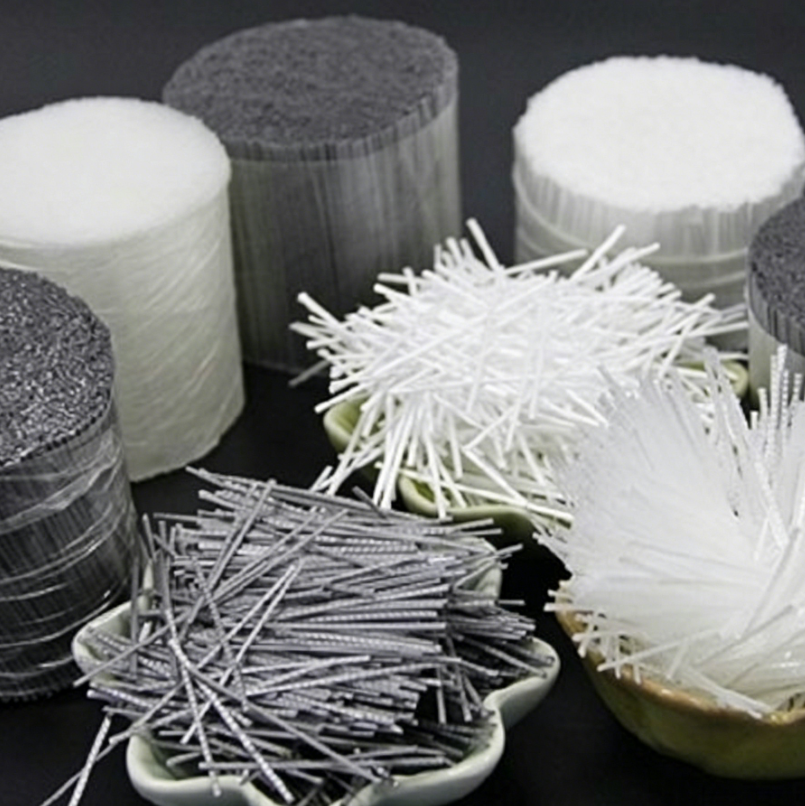
A monofilament (literally “one thread”) is a solitary continuous strand extruded as a single solid profile. Because it consists of only one solid cross-section, its mechanical properties—such as bending stiffness, tensile resistance, and surface smoothness—are governed entirely by the polymer’s molecular weight, draw ratio, and uniform strand diameter. To understand how single strands are defined in factory settings, see NLY’s guide on what monofilament is in plastic manufacturing.
3. Multifilament (Bundled Micro-Filaments)
A multifilament yarn is created when dozens or hundreds of fine, continuous individual filaments (often 5 to 50 microns in diameter) are extruded simultaneously from a multi-hole die plate (spinneret). These fine strands are gathered, quenched, and bundled together—frequently receiving a protective twist or intermingling air-jet treatment—to form a flexible, supple textile yarn.
Structural and Physical Comparison
The fundamental difference between single-strand and multi-strand construction directly dictates how the material behaves under mechanical stress, fluid flow, and environmental wear.
Strand Cross-Section and Diameter
A monofilament is manufactured as a heavy, uniform strand, typically ranging from 0.08 mm to 5.0 mm in diameter (or 50 Denier up to several thousand Tex). Because it is a single solid cylinder, its cross-sectional uniformity and roundness (ovality) are paramount.
Multifilaments consist of dozens of micro-strands bundled together. While the overall yarn bundle may match the outer diameter of a coarse monofilament, its internal cross-section contains air voids between individual fibers.
Bending Rigidity vs. Flexibility
Bending stiffness scales dramatically with strand diameter (proportional to the fourth power of the radius in solid rod mechanics).
Monofilament: Highly rigid and stiff. It resists bending, retains its shape, and snaps back when deflected, making it ideal for bristles, zipper coils, and structural meshes.
Multifilament: Highly flexible and supple. Because the individual micro-filaments can slide past one another when bent, a multifilament yarn offers superior drape, softness, and knot flexibility.
Surface Smoothness and Fluid Drag
According to findings published on monofilament mesh structural advantages, a solid monofilament strand presents an unbroken, non-porous outer wall. This provides extremely low fluid drag, minimal particle retention, and easy cleaning. Multifilaments, having a textured surface composed of many individual fibers, trap particles more easily and exhibit higher surface friction.
Side-by-Side Technical Comparison Matrix
Technical Parameter | Monofilament | Multifilament |
|---|---|---|
Strand Construction | 1 single solid continuous strand | 10 to 1,000+ bundled micro-filaments |
Typical Strand Diameter | 0.08 mm – 5.00 mm (80 µm – 5000 µm) | 5 µm – 50 µm (per individual filament) |
Manufacturing Process | Single-screw extrusion → Water bath quench → Multi-stage godet drawing → Heat setting | Melt spinning → Air quench chimney → Spin-draw godet orientation → Texturing / Intermingling |
Surface Friction & Texture | Very smooth, low friction, easy cake/particle release | Textured, higher friction, softer hand-feel |
Bending Rigidity | High (stiff, resilient shape retention) | Low (soft, flexible, high drape) |
Abrasion Resistance | Excellent solid-wall wear resistance; no fiber fraying | Moderate; surface micro-fibers can snag or fray under friction |
Load Distribution Principle | Concentrated in one solid core | Distributed across multi-strand bundle |
Primary Industrial Uses | Zipper teeth, brush bristles, fishing lines/nets, paper machine clothing, filter cloths | Apparel, industrial ropes, seatbelts, tire cord, woven webbing, sewing thread |
Extrusion and Manufacturing Process Differences
Producing single-strand monofilaments requires a fundamentally different machinery setup than spinning multifilament yarns.
Monofilament Extrusion Line Flow:
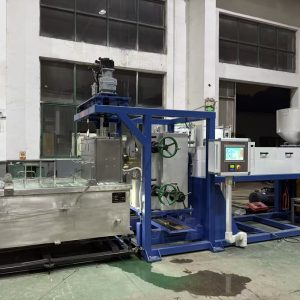
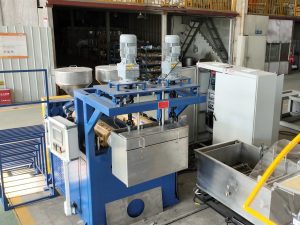
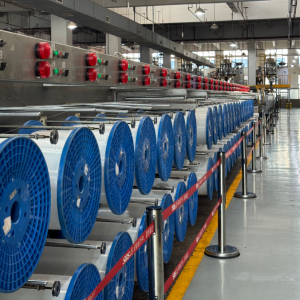
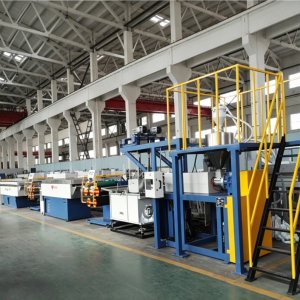
Extruder → Metering Pump → Single/Spaced Die → Quench Water Bath → 1st Godet → Hot Water / Air Draw Tank → 2nd Godet → Annealing Oven → 3rd Godet → Precision Spool Winder
1. Die & Spinneret Design
Monofilament extrusion uses dies with individual, widely spaced capillary orifices to prevent adjacent strands from fusing together before cooling. Melt pressure and flow uniformity across each orifice must be strictly controlled to prevent strand-to-strand diameter variation.
Multifilament spinning utilizes high-density spinnerets with hundreds of micro-holes closely grouped together, relying on precise melt distribution plates to ensure every hole receives equal polymer volume.
2. Quenching Method (Water Bath vs. Air Chimney)
Because monofilaments are relatively thick polymer streams, air cooling is insufficient. The extruded melt streams enter a temperature-controlled water quench bath (typically 15°C to 40°C depending on polymer type). Rapid, uniform cooling is essential to solidify the core without creating void bubbles, internal stress, or ovality. For a full breakdown of the machinery chain, read NLY’s guide on the monofilament extrusion process step-by-step.
Multifilament lines pass extruded fibers through an air-quench cooling chimney, where laminar airflow cools the fine streams gently to prevent fibers from sticking together.
3. Stretching and Orientation
Once quenched, monofilaments are amorphous and lack high tensile strength. They must undergo multi-stage orientation over heated godet rollers and through hot-water tanks or hot-air stretching ovens. Achieving draw ratios between 1:4 and 1:6+ aligns the polymer chains crystalline structure longitudinally.
According to research on single-strand monofilament load distribution principles, precise speed synchronization across godet groups is critical to prevent necking or tension spikes. Processors looking to upgrade downstream stretching equipment can evaluate a dedicated monofilament drawing machine to ensure tight draw ratio control.
4. Heat Setting and Annealing
Unlike multifilaments, which are often textured or wound immediately after drawing, high-quality monofilaments require an in-line thermal annealing stage. Passing the oriented strand through a heated relaxation zone relieves internal frozen-in stress, locking in the final diameter and reducing thermal shrinkage in downstream applications.
Polymer Material Selection for Monofilament Production
The choice of thermoplastic resin governs the mechanical and thermal performance of the extruded monofilament:
Polyamide (Nylon PA6 / PA66): Chosen for high toughness, excellent abrasion resistance, and superior flex fatigue life. Widely used in zipper monofilament, trimmer line, and fishing nets. Requires thorough resin pre-drying to prevent hydrolytic degradation during extrusion.
Polyester (PET): Offers high tensile modulus, low moisture absorption, and thermal dimensional stability. Ideal for paper machine clothing, zipper monofilaments, and high-precision screen printing mesh. Requires high intrinsic viscosity (IV ≥ 0.70–0.85 dL/g).
Polypropylene (PP) & High-Density Polyethylene (HDPE): Lightweight, chemical-resistant, hydrophobic, and cost-effective. Commonly extruded for agricultural shading nets, safety nets, industrial ropes, and brush bristles.
Application Decision Framework: When to Choose Monofilament
When deciding between monofilament and multifilament for an industrial product, use the following decision rules:
Select Monofilament When:
Precise Outer Diameter and Ovality Control Are Required: Zipper teeth, surgical sutures, and technical filter meshes require exact physical dimensions to function reliably.
Easy Cleaning and Cake Release Matter: Industrial liquid-solid separation filter cloths benefit from the non-porous, smooth surface of monofilament strands.
High Bending Stiffness and Memory Are Essential: Toothbrush bristles, street sweeper brooms, and agricultural trellis wires rely on single-strand flexural recovery.
Abrasion Resistance Against Hard Surfaces Is Critical: Heavy-duty netting and braided protective sleeving resist severe surface wear when constructed from monofilaments.
Select Multifilament When:
Suppleness, Drape, and Softness Are Priority: Clothing, upholstery, and bed linens require the soft hand-feel of multi-strand yarns.
High Knot Security and Shock Absorption Are Needed: Dynamic climbing ropes, towing straps, and lifting slings rely on multi-fiber friction to hold knots and absorb sudden energy impact.
High Surface Area Is Advantageous: Air filtration media and moisture-wicking activewear benefit from the capillary action of fine fiber bundles.
How Line Configuration Impacts Monofilament Quality
In monofilament manufacturing, raw material quality accounts for only part of the final product’s success. The stability of the extrusion equipment determines whether the strand meets tight dimensional specifications shift after shift.
Key machinery factors affecting monofilament quality include:
Melt Pump Metering: Eliminates extruder screw pulsation, delivering a pulse-free melt flow to the die head.
Quench Water Temperature Uniformity: Prevents diameter fluctuations caused by localized thermal variation in the cooling bath.
Multi-Stage Godet Synchronization: Digital servo drives ensure exact speed ratios between drawing zones, preventing strand necking or breakage.
To eliminate quality defects on the plant floor, manufacturers should focus on strategies to achieve stable diameter in monofilament production.
Frequently Asked Questions (FAQ)
Is monofilament stronger than multifilament?
Tensile strength depends on how it is measured. On a pure tenacity basis (cN/dtex), a well-oriented multifilament yarn can achieve higher breaking tenacity because fine fibers cool and orient more uniformly during spinning. However, for a given line thickness, a single solid monofilament provides far higher bending strength, puncture resistance, and solid-wall abrasion resistance.
Is all fishing line made of monofilament?
No. Traditional single-strand nylon or fluorocarbon fishing line is monofilament. However, modern “braided” fishing line is a multifilament construction made from ultra-high-molecular-weight polyethylene (UHMWPE) fibers braided together for higher tensile capacity at thinner diameters.
Can a monofilament extrusion line produce multifilament yarn?
No. Monofilament extrusion lines are specifically engineered with water quench baths, multi-stage heavy-duty godet draw stands, and individual spool winders. Multifilament yarn requires specialized spinning chimneys, spin-finish applicators, intermingling jets, and high-speed yarn take-up winders.
Summary and Next Steps
The distinction between filament and monofilament comes down to structural architecture: filament is the broad material family, while monofilament represents a single, solid continuous strand engineered for stiffness, smooth surface performance, and tight dimensional tolerance.
Optimizing monofilament production requires custom-engineered machinery tailored to your target polymer resin, strand diameter, and output requirements.
Need expert guidance on configuring your monofilament line? Changzhou New Liaoyuan Machinery Co., Ltd. (NLY) brings over 30 years of specialized extrusion manufacturing experience to help you build stable, high-efficiency production lines for PA, PET, PP, and HDPE monofilaments. Contact our engineering team today to review your production specifications or request a custom line quote.