If you run extrusion and downstream drawing, you’ve seen this problem: a resin change that looked small on a purchasing sheet turns into diameter drift, surface defects, or scrap on the floor.
PET, PP, and PE are all common thermoplastics, but they behave differently in the melt and during cooling and drawing. That’s why the “right” material choice isn’t only about cost per kg. It’s also about what process controls you’ll need to keep output stable.
PET vs PP vs PE: quick definitions
PET = polyethylene terephthalate. It’s a polyester (in textiles, PET is often called “polyester”). A key practical point is that PET is hygroscopic and can degrade by hydrolysis if processed with too much moisture, which reduces molecular weight and can make products brittle (see Polyethylene terephthalate (PET)).
PP = polypropylene. It’s a polyolefin.
PE = polyethylene. It’s also a polyolefin, and it comes in multiple grades (most commonly LDPE and HDPE) with noticeably different stiffness and melt behavior.
Key Takeaway: PET’s biggest “gotcha” is moisture sensitivity. PP and PE are usually easier on drying, but more sensitive to cooling consistency, crystallization shrinkage, and draw/tension stability.
Side-by-side comparison (what changes in the process)
The table below is intentionally practical: it focuses on what you’ll feel in extrusion/drawing, not just chemistry.
Category | PET | PP | PE (LDPE/HDPE) |
|---|---|---|---|
Polymer family | Polyester | Polyolefin | Polyolefin |
Melt temperature ranking (typical) | Highest | Middle | Lowest (grade-dependent) |
Drying sensitivity | High: manage moisture to avoid hydrolysis and property loss | Usually low | Usually low |
Cooling / shrinkage sensitivity | Medium to high (thermal history and crystallization matter) | High: semi-crystalline shrinkage can show up as ovality/diameter drift | High: grade-dependent; HDPE crystallizes strongly; quench stability is critical |
Drawing/orientation behavior | Often strong orientation potential, but needs disciplined thermal control | Moderate; stability depends on draw consistency + heat-setting | Varies by grade; can be drawn but may relax/shrink if thermal control is weak |
“First checks” when quality drifts | Dryer/moisture, melt temp stability, cooling consistency | Cooling stability, draw speed synchronization, tension control | Quench stability, die swell/flow stability, tension control |
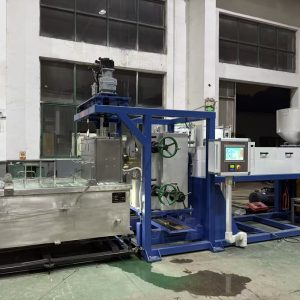
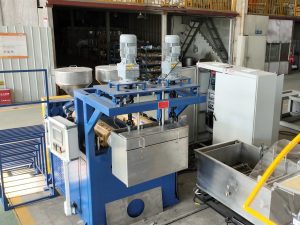
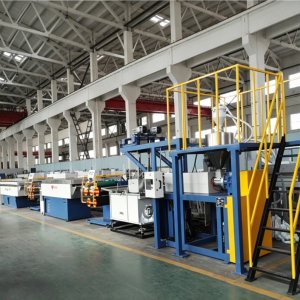
If you want a stage-by-stage view of a typical line (drying → extrusion → quench → drawing → heat-setting → winding), NLY’s process overview is a good reference: how a monofilament extrusion line works.
PET (polyester): where it’s strong, where it’s demanding
What PET “likes”
PET is often chosen when you need a stiffer filament and good property gain from orientation. In practice, PET responds well when the melt quality and thermal history are stable.
The real risk: moisture + thermal history
PET absorbs moisture. If wet PET is processed at melt temperatures, water can trigger hydrolysis, cutting polymer chains and lowering molecular weight.
On the floor, this shows up as problems that are hard to “tune out” with rollers or winder settings:
unstable mechanical feel (brittle vs tough)
inconsistent draw response
visual defects that track with storage/dryer discipline
Practical controls for PET extrusion + drawing
Treat drying as a quality gate, not a checkbox.
Keep melt temperature uniform and residence time under control (avoid “hot and slow”).
Stabilize quench conditions so the filament enters drawing with consistent thermal state.
Use heat-setting/annealing intentionally to reduce post-process movement.
PP (polyolefin): usually easier to start, but shrinkage can bite you
PP is forgiving on moisture, less forgiving on cooling consistency
Compared with PET, PP typically doesn’t punish you for small moisture excursions the same way. But PP’s semi-crystalline behavior means cooling conditions and downstream stability matter.
If you’re deciding between polyolefins, a simple baseline reference is that PP has a higher melting point than PE, and PE melt behavior varies by grade (LDPE vs HDPE), as summarized in Polypropylene vs. Polyethylene (Xometry).
Where PP process problems usually show up
In a filament line, PP issues often look like:
diameter drift after quench
ovality that tracks with bath temperature fluctuation
stiffness inconsistency that tracks with draw ratio changes
That’s why the “boring” controls matter:
stable quench water bath conditions
consistent draw speed synchronization
stable tension control
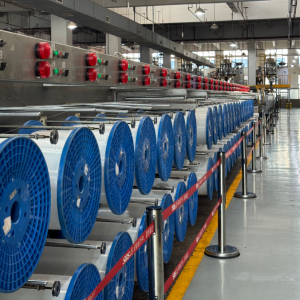
For a deeper look at the downstream side (and why synchronization matters), see NLY’s guide on plastic monofilament drawing and producing high-quality single filament.
PE (polyolefin): easiest melt, but grade differences matter
PE is not one material
When people say “PE,” they might mean LDPE (more flexible) or HDPE (stiffer). That grade choice changes cooling behavior, shrinkage, and how “tight” your stable window feels.
PE line stability is often a cooling + flow game
Because PE (especially HDPE) crystallizes strongly, small changes in cooling can translate into dimensional changes. On the floor, when PE/HDPE runs drift, the first checks are usually:
quench water stability and cleanliness
melt temperature uniformity
draw ratio and tension consistency
A buyer’s checklist: choosing PET vs PP vs PE for extrusion stability
Use this as a quick spec conversation guide (engineering + operations + procurement).
1) Start with your “must control” constraints
Are you willing to run strict drying discipline (equipment + handling + SOPs)? If yes, PET becomes more realistic.
If your plant environment makes moisture control difficult, PP/PE may be easier to stabilize.
2) Define the process window you can actually hold
How stable is your quench system temperature and flow?
How tight is your draw speed synchronization?
Do you have reliable tension control and diameter monitoring?
If you’re quoting or budgeting a new system, NLY also breaks down what changes a quote in monofilament extrusion machine price cost factors.
3) Decide what you want to optimize
If stiffness and dimensional stability are top priority and you can control moisture: PET is often worth the extra discipline.
If you want simpler melt processing and robust chemical resistance: PP and PE are typically easier.
If flexibility and toughness are primary: PE grades can be attractive, but cooling consistency becomes more sensitive.
Troubleshooting: symptom → what to check first
Symptom on the line | Likely first checks | PET vs PP vs PE note |
|---|---|---|
Bubbles/splay/void-like defects | Resin handling + dryer, moisture control, contamination | Most common risk pattern is PET moisture/hydrolysis |
Diameter drift after quench | Quench bath stability, melt temp uniformity, draw ratio stability | PP/PE/HDPE often track cooling + crystallization shrinkage |
Ovality / inconsistent stiffness | Draw speed synchronization, tension control, roller slip | Often downstream-control related (drawing/tension) |
Output increase causes scrap | Check stability before RPM; confirm cooling and downstream limits | For an operator’s mindset on this, see increase monofilament output without losing stability |
Next step (if you’re specifying a line)
If you’re comparing PET vs PP vs PE for a new or upgraded monofilament line, the fastest way to avoid rework is to match the material to the controls you can hold (drying discipline, quench stability, draw synchronization, tension control).
NLY (Changzhou New Liaoyuan Machinery) can help you map resin choice to a practical line configuration and trial plan. If you share your target filament diameter range, throughput, and material (PET/PP/PE/HDPE), we’ll propose a configuration and a run sample/FAT plan.