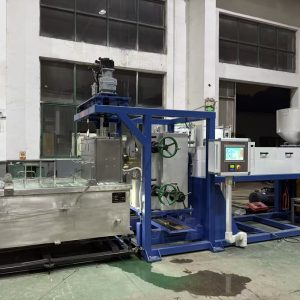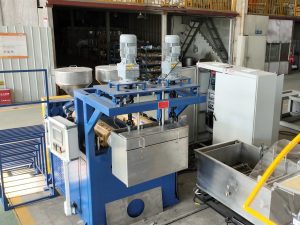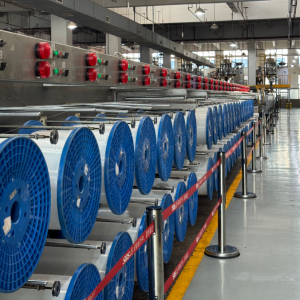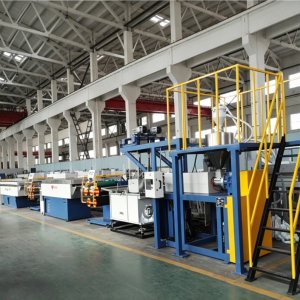
If you’re shopping for a plastic extruder for monofilament, it’s tempting to start with the machine nameplate: screw diameter, motor kW, “high output,” and a nice photo.
But in real monofilament production, the buying problem usually looks like this—and it’s exactly what a plastic extruder for monofilament is supposed to stabilize:
you’re fighting diameter variation and out-of-round (ovality)
surface defects show up only after hours of running
the line is stable on one resin grade and unstable on another
operators spend too much time “tuning” instead of producing
This guide is written for early-stage buyers who want to understand what matters in a monofilament extrusion line for zipper monofilament—and what to ask suppliers so you don’t discover the limits after installation.
Start with the specs that define your problem (not the machine)
Before you compare vendors, write down the 5 inputs that dictate almost every downstream choice:
Polymer family: Nylon (PA), PET, PP, or PE (and whether recycled content is planned)
Target diameter range (and how many sizes you want to run)
Diameter tolerance and ovality limit you actually need
Target line speed / output (kg/h and m/min)
Quality deal-breakers for your customers: surface smoothness, stiffness, dye/finish consistency, break rate
If you don’t define these, suppliers will fill the gaps with “typical” assumptions—and “typical” is where most monofilament scrap is born.
Pro Tip: Ask your team to bring two real samples to the supplier call: (1) your current-best monofilament, (2) your worst batch. The contrast makes it easier to talk about the defect mechanisms that the extruder and line must control.
What the extruder must do for a plastic extruder for monofilament quality
Zipper monofilament is unforgiving because small process swings create visible and functional variation. Your extruder selection should map to three outcomes:
1) Hold diameter and roundness steady
When pressure, melt temperature, or downstream tension fluctuates, it shows up as diameter drift or short-term spikes.
A good selection process ties machine choices directly to measurable quality outcomes. For practical quality factors—especially diameter variation/ovality and surface quality—see NLY’s “10 Factors That Affect Plastic Monofilament Quality” (2026).
2) Protect the polymer from moisture and thermal damage
For hygroscopic polymers, “good melting” isn’t enough. If moisture management is wrong, the polymer can degrade during processing.
PlasticsToday explains why keeping water out of the extruder matters in “Water, water, everywhere (but keep it out of the extruder)” (2017).
Eastman notes that for polyesters, “Drying is an absolute necessity…” (PDF).
For zipper monofilament, that translates to fewer bubbles/voids, fewer surface defects, and more stable running when you change resin lots.
3) Deliver a stable, clean melt to the die
Contamination and unstable back pressure are silent killers in monofilament.
Even when you don’t visibly “see dirt,” small gels or impurities can create surface lines, break events, and winding problems later.
Screw design basics (including extruder screw L/D ratio)
A screw isn’t just a conveyor. It has to feed, melt, mix, and pump the polymer in a predictable way.
NCSU summarizes the functional targets well: an ideal screw should efficiently pump material, homogenize/melt it, and develop appropriate melt temperature and pressure in “Screw Functionality and Screw Profile Design for Extrusion Processing” (2024).
For buying decisions, you don’t need to design a screw from scratch—but you do need to understand what to request.
A quick definition: extruder screw L/D ratio is the screw’s effective length (L) divided by its diameter (D). It influences residence time, melting, mixing, and how stable the melt is by the time it reaches the die.
What to ask the supplier about the screw
Is the screw general-purpose or designed for your polymer family (PA/PET/PP/PE)?
Is there a mixing section (and what is it optimized for: dispersive vs distributive mixing)?
How does the design handle melt temperature rise (shear heating) at your target output?
What’s the approach to pressure stability into the die?
What to watch out for
If a supplier can’t explain the screw beyond “it works for many materials,” assume you’ll spend months compensating with process tweaks.
⚠️ Warning: For PET and nylon, moisture and thermal history are often bigger problems than motor power. A “high output” screw that overheats or extends residence time can cost more in scrap than it gains in kg/h.
L/D ratio, venting, and melt temperature stability
Three topics tend to get oversimplified in quotations: L/D ratio, vented/degas sections, and temperature control.
What L/D ratio really changes
The L/D ratio (screw length divided by diameter) influences how much “process room” you have for melting, mixing, and pressure stabilization.
Dynisco’s handbook provides typical context for extrusion screw lengths and how they relate to output and application needs in the Dynisco “Extrusion Processors Handbook” (PDF).
Selection mindset:
If L/D is too short, you may struggle to fully melt and stabilize the stream at useful output rates.
If L/D is too long for your material and operating window, you may increase residence time and risk thermal degradation.
When venting/degas matters
Venting (often with vacuum) is used to remove moisture and volatiles from the melt.
Edwards Vacuum describes the purpose of extruder degassing/venting in “Why is vacuum needed for plastics extruder degassing?” (2021).
Practical guidance for buyers:
If you run PET or nylon, assume moisture control is a core system requirement.
Even with good drying, venting can provide margin when resin lots vary or recycled content is introduced.
Temperature control: “more zones” isn’t the goal
Multiple zones are useful only if the machine can hold stable temperatures and respond predictably to load changes.
Instead of asking “how many zones,” ask:
how fast it stabilizes after startup
how the supplier handles hot spots near the metering zone and die
what sensors/control approach is used for repeatability
Melt filtration and pressure stability in a plastic extruder for monofilament
Melt filtration is usually framed as “remove impurities.” For monofilament, it’s also about stability.
A stable, repeatable filter pack and screen-changing method helps maintain consistent back pressure—one of the contributors to diameter consistency.
What to specify
filter type (breaker plate + screen pack vs continuous screen changer)
screen-change strategy (how often, how to avoid pressure shocks)
contamination expectations (virgin vs recycled feedstock)
Common failure mode
If screen changes cause pressure swings, operators will compensate by changing line speed or draw tension—and the result is diameter variation.
Don’t choose the extruder without the downstream line
A monofilament extrusion line is a system: die → cooling/quench → drawing → heat-setting/stabilization → winding.
If you evaluate only the extruder, you miss half the reasons monofilament becomes inconsistent.
Cooling/quench stability
Uniform cooling reduces internal stress and helps the filament solidify consistently before drawing.
Drawing and tension control
Drawing sets orientation and stiffness. If draw ratio or tension fluctuates, your “same diameter” filament can behave differently in stiffness and shrinkage.
Winding and package quality
A winder that can’t hold tension or traverse consistently will create downstream handling problems—and can even distort filament dimensions on the package.
Buyer move: ask the supplier to show how extruder output stability is synchronized with draw and winding control (not only the maximum speed).
Supplier questions + simple acceptance checks (FAT-ready)
Use this checklist in early calls. It keeps the conversation technical without forcing you into a full RFQ.
A. Needs-assessment questions (so the supplier can’t guess)
Which polymer(s) will you run first: PA / PET / PP / PE?
What is the diameter range and the tightest tolerance required?
What defect causes the most scrap today: ovality, surface lines, bubbles, breaks, inconsistent stiffness?
What is the target output and expected uptime?
B. Extruder and screw questions
What screw design is proposed, and what is it optimized for?
What L/D is used, and why does it fit this polymer and output?
If venting is proposed, how is vacuum/vent stability maintained?
C. Filtration and stability questions
What filtration is included, and how do you change screens without pressure shocks?
How is melt pressure monitored and controlled near the die?
D. Line-integration questions
How do you control cooling temperature/flow stability?
How is draw ratio controlled and kept repeatable across shifts?
What winding tension and traverse controls are included?
E. Simple acceptance checks to request
Ask for evidence, not promises:
a steady-state run showing stable diameter control over time (define your sampling window)
ovality measurement method and typical results for similar products
defect logging during trial (surface lines, gels, break events)
changeover procedure and time-to-stability after startup
Next steps
If you’re still in the awareness stage, the best next step is to turn your needs into a one-page checklist that you can reuse across vendors.
If you want to explore equipment options, you can start with the catalog at NLY extrusion equipment and then compare suppliers using the checklist above.