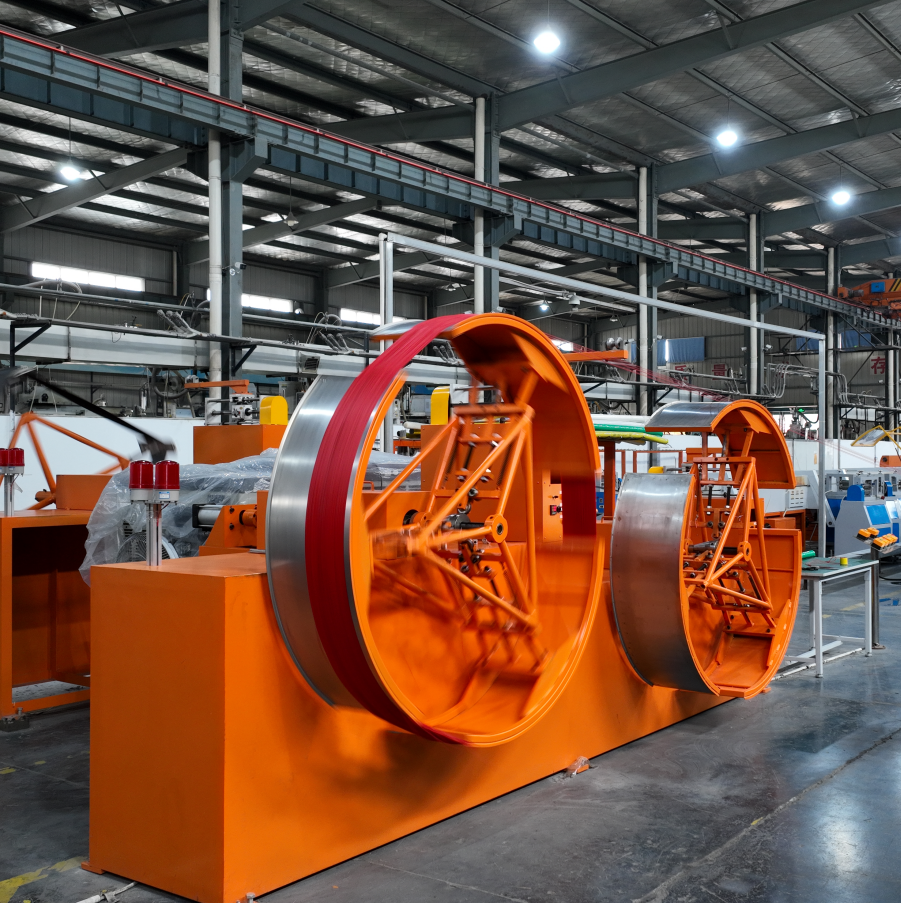
Nylon (polyamide) is universally recognized as the premium synthetic polymer for high-performance brush bristles. From oral hygiene toothbrushes and household cleaning tools to heavy-duty industrial abrasive rollers and street sweepers, nylon filaments deliver exceptional flex fatigue resistance, elastic bend recovery, and abrasion resistance.
However, nylon brush filament production presents significant process engineering challenges. Polyamide resins are intensely hygroscopic, thermally sensitive, and prone to crystallization fluctuations during quenching. Achieving consistent bristle diameters within ±0.005mm tolerances, preventing internal micro-voids, and setting stable wave crimps requires precise coordination across every stage of the extrusion line.
This technical guide breaks down the chemical behavior of polyamide grades, mandatory resin pre-drying protocols, step-by-step extrusion line architecture, crimping mechanics, and quality control standards for industrial brush filament manufacturing.
Polyamide Resin Selection for Brush Bristles: PA6, PA66, PA610 & PA612
Selecting the appropriate polyamide resin is the first critical decision in line design. While all nylon variants share strong mechanical toughness, variations in moisture absorption, melting temperature, and crystal structure dictate their suitability for specific brush applications. Understanding polyamide material selection guide principles ensures that line heating, cooling, and drawing capacities align with resin kinetics.
Resin Grade | Moisture Absorption (%) | Melting Point (°C) | Bend Recovery | Primary Brush Applications |
|---|---|---|---|---|
PA6 (Nylon 6) | High (2.8% – 3.2%) | 220°C – 225°C | Good | General cleaning brushes, household brooms, commercial scrubbing tools |
PA66 (Nylon 66) | Moderate (2.5% – 2.8%) | 255°C – 265°C | Excellent | High-speed industrial brushes, abrasive strip brushes, automotive wash rollers |
PA610 (Nylon 610) | Low (1.2% – 1.5%) | 215°C – 225°C | Superior | Fine toothbrushes, cosmetic brushes, wet-environment industrial seals |
PA612 (Nylon 612) | Very Low (1.0% – 1.3%) | 212°C – 220°C | Premium | Premium medical toothbrushes, precision technical brushes, wet abrasive discs |
Process Implications of Chemical Differences
PA6 vs. PA66: PA6 offers high impact strength and lower raw material cost, making it the workhorse resin for commercial cleaning brooms. However, PA66 features a higher heat deflection temperature and tighter intermolecular hydrogen bonding, delivering superior bend recovery and heat resistance under continuous mechanical friction.
PA610 & PA612: Long-chain aliphatic polyamides (PA610 and PA612) absorb less than half the moisture of PA6. Because wet nylon bristles soften as water acts as a plasticizer, PA612 bristles maintain stiff bend recovery even when continuously submerged in water or dental liquids.
Essential Pre-Extrusion Requirement: Dehumidifying Desiccant Drying
Polyamide polymers undergo rapid thermal hydrolysis if processed with excess moisture. At extrusion melt temperatures (230°C to 290°C), water molecules cleave the polymer chains, drastically reducing molecular weight and intrinsic viscosity. Understanding polyamide resin behavior on extrusion lines reveals why inadequate drying immediately leads to melt surging, die drool, internal micro-porosity, and frequent filament breakage during drawing.
⚠️ Warning: Standard hot-air hopper dryers only remove surface moisture. Because nylon is deeply hygroscopic, processing virgin or recycled PA pellets requires a closed-loop dehumidifying desiccant air dryer capable of delivering air at a dew point of -40°C or lower.
Standard Nylon Drying Protocol
Target Moisture Content: Strictly below 0.05% (0.02% to 0.03% recommended for PA66 and PA612).
PA6 / PA610 / PA612 Drying: 80°C to 90°C for 4 to 6 hours.
PA66 Drying: 90°C to 100°C for 4 to 6 hours.
Hopper Purge: Dried resin must feed directly into sealed, insulated extruder hoppers with dry-air blanket purging to prevent ambient re-absorption before entering the feed throat.
The 7-Stage Nylon Brush Filament Extrusion Line Architecture
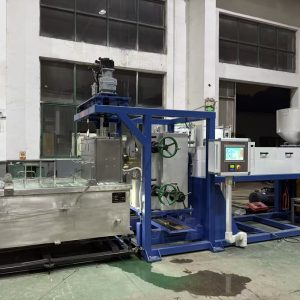
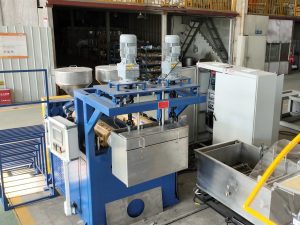
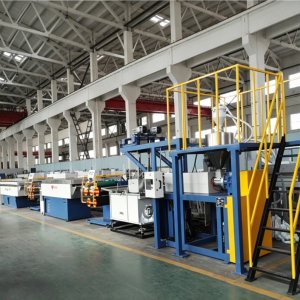
A dedicated nylon brush monofilament extrusion line converts dried resin into continuous, oriented strands with a uniform single solid monofilament structure. The line operates as an integrated system across seven sequential stages.
Dried Resin Feed → Extrusion & Melt Pump → Water Bath Quench → 1st Stage Draw → 2nd Stage Draw → Heat Setting Oven → Gear Crimper → Automatic Winder
1. Single-Screw Extrusion & Homogenization
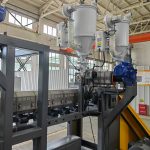
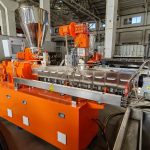
The single-screw extruder melts and pressurizes the polymer. Because nylon exhibits a sharp melting point and low melt viscosity, the screw design must feature a high length-to-diameter (L/D) ratio of 30:1 to 32:1 with barrier flighting and a Maddock mixing section to achieve thermal and shear uniformity.
Recommended Barrel Zone Temperature Profiles (°C)
PA6: Feed Zone 220°C–230°C | Transition 235°C–245°C | Metering 245°C–255°C | Die Head 245°C–250°C
PA66: Feed Zone 250°C–260°C | Transition 265°C–275°C | Metering 275°C–290°C | Die Head 270°C–280°C
PA612: Feed Zone 215°C–225°C | Transition 225°C–235°C | Metering 235°C–245°C | Die Head 235°C–240°C
2. Precision Gear Melt Pump & Spinneret Distribution
To eliminate pressure fluctuations caused by screw rotation, a positive-displacement gear melt pump meters polymer flow into the spinneret die with volumetric precision. The spinneret plate features high-precision capillary orifices (0.30mm to 1.50mm diameter) manufactured from SUS316 stainless steel to ensure uniform melt delivery across all filament strands.
3. Temperature-Controlled Quenching Bath
Extruded molten strands enter a stainless-steel water quench bath positioned 20mm to 50mm below the spinneret die face. Water temperature is strictly maintained between 15°C and 25°C via a closed-loop water chiller.
Crystallization Control: Rapid water quenching freezes the extruded melt into an amorphous or fine-spherulite crystal state. Rapid cooling makes the filament ductile, allowing high-ratio orientation stretching without snapping. If the quench bath is too warm, large spherulite crystals form, rendering the bristle brittle and rigid.
4. Multi-Stage Hot Drawing (Uniaxial Orientation)
Drawing transforms unoriented amorphous strands into high-strength bristles by aligning polyamide polymer chains parallel to the filament axis.
Primary Draw (Hot Water Bath): Filaments pass through a hot-water draw tank maintained at 85°C to 95°C. Godet roller speed ratios create a primary draw ratio between 3.2:1 and 4.0:1.
Secondary Draw (Hot Air Oven): Filaments enter a high-velocity hot-air circulation oven heated to 140°C to 170°C for secondary orientation, bringing the total cumulative draw ratio to 4.0:1 – 5.2:1.
5. Thermal Heat Setting (Annealing) & Stress Relief
After high-ratio orientation, internal residual stress remains locked within the molecular chain network. If uncorrected, bristles will exhibit severe thermal shrinkage (up to 15%) and curl when exposed to warm water or tufting friction.
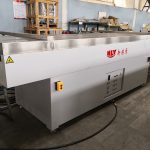
Filaments enter a continuous thermal annealing oven heated to 150°C to 180°C under a controlled 3% to 6% speed relaxation ratio. Heat setting relieves internal stress, locks in crystal orientation, and limits post-production shrinkage to under 1.5%.
6. Mechanical Gear Crimping & Waving Units
For broom bristles, industrial roller brushes, and street sweepers, straight filaments lack bulk volume and liquid retention. An inline gear crimping unit passes heated filaments between intermeshing temperature-controlled gear rollers.
Crimp Parameters: The unit imprints precise sinusoidal wave patterns with crimp pitches from 1.5mm to 6.0mm and wave amplitudes from 0.2mm to 1.2mm.
Thermal Setting: Crimp geometry is permanently set while passing through a post-crimp stabilization zone to prevent wave relaxation during storage.
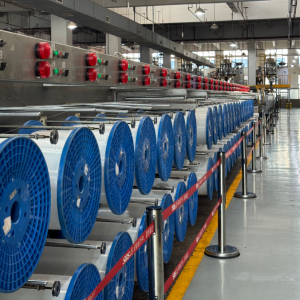
7. Precision Spooling & Bundle Winding
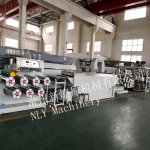
Finished filaments are wound onto multi-spool winders equipped with individual magnetic tension controllers or automatically cut into fixed bundle lengths (e.g., 300mm to 1200mm) wrapped in protective paper sleeves.
Pro Tip: Operating monofilament bristle extrusion machinery with closed-loop tension control on winding spindles prevents filament ovality and outer-layer crushing on heavy spools.
Quality Control Checkpoints & Defect Troubleshooting
Maintaining high OEE (Overall Equipment Effectiveness) requires systematic online monitoring and rapid defect resolution.
Online Laser Inspection → Tensile / Elongation Test → Bend Recovery Test (ISO 20126) → Crimp Wave Verification
Key Inspection Benchmarks
Diameter Uniformity: Online dual-axis laser gauges scan filament cross-sections continuously. Feedback loops adjust haul-off godet speeds automatically to maintain stable monofilament diameter control within ±0.005mm.
Bend Recovery Rate: Samples undergo 90° bend deformation for 15 seconds. High-quality nylon bristles must recover >88% of their original straight position within 60 seconds (tested according to ISO 20126 standards).
Tensile Strength: Oriented bristles should exhibit tensile breaking strength between 4.5 g/d and 6.5 g/d with elongation at break controlled between 20% and 35%.
Common Production Defects & Solutions
Defect / Problem | Root Cause | Engineering Solution |
|---|---|---|
Micro-bubbles / Porosity | Excessive resin moisture content (>0.05%) | Check desiccant dryer dew point (-40°C); increase drying time to 5+ hours |
Diameter “Hunting” / Surge | Melt pump pressure variation or temperature instability | Clean spinneret filter pack; adjust PID temperature loop on metering zone |
Filament Snapping in Draw Bath | Quench bath temperature too high or draw ratio too aggressive | Lower quench bath water to 18°C; reduce primary draw ratio by 0.2:1 |
Bristle Curling / High Shrinkage | Inadequate heat setting (annealing) temperature or time | Increase annealing oven temperature to 165°C; increase relaxation speed ratio |
Crimp Wave Flattening | Crimping gear temperature too low or insufficient post-crimp cooling | Raise crimping roller heating to 130°C; ensure immediate cold-air quenching after gear pass |
Evaluating Machinery Investments: Selecting the Right Extrusion Line Setup
When establishing or expanding a nylon brush bristle production plant, selecting turnkey equipment engineered specifically for polyamide processing is essential for long-term profitability.
Equipment Checklist for Plant Managers
Desiccant Dryer Integration: Closed-loop dehumidifying dryer with -40°C dew point guarantee.
High L/D Extruder: 30:1 or 32:1 L/D bimetallic barrel and barrier screw designed for PA processing.
Precision Melt Pump: Positive-displacement gear pump with AC servo drive.
Stainless Quench Tank: Closed-loop temperature regulation (15°C–25°C ±1°C).
Multi-Stage Drawing System: Combination hot-water tank and hot-air circulation oven with individual godet speed regulation.
Inline Gear Crimper: Changeable gear sets for variable wave pitch and amplitude.
Closed-Loop Laser Gauging: Dual-axis laser feedback tied to haul-off drives.
As a leading Chinese monofilament machinery manufacturer with over 30 years of engineering experience, Changzhou New Liaoyuan Machinery Co., Ltd. (NLY) provides complete, factory-customized nylon monofilament extrusion lines. From high-speed toothbrush bristle equipment to heavy-duty industrial brush filament lines, NLY offers turnkey line installation, precision screw engineering, and on-site operational training.
Contact NLY Machinery for Line Specifications
To request detailed machinery parameters, custom screw designs, or schedule a trial production run for your specific nylon bristle requirements, contact the engineering team at NLY Extruder Official Website.