https://youtu.be/aIXc0nL9AfU
The global transition from natural animal bristles (such as hog hair or horsehair) to engineered synthetic monofilaments has reshaped brush manufacturing. Today, high-performance synthetic filaments—produced from Polybutylene Terephthalate (PBT), Polyethylene Terephthalate (PET), Nylon (Polyamide 6/66/612), and Polypropylene (PP)—dominate every sector, including cosmetics, dental hygiene, industrial polishing, paintbrushes, and heavy-duty street-sweeping brooms.
However, producing commercial-grade brush filaments requires far more than basic plastic extruding. Synthetic bristles demand strict dimensional consistency, high bend recovery (elastic memory), uniform crimping, controlled static behavior, and precise flagging (feathering) characteristics. Achieving these mechanical traits consistently at commercial line speeds requires a purpose-built brush filament extrusion machine.
This guide examines the engineering architecture of a modern brush filament production line, details the material processing windows for major polymers, and provides a technical procurement framework for plant managers and operations directors.
Core Line Architecture of a Brush Filament Extrusion Machine
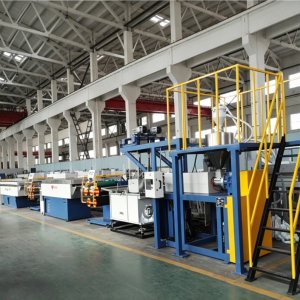
A synthetic bristle line operates as an integrated multi-stage thermo-mechanical system. Each stage directly influences the final filament’s tensile strength, straightness, diameter tolerance, and tufting performance.
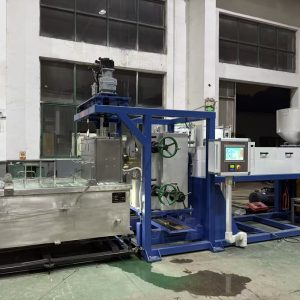
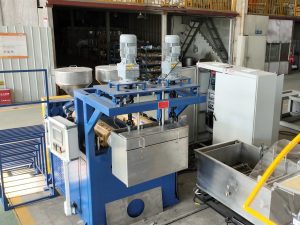
Polymer Pellets → Closed-Loop Dryer → Extruder & Melt Pump → Spinneret Die → Quenching Tank → 1st Haul-Off Godet → Stretching Oven → 2nd Haul-Off Godet → Crimping & Oiling → Heat Setting Oven → Take-Up Winder
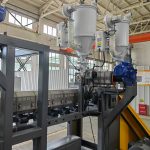
1. Resin Drying & Dehumidification Unit
Polymers used in brush bristles—particularly Nylon and PET—are highly hygroscopic. If processed with absorbed moisture, water molecules vaporize inside the heated barrel, causing severe hydrolytic degradation, intrinsic viscosity (IV) drop, internal void formation, and frequent strand breakage.
-
Nylon (PA6, PA66, PA612): Requires a closed-loop desiccant air dryer capable of delivering dry air at a dew point of -40°C or lower. Operating temperatures range between 80°C and 90°C for 4 to 6 hours.
-
PET & PBT: According to research on PET filament extrusion drying parameters, PET must be dried to below 0.005% (50 ppm) moisture content using a dehumidifying dryer operating at 150°C to 170°C for 4 to 6 hours before entering the hopper.
2. Single-Screw Extruder & Precision Melt Delivery
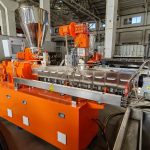
The extruder melts, homogenizes, and pressurizes the polymer. Because brush filaments require extreme cross-sectional roundness and tight diameter control, the extruder barrel and screw must maintain exceptional thermal and volumetric stability.
-
Screw Design: Industrial lines utilize single-screw extruders with a Length-to-Diameter (L/D) ratio of 28:1 to 33:1. Nitrided 38CrMoAlA alloy steel screws (or bimetallic coated screws for abrasive filled resins) ensure uniform plasticization without overheating the melt.
-
Gear Melt Pump: Positioned between the barrel and die head, a positive-displacement melt pump eliminates pressure surges and screw pulsation. As noted in Dynisco extrusion processing guidelines, closed-loop pressure feedback control maintains constant volumetric flow to the spinneret, directly preventing filament diameter fluctuations.
-
Spinneret Die: Custom die plates contain hundreds of micro-drilled orifices (ranging from 0.20 mm to 1.50 mm diameter). Die geometry dictates whether the machine produces solid round, hollow, star-shaped, or multi-filament profiles.
3. Water Quenching & Sizing Bath
Upon exiting the spinneret, molten polymer streams enter a temperature-controlled water bath. Quenching rapidly freezes the polymer into an amorphous state before crystal growth occurs, which is essential for subsequent drawing.
Pro Tip: Keep quenching water temperatures within ±1.0°C of the target setpoint (typically 18°C to 25°C for PBT/PET). Water turbulence or temperature swings cause immediate variations in filament ovality and shrinkage.
4. Multi-Stage Roller Stretching & Orientation
Untreated extruded strands lack tensile strength and bend recovery. The orientation stage stretches the amorphous filament along its molecular axis, aligning polymer chains to establish high tensile modulus and elasticity.
-
First Haul-Off Godet: A set of 5 or 7 speed-controlled rollers pulls filaments from the quenching tank at a stable linear speed (V₁).
-
Stretching Tank / Hot-Air Oven: Filaments pass through a hot water bath (90°C to 98°C) or a circulating hot-air oven (120°C to 180°C).
-
Second Haul-Off Godet: Rotates at a higher velocity (V₂). The draw ratio (DR = V₂ / V₁) typically ranges from 1:4.0 to 1:6.5 depending on the polymer grade.
Higher draw ratios increase filament tensile strength and stiffness, while lower draw ratios preserve elongation and impact resistance.
5. Surface Finishing: Crimping, Antistatic Oiling, and Annealing
Downstream finishing modules prepare filaments for high-speed automated tufting machinery:
-
Mechanical Crimping Unit: Interlocking gear wheels deform the heated filaments to impart a zig-zag or wave crimp profile. Crimped bristles increase brush head volume, improve liquid holding capacity in paintbrushes, and enhance sweeping coverage in broom bristles.
-
Antistatic Oiling Unit: Applies a thin film of emulsified silicone or antistatic oil. This neutralizes surface static charges generated during high-speed drawing, preventing strands from repelling or clinging together during winding and tufting.
-
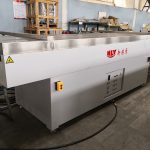
Heat-Setting (Annealing) Oven: The oriented and crimped filaments pass through a hot-air relaxation oven. Heat setting relieves internal mechanical stresses, locking in molecular orientation and reducing thermal shrinkage to below 3% in finished products.
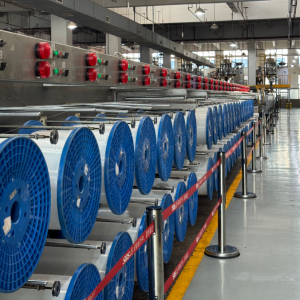
6. Precision Winding & Spooling
Finally, filaments are taken up by multi-spool winders, bobbin winders, or automatic hank cutters that bundle filaments into predefined lengths for direct shipping.
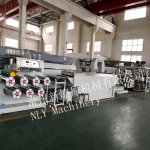
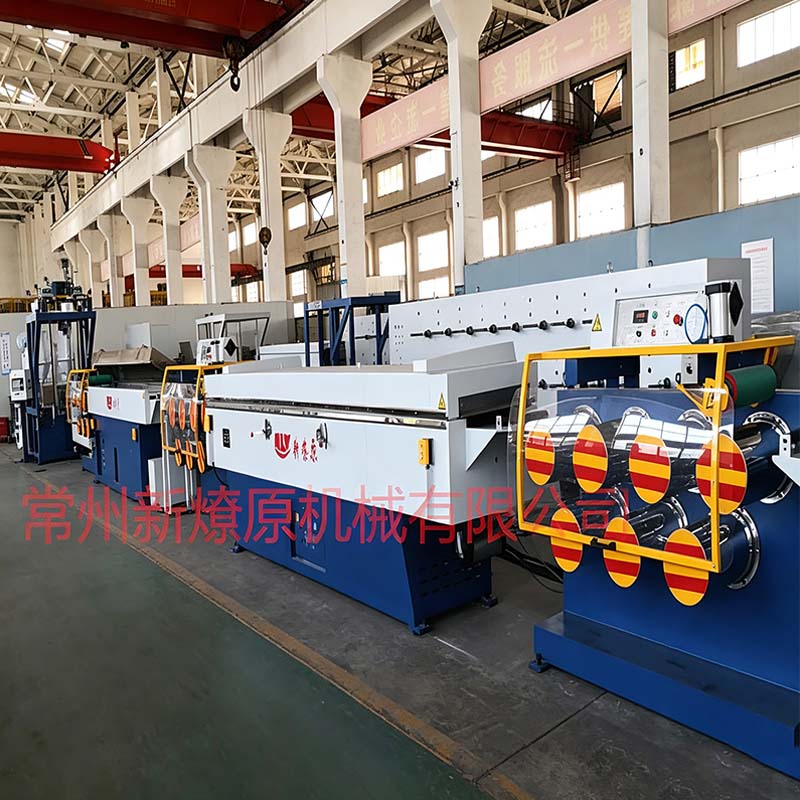
For plant engineers evaluating complete machinery layouts, specialized equipment like NLY monofilament extrusion lines integrates these modules onto a unified automation bed with centralized PLC controls.
Processing Windows by Polymer Type
Selecting the right machine configuration requires understanding how different polymers behave under heat, tension, and shear.
|
Processing Parameter |
PBT (Polybutylene Terephthalate) |
PET (Polyethylene Terephthalate) |
Nylon (PA6 / PA66) |
PP (Polypropylene) |
|---|---|---|---|---|
|
Primary Brush Applications |
Toothbrushes, cosmetic brushes, fine paintbrushes |
Cleaning brooms, street sweepers, industrial brushes |
High-end paintbrushes, abrasive technical brushes |
Outdoor broom bristles, industrial scrubber brushes |
|
Resin Pre-Drying |
100°C–120°C for 3–4 h (Moisture < 0.02%) |
150°C–170°C for 4–6 h (Moisture < 0.005%) |
80°C–90°C for 4–6 h (-40°C Dew Point) |
No pre-drying needed (Non-hygroscopic) |
|
Extrusion Melt Temp |
240°C – 265°C |
260°C – 290°C |
230°C–270°C (PA6), 260°C–290°C (PA66) |
200°C – 250°C |
|
Draw Ratio Range |
1:4.0 – 1:5.2 |
1:4.5 – 1:5.8 |
1:3.8 – 1:4.8 |
1:5.0 – 1:6.5 |
|
Key Mechanical Characteristic |
Superior bend recovery, low water absorption |
High stiffness, cost-effective, durable |
Maximum toughness, high wear resistance |
Lightweight, chemical resistance, low cost |
Resin Specifics
-
PBT (Polybutylene Terephthalate): PBT crystallizes rapidly upon exiting the die. As documented in PBT extrusion material processing parameters, precise melt control between 250°C and 260°C prevents thermal degradation while ensuring high elasticity. PBT is preferred for toothbrush bristles and premium cosmetic brushes because its low moisture absorption preserves bristle stiffness in wet environments.
-
PET (Polyethylene Terephthalate): Highly cost-effective, PET can utilize virgin resin or recycled bottle flakes (rPET). Because PET has a narrow processing window, stable melt pumping and rigid draw temperature control are critical to avoid brittle strands.
-
Nylon (PA6 / PA66 / PA612): Nylon exhibits unmatched mechanical toughness and abrasion resistance, making it ideal for technical industrial brushes and heavy-duty paintbrushes. For a deep dive into moisture management and crimp control for Polyamide resins, refer to our technical guide to nylon brush filament production.
-
Polypropylene (PP): PP is non-hygroscopic and easy to process, making it the standard material for low-cost household broom bristles and outdoor sweeping equipment.
Technical Procurement & Selection Criteria for Buyers
When sourcing a brush filament extrusion line, evaluate potential equipment suppliers against four core engineering benchmarks:
1. Screw Metallurgy & L/D Ratio
Ensure the extruder screw geometry matches your primary resin choice. Standard 38CrMoAlA nitrided steel screws handle virgin PET, PBT, and PP effectively. However, if your production involves abrasive additives (such as Silicon Carbide or Aluminum Oxide for abrasive industrial brushes) or flame retardants, specify a bimetallic screw and barrel package to prevent premature wear.
2. Diameter Tolerance & Ovality Controls
In automated brush tufting machines, a diameter deviation exceeding ±0.01 mm can cause picking mechanical jams or loose tuft knots. Look for extrusion lines equipped with:
-
Closed-loop laser diameter gauges after the heat-setting oven.
-
Automated feedback loops connecting the laser gauge to the melt pump speed.
Operators seeking troubleshooting strategies for dimensional drift can review our engineering checklist on filament diameter stability troubleshooting.
3. Downstream Module Compatibility
A complete line must support downstream secondary operations required by brush makers:
-
Flagging Compatibility: Ensure the line produces filaments with optimal molecular orientation so flagging machines can split (feather) the filament tips smoothly without splitting the entire length.
-
Crimp Uniformity: Verify that the crimper offers adjustable gear gap spacing and temperature-controlled crimping rollers to achieve consistent crimp pitch and amplitude.
4. Specific Energy Consumption (kWh/kg) and OEE
Extrusion lines run continuously. Modern energy-efficient lines utilize ceramic infrared heaters, inverter-driven motors, and insulated hot-air ovens to minimize specific power consumption (kWh per kilogram of finished filament). Reducing power draw by 15% to 20% yields substantial long-term operational savings.
Review our complete monofilament extrusion machinery selection framework for more details on calculating equipment total cost of ownership (TCO).
Technical RFQ Checklist for Plant Managers
Before issuing a Request for Quotation (RFQ) or attending a Factory Acceptance Test (FAT), confirm these critical parameters with your equipment vendor:
-
Material Flexibility: Can the extruder screw and heating zones handle both PBT/PET and Nylon without changing the screw?
-
Melt Pump Inclusion: Is a high-precision gear melt pump integrated with closed-loop pressure control?
-
Drying Dew Point: Does the offered drying package guarantee a -40°C dew point for hygroscopic polymers?
-
Draw Ratio Range: What is the maximum linear draw ratio of the haul-off godet units?
-
Diameter Precision: Can the line guarantee a continuous diameter tolerance within ±0.005 mm at maximum line speed?
-
Spare Parts & Service: Are replacement spinneret plates, heater bands, and crimper gears readily available with local technical support?
Key Takeaway: A high-performance brush filament line is an integrated system. Superior extruder output means little if quenching temperature stability, multi-stage draw ratios, or antistatic oiling modules are inadequate.
Conclusion & Next Steps
Investing in a purpose-built brush filament extrusion line enables manufacturers to produce high-margin bristles tailored for cosmetics, dental care, household cleaning, and heavy industrial applications. By matching screw metallurgy, drying systems, drawing ratios, and crimping units to your target resin, your plant can achieve stable production, minimal scrap, and superior tufting performance.
To explore customized machine configurations or learn more about how a brush filament extrusion line works, contact the engineering team at Changzhou New Liaoyuan Machinery Co., Ltd. (NLY) for a tailored technical proposal and line layout design.