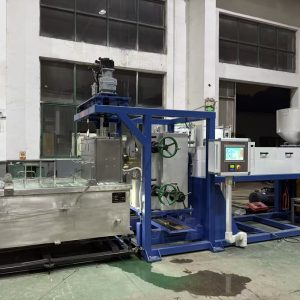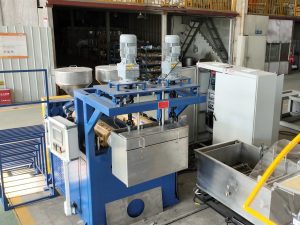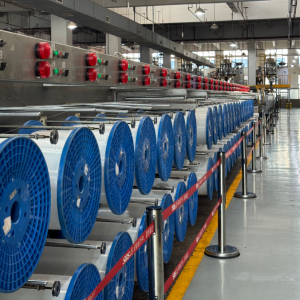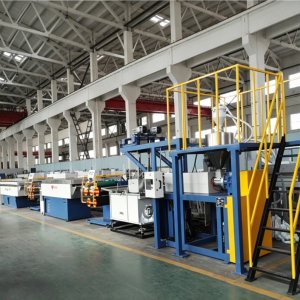
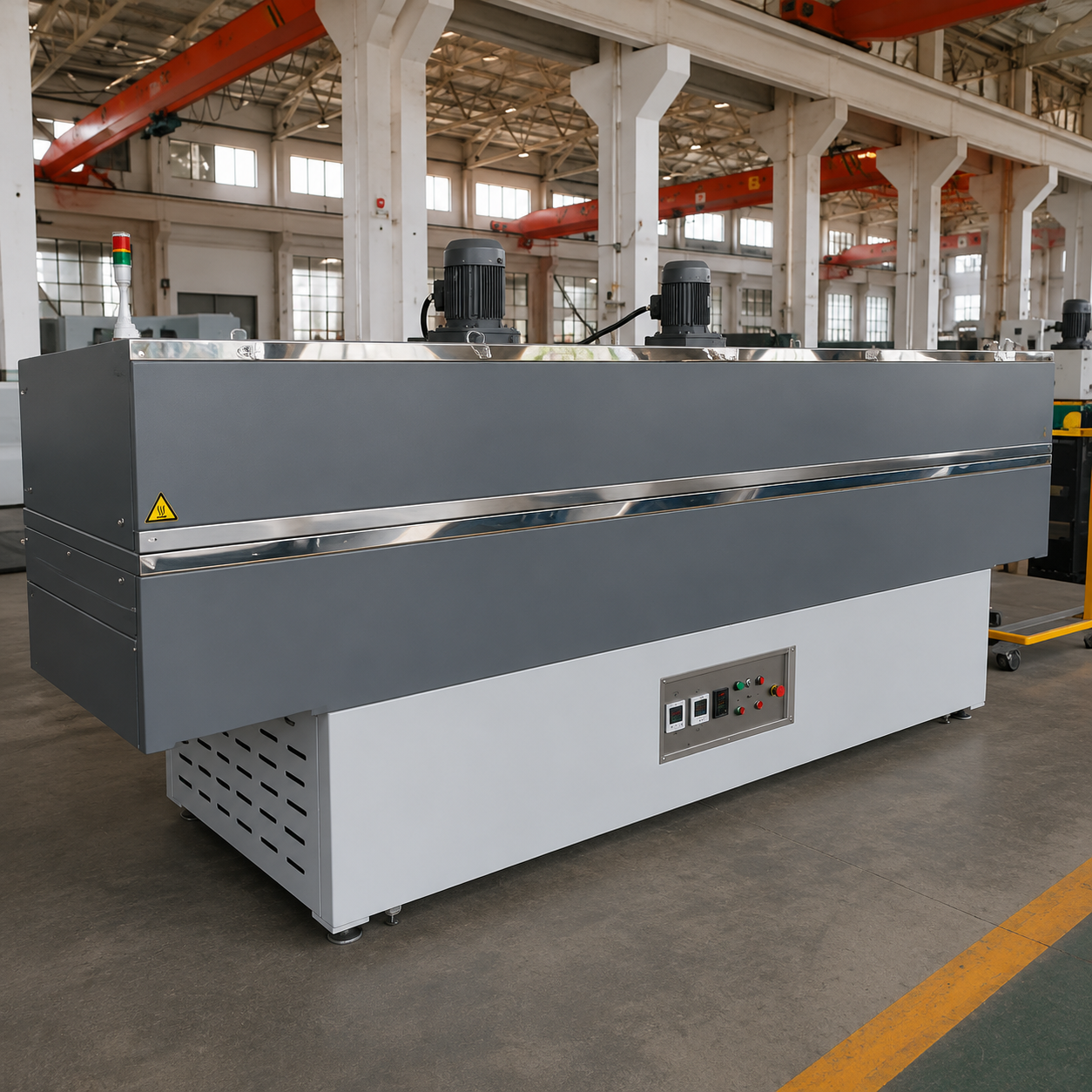
When industrial manufacturers evaluate a plastic monofilament extrusion machine, they are rarely buying a single standalone piece of equipment. In commercial polymer processing, producing high-tenacity monofilaments—whether for zipper coils, toothbrush bristles, fishing nets, lawn trimmer line, or agricultural shade cloth—requires a synchronized, continuous production system.
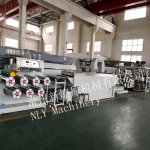
A complete monofilament extrusion line must melt raw resin, deliver a pulsation-free melt stream to a spinneret die, rapidly quench the extruded filaments, draw the polymer molecules through multi-stage godets to build tensile strength, heat-set the strands to lock dimensional stability, and wind them under precise tension onto individual spools.
If any single component in this chain fails—whether due to screw wear, temperature fluctuation, uneven quench bath flow, or godet speed drift—the resulting filament will suffer from diameter variations, internal voids, low tensile strength, or frequent draw breakage.
This technical buyer’s guide breaks down the core engineering components of modern plastic monofilament extrusion machines, details polymer-specific processing configurations (PET, Nylon, PP, and HDPE), explores diameter control physics, and provides a structured evaluation framework for plant managers and engineering directors.
Complete Line Architecture: The 6 Core Engineering Stages
To make an informed purchasing decision, engineering teams must look beyond horse-power ratings and evaluate how each sub-system contributes to continuous process stability.
Resin Feeding & Dryer → Single-Screw Extruder (30:1 L/D) & Melt Pump → Spinneret Die & Quench Bath
↓
[Tension-Controlled Spool Winder] ← [Thermal Heat-Setting Oven] ← [Multi-Stage Godet Stretching Rollers]
Stage 1: Material Conditioning & Dehumidifying Drying
The extrusion process begins before resin ever enters the hopper. Hygroscopic polymers such as Polyester (PET) and Polyamide (Nylon PA6/PA66) readily absorb atmospheric moisture. If processed wet, water molecules cause severe hydrolytic degradation in the extruder barrel, breaking down polymer chain length and resulting in brittle filaments, surface bubbles, and frequent draw snaps.
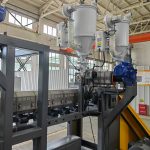
For PET and Nylon, a closed-loop dehumidifying desiccant dryer capable of lowering resin moisture below 50 ppm (0.005%) at dew points of -40°C is an essential pre-conditioner. Non-hygroscopic resins like Polypropylene (PP) and High-Density Polyethylene (HDPE) require standard hot-air drying to remove surface condensation and preheat pellets for thermal efficiency.
Stage 2: Single-Screw Extruder (30:1 L/D), Barrel Zones & Melt Metering
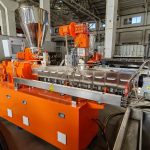
The plastic extruder single screw unit acts as the thermal and mechanical heart of the machine. Monofilament production demands exceptional melt homogeneity and pressure stability.
Screw Geometry & L/D Ratio: Standard monofilament extruders utilize a single screw with a length-to-diameter (L/D) ratio of 30:1 (typically ranging from 65 mm to 90 mm screw diameter). High L/D ratios ensure sufficient residence time for thorough plastication without overheating the polymer. Screws are typically precision-machined from 38CrMoALA high-grade nitrided alloy steel (nitrided layer depth 0.5–0.8 mm, hardness HV900–1000) to resist abrasive wear from color masterbatches or additives.
Barrel Heating & Temperature Zones: The barrel is divided into 4 to 6 independent PID heating zones equipped with cast aluminum heaters and cooling blowers. Temperature precision must be maintained within ±1°C to prevent viscosity fluctuations.
Screen Changer & Melt Pump: A hydraulic double-station screen changer filters out carbonized particles and raw resin contaminants. To eliminate screw-rotation pressure surging, high-precision lines incorporate a positive-displacement gear melt pump between the barrel and die head. The melt pump metes out an exact volumetric flow rate, stabilizing pressure at the spinneret within ±0.1 MPa. For an in-depth look at barrel zones and screw mechanics, see our engineering guide on the single-screw extruder working principle.
Stage 3: Spinneret Die Head & Water Quench Bath
Molten polymer exits the melt pump and enters the spinneret die head, which distributes the melt across micro-machined orifices (ranging from 8 to 250+ holes per die, depending on filament diameter and output capacity).
Spinneret Orifice Precision: Die orifices are micro-drilled to exact tolerances, shaping round, profile, hollow, or triangular filaments.
Quench Water Trough: Upon exiting the die, the molten strands drop into a stainless steel water quench bath. Rapid cooling freezes the polymer in an amorphous state, preventing uncontrolled crystallization before stretching. Water temperature control (typically 20°C–30°C) and laminar water flow are critical; turbulent water creates surface ripples that cause diameter drift along the filament length.
Pro Tip: Keep quench bath water turbulence to an absolute minimum. Installing submerged baffle plates and laminar weir overflows prevents filament vibration as strands enter the water line.
Stage 4: Multi-Stage Godet Stretching Rollers & Hot Water/Air Ovens
Solidified filaments exiting the quench tank possess minimal tensile strength because their polymer chains are randomly oriented. To achieve high tenacity, the line utilizes a multi-stage filament stretching and drawing process.
1st Godet Unit: A set of 5 to 7 mirror-polished, chrome-plated rollers grips the filaments at a constant linear speed (e.g., 20 m/min).
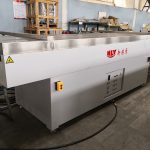
Stretching Medium: Strands pass through a hot-water stretching tank (90°C–98°C) or a hot-air circulation oven (160°C–220°C), heating the polymer above its glass transition temperature (Tg).
2nd Godet Unit: The second godet set operates at a significantly higher linear speed (e.g., 100 m/min), pulling the softened filaments. The linear speed ratio between the godets defines the draw ratio (typically 4:1 to 10:1). This mechanical stretching aligns polymer molecules parallel to the filament axis, multiplying tensile strength by up to 500%.
Stage 5: Thermal Heat Setting (Annealing) & Stress Relief
Stretching creates high internal orientation stress. If filaments are wound immediately after drawing, they will experience severe longitudinal shrinkage when exposed to ambient heat or downstream processing.
The line directs drawn filaments through a heat-setting annealing oven (170°C–220°C for PET/Nylon; 100°C–120°C for PP/HDPE) under controlled relaxation provided by a 3rd godet unit. Thermal annealing relieves internal molecular strain, locking in structural dimensions and reducing thermal shrinkage below 3–5%.
Stage 6: Precision Tension-Controlled Spool Winders
The final stage of the monofilament extrusion process is continuous winding. Individual spools or bobbins are driven by torque motors or individual AC servo drives. Winders must maintain constant winding tension as the spool diameter grows from empty core to full bobbin, preventing filament crushing, overlapping, or loose package formation.
Polymer Processing Matrix: PET, Nylon (PA), PP, and HDPE Configurations
Different resin families exhibit vastly different rheological, thermal, and mechanical behaviors. A monofilament extrusion line optimized for HDPE net yarn cannot run PET zipper monofilaments without specific equipment adaptations.
Processing Parameter | Polyester (PET) | Polyamide 6 / 66 (Nylon) | Polypropylene (PP) | High-Density Polyethylene (HDPE) |
|---|---|---|---|---|
Resin Drying Need | Dehumidifying dryer (<50 ppm moisture, 150–170°C, 4–6 h) | Desiccant dryer (<100 ppm moisture, 80–90°C, 4 h) | Standard pre-heating / surface moisture removal | Standard hopper pre-heating |
Melt Temperature Range | 270°C – 295°C | 240–270°C (PA6) / 275–295°C (PA66) | 210°C – 250°C | 180°C – 230°C |
Quench Bath Temp | 25°C – 35°C | 20°C – 30°C | 20°C – 25°C | 18°C – 22°C |
Stretching Medium | Hot water bath + Hot air oven | Hot water bath + Steam / Hot air oven | Hot water bath | Hot water bath |
Typical Draw Ratio | 4.0:1 – 6.2:1 | 3.5:1 – 5.5:1 | 5.0:1 – 8.0:1 | 8.0:1 – 10.0:1 |
Heat Setting Temp | 180°C – 220°C | 170°C – 200°C | 100°C – 120°C | 90°C – 110°C |
Target End-Uses | Zipper teeth, broom bristles, filter cloth | Fishing line, trimmer line, brush bristles | Agricultural nets, packaging twine, rope | Safety nets, shade cloth, heavy ropes |
Understanding these resin variations is essential when configuring line drive power, heater capacities, and oven lengths. For detailed material selection guidance, review our comparative study on polymer material behavior on extrusion lines.
Filament Diameter Control & Quality Assurance Physics
In high-precision applications—such as zipper monofilament manufacturing where tooth meshing requires tight pitch tolerances—maintaining consistent filament diameter is non-negotiable.
The mathematical relationship governing filament diameter is expressed by volumetric mass conservation:
Volumetric Flow Rate = Melt Density × Die Orifice Cross-Section × Extrusion Velocity = Final Filament Cross-Section × Take-Up Velocity
To maintain an target diameter tolerance of ±0.002 mm across all running strands, modern lines implement closed-loop quality control:
Laser Micrometer Measurement: A dual-axis laser diameter gauge positioned after the first godet or before the winder continuously scans running filaments at high frequency (1000+ readings per second).
Closed-Loop Feedback: If the laser gauge detects a negative diameter drift (-0.003 mm), the central PLC automatically signals the second and third godet drives to decrease velocity slightly or signals the melt pump to increase RPM, restoring nominal diameter in real time.
Melt Pressure Cascade Control: Pressure transducers before and after the melt pump feed pressure signals back to the main extruder drive, ensuring constant head pressure regardless of raw pellet size distribution.
Key Takeaway: A gear melt pump combined with a dual-axis laser diameter gauge feedback system is the single most effective hardware upgrade for eliminating filament diameter variation and ovality.
Common Line Operational Issues & Engineering Troubleshooting
Even high-end machinery experiences operational disruptions if process parameters drift. Plant engineers should utilize a structured diagnostic approach:
Process Instability Detected
Diameter Variance → Check melt pump pressure stability & laser closed-loop feedback
Draw Breakage → Verify resin drying dew point & godet surface temperature uniformity
Internal Voids / Bubbles → Inspect melt temperature profile & quench bath cooling speed
1. Diameter Oscillations & Wave Patterns
Root Cause: Screw pressure surging, cold spots in the adapter/die head, or hunting godet drives.
Mitigation: Inspect barrel heater bands for failed elements. Confirm the gear pump inlet pressure setting is holding steady. Ensure godet drive inverter parameters do not have aggressive PID speed acceleration ramps.
2. Frequent Draw Breakage in Stretching Ovens
Root Cause: Degradation from un-dried resin, thermal degradation from excessive melt temperatures, or incorrect draw ratio for the specific resin grade.
Mitigation: Test raw resin moisture content prior to feeding. Lower stretching oven temperatures slightly or reduce the 2nd godet speed ratio.
3. Internal Voids and Micro-Porosity
Root Cause: Moisture vapor expanding in the die or excessively rapid surface quenching that traps internal contraction voids.
Mitigation: Increase dehumidifying drying time and adjust quench water temperature upward to allow uniform thermal conduction. For a complete troubleshooting matrix, consult our monofilament line troubleshooting guide.
Supplier Evaluation Checklist & TCO Optimization
When requesting proposals for a plastic monofilament extrusion line, plant procurement teams should evaluate quotes against a technical scoring framework rather than initial capex alone.
Engineering Audit Checklist for Machine Quotes
Screw Material & Treatment: Is the screw machined from 38CrMoALA nitrided steel or bimetallic alloy with a nitriding depth ≥ 0.5 mm?
Extruder L/D Ratio: Does the extruder feature a true 30:1 L/D ratio for homogeneous melting?
Melt Metering: Is a high-precision positive-displacement melt pump included in the base quote?
Godet Roller Finish: Are godet rollers hard-chrome plated, mirror-polished (roughness Ra ≤ 0.05 µm), and dynamically balanced at maximum line speed?
Oven Heating Efficiency: Does the stretching oven utilize forced hot-air circulation with thermal insulation thickness ≥ 80 mm to minimize heat loss?
Control System: Is the line integrated via a centralized Siemens or Omron PLC with a touch-screen HMI, recipe management, and Ethernet SCADA connectivity?
Energy Efficiency Metrics: What is the line’s specific energy consumption rating (target ≤ 0.35–0.45 kWh per kg of extruded filament)?
Spare Parts & MTTR: Does the supplier stock critical replacement parts (heater bands, pressure sensors, spare spinnerets, gear pump seals) for rapid dispatch?
Frequently Asked Questions (FAQ)
What is the difference between a standalone extruder and a monofilament extrusion line?
A standalone extruder only melts and pushes polymer resin through a die. A monofilament extrusion line is a complete, multi-stage production system that includes resin drying, extrusion, water quenching, multi-stage godet stretching, thermal heat setting, and tension-controlled winding to produce high-tenacity filaments with precise diameters.
What screw diameter and output capacity should I select?
Output capacity depends on filament denier and the number of spinneret holes. A standard 65 mm (30:1 L/D) extruder typically delivers 40–80 kg/h, suitable for fine zipper or brush filaments. An 85 mm or 90 mm extruder delivers 100–180 kg/h, ideal for heavy ropes, agricultural netting, or industrial fabrics.
Can a single monofilament line process PET, Nylon, PP, and HDPE interchangeably?
While a line can process multiple resins, key sub-systems must be modular. PET and Nylon require closed-loop dehumidifying dryers and higher oven heating capacities (up to 220°C), whereas PP and HDPE require hot-water draw tanks and lower thermal profiles. A versatile line must feature multi-zone temperature controls and variable-frequency godet drives.
How does line automation affect overall equipment effectiveness (OEE)?
PLC-automated lines with closed-loop laser diameter control and recipe management drastically reduce changeover times, eliminate operator setup errors across shifts, and maintain continuous diameter consistency, directly increasing OEE and reducing scrap rates.
Next Steps for Line Planning & Custom Machinery Quotes
Selecting the optimal plastic monofilament extrusion machine requires aligning polymer chemistry, output capacity, and mechanical line design with your specific end-product requirements.
At Changzhou New Liaoyuan Machinery Co., Ltd. (NLY), we have specialized in the design and manufacture of high-precision monofilament extrusion lines for over 30 years. From turnkey zipper monofilament systems to industrial brush and net yarn machinery, our ISO 9001 and CE-certified lines are engineered for long-term stability, tight diameter tolerances (±0.002 mm), and energy-efficient operation.
Contact our process engineering team today at https://nlyextruder.com/ to discuss your technical specifications, request a custom line layout, or arrange raw material trial testing at our manufacturing facility.