In plastic monofilament manufacturing, the extrusion die gives the molten polymer its initial cross-sectional shape, but the filament stretching process dictates its ultimate mechanical performance. A strand emerging from a quench bath without post-extrusion stretching is weak, soft, and prone to rapid deformation under minimal load.
Through controlled mechanical drawing between rotating godet rollers, the randomly coiled polymer chains inside the quenched strand align along the longitudinal fiber axis. This solid-state orientation transforms raw extrudate into high-tenacity monofilaments capable of meeting strict tensile, elasticity, and creep-resistance specifications for industrial zippers, brush bristles, fishing nets, and agricultural screens.
Understanding the physics, speed ratios, thermal media, and multi-stage configurations of the monofilament drawing line allows plant managers and process engineers to maximize throughput while maintaining tight diameter tolerances.
The Science of Filament Stretching: Polymer Chain Orientation
When polymer melt exits the spinneret die and enters the cooling water bath, it solidifies into an isotropic state. At a microscopic level, the macromolecular chains exist as folded, unoriented entanglements interspersed with amorphous regions and unaligned crystallites.
The stretching process—often referred to as orientation or drawing—applies continuous uniaxial tension to the solid or semi-solid strand at controlled temperatures. This force produces three distinct structural changes:
Uncoiling and Alignment: The longitudinal tension pulls entangled polymer chains straight, orienting them parallel to the direction of fiber travel.
Strain-Induced Crystallization: As chains align closely, intermolecular forces increase, promoting the formation of dense, ordered crystalline regions.
Cross-Sectional Reduction: As the strand elongates, its diameter decreases proportionally according to mass balance and polymer density.
Key Takeaway: The primary goal of the filament stretching process is not simply making the strand thinner, but converting an unoriented amorphous polymer structure into a highly oriented, crystalline fiber with superior tensile strength and low break elongation.
This molecular alignment causes a dramatic shift in mechanical properties. For example, standard industrial polyester (PET) or polyamide (Nylon 6) strands increase in tensile tenacity from approximately 1.5–2.0 g/d (grams per denier) in their un-drawn state to 7.0–9.0 g/d after precision drawing, while elongation at break drops from over 300% down to 15–25%.
Understanding the clear difference between extrusion and drawing is essential for extrusion line operators: extrusion shapes the molten polymer, whereas drawing restructures the solid polymer at a molecular level.
Key Operating Parameters in the Monofilament Drawing Process
Achieving uniform tensile properties without causing strand breaks or diameter variation requires precise control over three core parameters: speed ratio, temperature, and drawing stages.
Calculating the monofilament draw ratio and understanding the godet roller speed ratio is essential for maintaining tensile strength without causing strand breakage.
1. Godet Roller Speed Differential (Draw Ratio)
The drawing force is generated by running two or more sets of godet rollers at different surface speeds. The ratio of the downstream roller speed to the upstream roller speed defines the draw ratio (DR):
Draw Ratio (DR) = V₂ / V₁
Where:
V₁= Surface speed of the feed / haul-off godet roller set (m/min)V₂= Surface speed of the draw godet roller set (m/min)
If the feed godet set rotates at 20 m/min and the draw godet set rotates at 100 m/min, the stage draw ratio is 5.0:1 (or 5:1). Higher draw ratios yield stronger, stiffer filaments, but exceeding the polymer’s natural draw limit causes necking instabilities, micro-voiding, or line snapping.
2. Thermal Windowing (Glass Transition and Melting Point)
Polymer chains cannot slide past one another at room temperature without fracturing (cold drawing), nor can they hold orientation if drawn above their melting point (where thermal motion randomizes chain alignment).
Effective stretching occurs within a specific thermal window:
Lower Limit: Above the glass transition temperature (T g), where amorphous polymer segments gain mobility.
Upper Limit: Below the crystalline melting temperature (Tₘ), ensuring the crystal backbone remains intact.
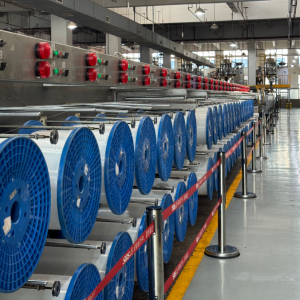
Maintaining uniform temperature across every strand in a multi-end line (often processing 30 to 120 strands simultaneously) is critical. A temperature variance of just 2°C across the heating zone causes noticeable diameter and tenacity fluctuations between strands.
3. Multi-Stage Drawing
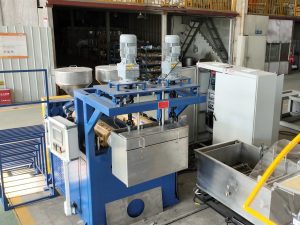
Single-stage stretching subjects the filament to abrupt mechanical shock, increasing the risk of individual strand breaks. Modern high-output production lines employ multi-stage drawing (typically two or three stages):
Primary Draw (Pre-Drawing): Performed at a lower temperature near T g with a modest draw ratio (1.3:1 to 2.5:1). This initiates uniform necking across all strands without localized stress concentration.
Secondary Draw (Main Drawing): Performed at an elevated temperature with a higher draw ratio to maximize molecular alignment and strain crystallization.
Splitting total elongation across multiple stages improves line stability, enables higher total draw ratios, and significantly reduces scrap rates.
Thermal Media Comparison: Hot Water Bath vs. Hot Air Oven Stretching
Selecting the correct thermal medium for the stretching zone depends on the polymer resin, filament diameter, and required line speed. The three primary industrial heating systems each offer distinct operational advantages.
System Type | Max Operating Temperature | Heat Transfer Efficiency | Primary Resin Suitability | Key Operational Advantage |
|---|---|---|---|---|
Hot Water Bath | 98°C to 100°C | Very High (Liquid Conduction) | HDPE, PP, Pre-heating PA6/PET | Rapid, uniform heat transfer; plasticizing effect on polyamide |
Hot Air Oven | 120°C to 230°C | Moderate (Forced Convection) | PET, PA6, PA66, PP | High thermal ceiling required for high-melting polymers |
Heated Godet Rollers | 80°C to 220°C | High (Direct Contact Conduction) | High-Tenacity PA, PET, Fine Denier | Individual roll temperature control; precise surface contact heating |
Hot Water Stretching Baths
Water transfers heat to synthetic fibers roughly 20 to 25 times faster than static air. A hot water tank provides exceptionally uniform thermal conditioning, making it ideal for high-density polyethylene (HDPE) and polypropylene (PP), or as a primary conditioning stage for nylon monofilaments. However, because water boils at 100°C at atmospheric pressure, water baths cannot supply the higher temperatures required for full PET drawing.
Hot Air Stretching Ovens
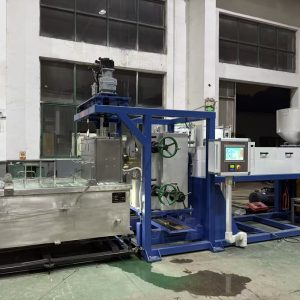
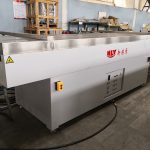
For materials like polyester (PET) or high-spec polyamide 66, which require drawing temperatures between 140°C and 210°C, insulated hot air ovens with recirculating blowers are standard. Precision ovens feature multi-zone PID temperature controls, adjustable air velocity nozzles, and pneumatic door lifts for easy string-up during startup.
Reviewing a complete step-by-step monofilament extrusion workflow helps clarify how hot water tanks and hot air ovens integrate sequentially between godet roller stands.
Polymer-Specific Drawing Parameter Reference
Different synthetic resins exhibit unique chain stiffness, crystallization rates, and thermal thresholds. The table below outlines standard industrial processing parameters for common monofilament polymers:
Polymer Resin | Glass Transition (T g) | Typical Total Draw Ratio | Recommended Drawing Medium | Heat Setting / Annealing Temperature |
|---|---|---|---|---|
PET (Polyester) | 70°C – 80°C | 1:4.8 – 1:6.2 | Hot Water (Pre-draw) + Hot Air Oven (160°C–210°C) | 180°C – 220°C |
PA6 / PA66 (Nylon) | 50°C – 60°C (Dry) | 1:3.5 – 1:6.5 | Hot Water Bath (80°C–95°C) or Hot Air Oven (160°C–190°C) | 170°C – 200°C |
PP (Polypropylene) | -10°C | 1:3.5 – 1:5.5 | Hot Air Oven (120°C–160°C) | 130°C – 150°C |
HDPE | -110°C | 1:8.0 – 1:10.0 | Hot Water Bath (95°C–98°C) or Hot Air Oven (105°C–120°C) | 110°C – 125°C |
Pro Tip: When processing recycled PET or regrind resin blends, intrinsic viscosity (IV) drops slightly compared to virgin resin. Reduce the primary draw ratio by 5% to 8% and raise the pre-heating oven temperature by 3°C to 5°C to prevent high-speed strand snapping.
Heat Setting and Thermal Relaxation: Eliminating Residual Shrinkage
Directly after the main drawing stage, polymer chains are held under intense internal elastic tension. If the filament is cooled and wound onto spools in this state, it will suffer from severe residual thermal shrinkage—often shrinking by 10% to 20% when exposed to boiling water or downstream processing heat.
To lock in dimensional stability, the drawn monofilament must pass through a heat setting (annealing) and relaxation zone:
Thermal Relaxation Zone: The monofilament travels through a final heated oven or over heated godet rolls maintained at the polymer’s peak crystallization temperature.
Controlled Speed Over-Feed: The third godet roller set (haul-off godet) is set to run slightly slower than the draw godet set:
Relaxation Speed Ratio = V₃ / V₂ (typically 0.92 to 0.97, representing a 3% to 8% speed reduction).
This slight reduction in tension allows frozen amorphous chain segments to relax and reorganize into stable crystalline lamellae without losing longitudinal orientation. Proper heat setting reduces boiling water shrinkage down to below 2% to 3%, ensuring consistent dimensional performance in end-use applications such as industrial filter meshes and zipper coils.
Scientific research on multi-stage PET orientation demonstrates that combining an initial drawing stage near T g with a secondary high-temperature annealing stage yields the optimal balance of tensile modulus and thermal stability.
Troubleshooting Common Filament Stretching Defect Modes
When drawing problems occur on the production floor, identifying the root cause quickly minimizes costly material scrap and line downtime.
Defect Mode | Typical Root Cause | Recommended Corrective Action |
|---|---|---|
Frequent Strand Snapping | Total draw ratio exceeds polymer limit; uneven heating zone; worn godet roll surface. | Lower downstream godet speed by 0.2 m/min; inspect water bath/oven temperature sensors; check godets for grooving or burrs. |
Diameter Fluctuation / Ovality | Slippage on godet rollers; water bath turbulence; unstable quench cooling prior to draw. | Increase wrap count on godet rolls; install anti-wave baffles in water tank; stabilize quench bath temperature within ±0.5°C. |
High Thermal Shrinkage in Finished Filament | Insufficient annealing temperature; relaxation speed ratio too tight (V₃ speed too high). | Raise heat setting oven temperature by 5°C; increase relaxation speed differential (e.g., lower V₃ from 0.96 V₂ to 0.94 V₂). |
Fibrillation / Surface Splitting | Over-orientation in high-density polyolefins; excessive drawing temperature causing melt localized voiding. | Reduce total draw ratio; optimize draw zone temperature; check resin melt flow rate (MFR) consistency. |
For a broader diagnosis of line stoppage issues across quenching, drawing, and winding units, refer to our comprehensive monofilament line breakage troubleshooting guide.
Optimizing Your Monofilament Stretching Line
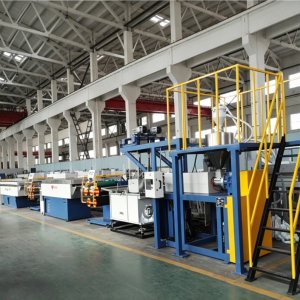
Modern monofilament extrusion lines demand precise synchronization across feed godets, heating chambers, draw godets, and tension-controlled winders. Minor speed drifts or temperature fluctuations directly compromise product quality and operational profitability.
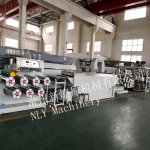
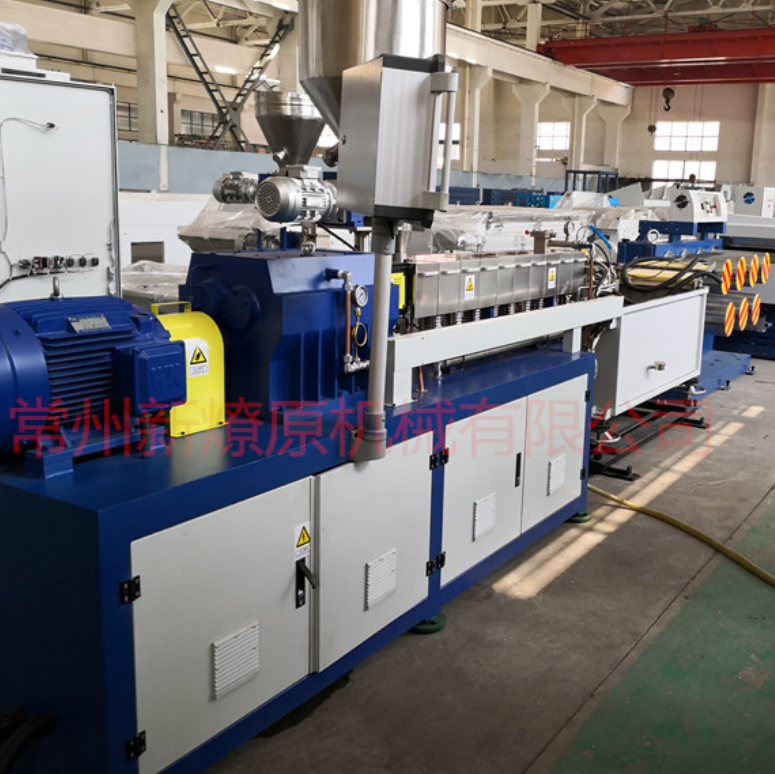
At Changzhou New Liaoyuan Machinery Co., Ltd. (NLY), our extrusion lines feature cantilevered multi-roll godet stands driven by individual AC servo motors, closed-loop digital thermal controls, and custom-engineered hot water and hot air heating units. This engineering precision ensures stable draw ratios, tight diameter tolerances, and high tenacity production for PET, PA, PP, and HDPE monofilaments.
Explore our line configurations and review technical parameters for your target resin by visiting our guide on the complete cooling, stretching, and winding process. For tailored technical advice or line custom-engineering, contact NLY’s process engineering team today.