In continuous plastic monofilament manufacturing, few operational events cause more frustration than frequent filament snapping. Whether you are producing high-tenacity PET zipper monofilament, Nylon fishing line, HDPE agricultural netting, or PP broom bristles, a single snapping strand in a multi-end array creates an immediate domino effect. Operators must stop take-up units, re-thread individual ends through godet stretching rollers, clear wrapped rollers, and purge scrap resin—slashing overall equipment effectiveness (OEE) and driving up scrap costs.
Understanding why filament breaks during production requires looking at the continuous line as an interconnected physical system. A monofilament extrusion line relies on precise harmony across material conditioning, melt delivery, quenching, godet drawing, heat setting, and spool winding. When a strand snaps, the root cause is rarely an isolated machine failure; it is almost always a localized breakdown in tension, thermal history, or polymer integrity along the monofilament extrusion process.
This comprehensive plant-floor troubleshooting guide breaks down the primary causes of monofilament breakage across all six core production stages and provides actionable engineering solutions to maintain zero-break line stability.
1. Resin Conditioning & Moisture-Induced Hydrolysis
The foundation of monofilament tensile strength begins long before polymer enters the extruder hopper. For hygroscopic resins like Polyethylene Terephthalate (PET) and Polyamide (Nylon 6/66), moisture is the single most destructive variable in the plant.
The Hydrolysis Mechanism
When damp PET or Nylon pellets enter the heated barrel, water molecules instantly react with the molten polymer chains in a chemical process called hydrolysis. High temperature and pressure accelerate this reaction, severing the long polymer chains into shorter fragments. This drastically drops the resin’s Intrinsic Viscosity (IV) and average molecular weight. While the melted strand may still exit the spinneret die looking intact, its reduced molecular weight leaves it incapable of handling high mechanical tension downstream. As soon as the filament reaches the stretching godets, it snaps cleanly under load.
⚠️ Warning: Residual moisture limits for PET and Nylon extrusion are exceptionally tight. For PET monofilament, moisture must be maintained below 0.005 wt% (50 ppm) prior to extrusion. For Nylon 6/66, moisture exceeding 0.1% can reduce tensile strength by up to 60%, making PET PETG Nylon filament breakage extrusion issues virtually inevitable.
Polyolefin Moisture Issues (HDPE & PP)
While HDPE and Polypropylene (PP) are non-hygroscopic, surface moisture from high-humidity storage or damp calcium carbonate (CaCO3) fillers presents a different hazard. During melting, trapped surface water turns into high-pressure steam micro-bubbles. These bubbles freeze inside the cooling filament as internal micro-voids, creating structural weak points that fracture when stretched.
Preventative Action Plan
Desiccant Dryer Verification:Confirm desiccant dehumidifying dryers achieve a continuous dew point of-40°C (-40°F) or lower.
Moisture Testing: Implement a mandatory loss-on-drying or Karl Fischer titration test for every batch before loading hopper receivers. According to guidelines in The Dynisco Extrusion Processors Handbook, maintaining strict polymer drying limits is the single most cost-effective way to prevent melt instability.
Sealed Hopper Systems: Use insulated, sealed hopper loaders with hot-air blankets to prevent ambient air re-absorption during long production runs.
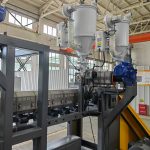
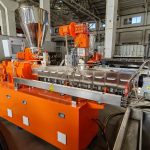
2. Melt Delivery, Degradation & Screen Pack Clogging
Once polymer enters the extruder, thermal and mechanical stability dictate strand uniformity. Inconsistency in melt pressure or melt temperature directly leads to downstream snapping.
Polymer Feed → Melt Filtration → Die Exudation → Quench Bath → Multi-Stage Drawing
Moisture / IV Filter Clogging Die Drool Thermal Shock Over-Drawing Hydrolysis Pressure Spikes Gels/Specks Turbulence Tension Snap
Melt Pressure Instability
A primary driver among monofilament breakage causes is cyclic melt pressure pulsation. As the screen pack in a manual screen changer gradually clogs with degraded polymer, gels, or raw material impurities, head pressure climbs steadily. If the screen changer is not serviced, or if the screw speed fluctuates, the melt pump or die receives a pulsating mass flow.
When melt pressure fluctuates, the extruded strand diameter surges and thins periodically. Thin spots carry lower cross-sectional areas, concentrating tensile stress during godet stretching until the filament snaps.
Thermal-Oxidative Degradation & Un-Melts
Thermal Hotspots: Excessive barrel zone temperatures or prolonged melt residence times inside dead corners degrade the polymer, generating hard carbon specks and gels. These inclusions do not stretch under draw tension and act as physical crack initiation sites.
Cold Un-Melts: Conversely, insufficient heat input or improper screw profile selection results in un-melted polymer crystalline cores. When an un-melted core passes through the die orifice, it creates an un-oriented lump that immediately fractures during godet drawing.
Pro Tip: Monitor upstream pressure trends closely. Upstream pressure stability is one of the most critical factors affecting monofilament quality. A rising pressure differential across the filter indicates it is time to cycle your continuous hydraulic screen changer before pressure spikes force gels through the spinneret.
Preventative Action Plan
Upgrade to Continuous Hydraulic Screen Changers: Replace manual breaker plates with dual-bolt continuous screen changers to eliminate line stops and pressure surges during mesh changes.
Calibrate Barrel Zone Heating: Conduct regular infrared thermal audits on barrel heaters and thermocouples to ensure actual melt temperatures match set-point recipes.
Optimize Screw L/D Ratio: Ensure your extruder utilizes a barrier screw with a high L/D ratio (such as 30:1 or 32:1) to guarantee thorough mixing and complete polymer homogenization.
3. Quench Bath Instability & Thermal Shock
After exiting the spinneret die, molten polymer strands enter the water quench bath to solidify. The quenching process sets the crystalline morphology of the un-drawn filament, making it a critical control zone for plastic extrusion line troubleshooting.
Thermal Shock and Spherulite Growth
The temperature of the quench water bath dictates whether the polymer solidifies into an amorphous state (ideal for subsequent drawing) or forms large, brittle crystalline structures (spherulites).
In PET and PP monofilament, quenching in water that is too warm allows large spherulitic crystals to grow. When these brittle crystals reach the stretching godets, they cannot undergo smooth plastic deformation and snap cleanly.
In Nylon monofilament, water that is too cold causes severe thermal shock, creating high frozen-in surface stress that leads to micro-cracking when tension is applied.
Water Flow Turbulence & Filament Ovality
Water movement inside the quench tank must remain perfectly laminar. High-velocity water inlets, fluctuating water bath levels, or air bubbles cause the delicate, molten strands to vibrate as they cool. This vibration distorts the filament cross-section from a true circle into an oval. Uneven oval cross-sections experience localized stress concentration on godet rollers, making it impossible to achieve stable filament diameter without triggering frequent breaks.
Laminar Water Flow → Uniform Cooling → Perfect Roundness → High Tensile Drawing
Turbulent Flow → Vibration → Filament Ovality → Localized Stress Snap
Preventative Action Plan
Closed-Loop Temperature Control:Install precision heat exchangers and digital temperature control loops to hold quench water temperature within±0.5°C of the target recipe.
Laminar Flow Diffusion Baffles: Equip the quench tank with submerged stainless-steel overflow weirs and flow diffusion plates to eliminate surface waves and water turbulence.
Adjust Die-to-Water Gap: Maintain a consistent distance (typically 20–50 mm) between the die face and the water surface to control melt-draw down before water entry.
4. Multi-Stage Godet Drawing & Over-Drawing Tension
The drawing (stretching) stage is where monofilament acquires its high tensile strength and orientation. Un-drawn monofilament is pulled through a heated medium (hot water bath, hot air oven, or steam chest) between differential-speed godet roller stands. Because mechanical tension is highest in this section, it is the most common location for snapping.
Exceeding the Maximum Draw Ratio Window
Polymer orientation obeys a strict physical draw window. The total draw ratio (DR = V draw / V haul-off) defines how far the polymer chains are stretched along the longitudinal axis.
Polymer Material | Typical Orientation Draw Ratio | Common Over-Draw Failure Symptom |
|---|---|---|
PET (Polyester) | 1:4.8 – 1:6.2 | High-speed snapping with fibrillated, split ends |
Nylon 6 / 66 | 1:3.8 – 1:4.5 | Surface micro-cracking and tension-drop snaps |
HDPE | 1:8.0 – 1:10.0 | Whitening (crazing) followed by abrupt snapping |
PP (Polypropylene) | 1:5.5 – 1:7.5 | Ovality flattening and snapping on roller guides |
If line operators push the draw ratio beyond the resin’s ultimate elongation limit—often in a misguided attempt to boost tenacity—polymer chains reach maximum strain hardening. Beyond this point, any minor surface scratch or temperature dip causes immediate monofilament drawing draw ratio snap.
Roller Speed Synchronization Drift
Multi-stage godet drawing relies on absolute speed stability between Godet 1 (haul-off), Godet 2 (primary draw), and Godet 3 (secondary draw). If an inverter drive experiences speed drift, or if mechanical slippage occurs on rubber-coated pressing rollers, the actual draw ratio surges unpredictably. Even a 0.5% sudden surge in roller ratio can snap a bank of filaments simultaneously.
Key Takeaway: Multi-stage drawing requires holding speed, tension, and thermal zones perfectly steady. Implementing precise multi-stage draw ratio control across every godet stand ensures smooth polymer orientation without exceeding maximum strain limits.
Preventative Action Plan
Verify Actual Ratio vs. Drive Readouts: Do not rely solely on HMI screen numbers. Use a precision optical tachometer to verify actual surface speeds (m/min) on all godet rollers.
Calibrate Hot Water / Hot Plate Temperatures: Ensure drawing tank water temperatures are maintained above the glass transition temperature (T g) of the polymer (e.g., 85–95°C for PET water bath drawing) to allow smooth molecular movement.
Check Godet Surface Integrity: Inspect godet roller surfaces for grooves, scratches, or polymer buildup. Smooth or re-chrome worn rollers to prevent friction snags.
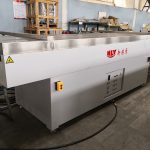
5. Heat Setting & Internal Stress Relaxation
After orientation, drawn monofilaments contain substantial residual internal stress. If monofilaments transition directly from high-tension drawing godets to winding units without stress relaxation, they become thermally unstable and prone to brittle snapping over time.
The Role of Relaxation Ovens
Heat setting (annealing) involves passing the drawn filament through a heated air oven or heated godet stand at a slightly reduced ratio ($DR < 1.0$, typically 0.92–0.97). This controlled relaxation allows polymer chains to relieve internal peak stresses while locking in dimensional stability and thermal shrinkage limits.
When the relaxation oven temperature is set too low, or if relaxation time is insufficient, internal frozen-in stresses remain trapped within the filament core. When the spooled filament later encounters ambient temperature fluctuations or bending on winder guide eyelets, the residual stress releases catastrophically, causing spontaneous brittle fractures.
Preventative Action Plan
Optimize Relaxation Ratios: Maintain a 3% to 7% over-feed (speed reduction) on the heat-setting godet stand relative to the final draw godet.
Uniform Hot-Air Circulation: Ensure hot-air relaxation ovens utilize high-velocity forced convection to maintain even thermal exposure across all running strands.
6. Take-Up, Winder Tension & Contact Friction
The final stage of the monofilament production line is take-up winding. Because monofilament lines often run dozens or hundreds of individual strands side-by-side, winder performance dictates final package build and operational continuity.
Extruder → Quench Tank → Godet Drawing → Heat Setting Oven → Guide Eyelets → Spool Winder
Friction Grooves Tension Spikes
High Winding Tension & Guide Abrasion
Excessive winding tension stretches the monofilament after it has already cooled, inducing cold-draw stress that weakens the strand on the spool. Furthermore, as monofilament travels at high speeds (often 100 to 300+ m/min) across guide eyelets, traverse guides, and ceramic oiling rollers, high friction generates localized heating.
Over months of operation, abrasive filaments (especially pigmented or titanium-dioxide-filled resins) carve sharp micro-grooves into ceramic guides. When a running strand slips into one of these sharp grooves, the guide acts like a blade, scoring the filament surface until it snaps at the winder.
Preventative Action Plan
Inspect and Replace Ceramic Guides: Conduct routine monthly inspections of all ceramic eyelets, pigtail guides, and traverse oiling rollers under magnification. Replace scored guides immediately.
Utilize Torque-Controlled Auto-Winders: Deploy individual torque-motor or servo-driven tension winders that automatically reduce winding torque as the spool diameter builds, maintaining constant filament winding tension (cN).
Plant-Floor Diagnostic Checklist: Quick Failure Isolation
When filament breakage occurs on your line, use this rapid isolation matrix to identify the root cause and execute corrective action:
Break Pattern / Location | Most Likely Cause | Primary Plant-Floor Check | Corrective Action |
|---|---|---|---|
Random snaps inside extruder die or right after die exit | High moisture / severe hydrolysis or heavy contamination | Dryer dew point & melt filter pressure differential | Verify dryer dew point (-40°C); cycle continuous screen changer |
Bubbles, voids, or popping noise in quench tank | Trapped moisture or volatile additives in raw material | Inspect raw resin moisture content (ppm) | Dry resin to spec (<0.005% for PET; <0.05% for Nylon) |
Strands vibrating; uneven roundness / ovality in water bath | Water turbulence or inconsistent bath temperature | Quench water level, flow velocity, and bath temp | Adjust flow baffles for laminar flow; hold water temp within ±0.5°C |
Frequent snapping inside hot water draw tank | Draw ratio too high or water temperature below T g | Optical tachometer speed ratio & water bath temp | Increase water bath temperature; reduce godet speed ratio slightly |
Filament splitting / fibrillating during high-speed drawing | Over-drawing or thermal oxidation from extruder hotspots | Godet surface speeds & extruder temperature profile | Lower final draw ratio; calibrate barrel zone heating thermocouples |
Snapping directly at winder traverse or guide eyelets | Excessive winding tension or grooved ceramic guides | Inspect ceramic guide surfaces & winder tension | Replace worn ceramic eyelets; lower winder torque set-point |
Optimizing Your Extrusion Line for Zero-Break Production
Eliminating filament breakage requires viewing your production line not as a collection of standalone machines, but as a fully integrated thermal and mechanical system. From precise desiccant drying and melt pressure control to synchronized multi-stage godet drawing and low-friction winding, every component plays an indispensable role in maintaining strand integrity.
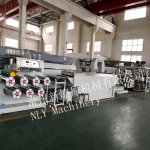
Investing in high-performance equipment designed specifically for processing stability is the ultimate preventative measure. Changzhou New Liaoyuan Machinery Co., Ltd. (NLY) has spent over 30 years engineering turnkey plastic monofilament extrusion lines optimized for precision diameter control, energy efficiency, and high-speed drawing stability. Whether you are running PET, Nylon, HDPE, or PP monofilaments, NLY’s custom-engineered extruders, continuous hydraulic screen changers, and multi-stage drawing systems deliver the process consistency required for zero-break industrial production.
Explore how upgrading to a modern, fully synchronized monofilament drawing line can eliminate unplanned downtime, lower scrap rates, and boost your plant’s profitability. Contact NLY’s engineering team today for a technical line consultation or customized Factory Acceptance Test (FAT) evaluation.