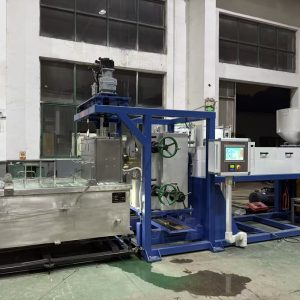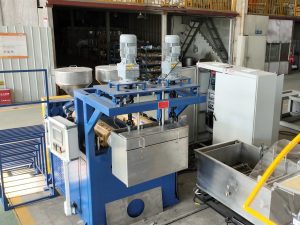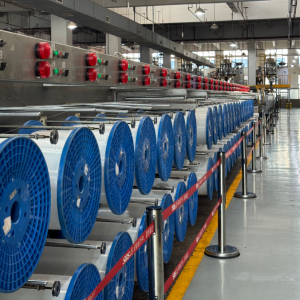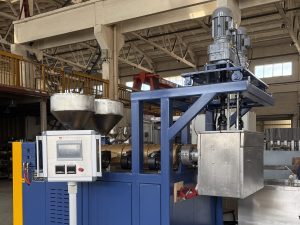
Two manufacturers send you a quote for a monofilament extrusion line. The specifications look almost identical — same screw diameter, same number of draw stages, similar price. Eighteen months later one line holds diameter tolerance shift after shift, and the other has become a permanent troubleshooting project.
The difference rarely shows up in the brochure. It shows up in whether the manufacturer can demonstrate, with evidence, that it has built and supported a line for your polymer, your diameter, and your end-use. Judging that is a different exercise from comparing machine specs.
This guide gives you a framework for doing it: define four inputs, convert them into line requirements, then score each manufacturer’s evidence against those requirements.
Define Four Inputs Before You Talk to Anyone
Manufacturers can only quote what you describe. Vague inquiries get vague answers — and vague answers are how buyers end up comparing incomparable proposals.
Write down four things first.
Polymer. PA6, PA66, PET, PP, or HDPE, and whether it’s virgin, recycled, or a blend. These are not interchangeable. PET typically needs high-temperature drying and often two draw stages; nylon is strongly moisture-sensitive and will foam or void if resin conditioning is inadequate; polypropylene is more forgiving but usually runs a looser dimensional window. A recycled blend adds filtration and wear considerations that a virgin-resin quote will not include.
Finished diameter and tolerance. Both the target and the band you must hold. The tolerance you accept drives how much control the line needs — continuous laser measurement with closed-loop correction is a different quote from periodic manual checks.
Output in kg/h. Not a nominal maximum. Output at your polymer, your diameter, and your tolerance.
End-use application. Brush and bristle filament, zipper monofilament, fishing line, ropes and nets, and industrial mesh each push the configuration in different directions.
Key Takeaway: Every line requirement you evaluate later traces back to these four inputs. Define them in writing before the first technical conversation — it’s the hour that decides how useful every later comparison will be.
Convert Your Inputs into Line Requirements
With the four inputs fixed, you can turn them into a specification you can hold a manufacturer to. The table below shows the elements that matter and the range industrial lines typically operate in. Treat these as reference points for the conversation, not as targets to accept unexamined.
Line element | Typical industrial range | What drives it |
|---|---|---|
Screw L/D ratio | 24:1–30:1 recommended for monofilaments, commonly 28:1–33:1 in practice | More length buys melting and homogenization margin; harder or moisture-sensitive polymers need the upper end |
Screw geometry | Barrier or mixing screw on demanding polymers; standard screw on easier ones | Barrier geometry limits unmelted particles that later appear as gels or breaks |
Draw stages | One or two; two is standard for PET-type products | Orientation and tenacity vs. synchronization burden |
Total draw ratio | Roughly 1:4.5 to 1:6.5 for many products | Higher draw raises strength but narrows the stable window |
Quench draw-down | Die diameter to filament diameter of about 4:1 to 10:1 | Cooling must freeze the filament consistently before drawing |
Hot water tank | Roughly 3,000–6,000 mm | Pre-draw residence time; longer for heavier denier |
Hot air oven | Roughly 4,000–6,000 mm | Second draw and heat-setting |
Winding | Station or multi-position, often modular | Strand count, line speed, package format |
For a closer look at the extrusion section itself, see this guide to monofilament extruder machine specifications.
Why Output Must Be Specified at Your Polymer and Tolerance
A capacity number on its own means very little. Line capacity is a function of screw size, draw synchronization, cooling capacity, and how tightly you need to hold diameter — so the same machine shows two very different production figures depending on what you ask it to make.
When a proposal states “up to 250 kg/h,” the only useful follow-up is: at which polymer, which diameter, and which tolerance? Ask for the guaranteed figure at your conditions, in contract language rather than in the cover email. DuPont’s Hytrel extrusion manual makes a related point about the quench zone — the draw-down ratio between die and filament governs whether the line can hold a consistent result at all, which is exactly what limits real output.
What Changes When Your End-Use Changes
End-use is the input buyers underestimate most. Brush filament needs consistent bending behavior and a clean surface. Zipper monofilament needs dimensional precision. Rope and net filament needs tensile strength, which means higher draw. Industrial mesh filament often needs tight ovality across many strands at once, which is why high-end mesh lines use dual-axis laser measurement after annealing with closed-loop correction of pump speed or godet velocity. The industrial mesh filament line configuration write-up walks through that arrangement.
If a manufacturer’s proposal doesn’t change when you change the end-use, that’s a signal about how the quote was assembled.
Read the Manufacturer’s Capability, Not the Brochure
The question to hold in mind through every conversation: can this factory design, build, test, and support a machine for my product, or is it assembling a generic line from a catalogue?
Your four inputs become the ruler. A manufacturer with genuine competence in your application answers configuration questions with reasons, challenges assumptions that conflict with physics, and volunteers tradeoffs. One selling a catalogue line answers in features.
Ask for an evidence pack before technical discussions go far. A capable builder has these ready; a weak one stalls.
Business registration and the actual factory address
ISO certificate number and issuing body
Critical-component traceability records for similar lines
Machining and assembly evidence — photos or a live video walkthrough
Written change-control procedure for component substitution
Drawings, electrical documentation, and software backups supplied at handover
References for comparable projects, with material and output stated
Item five matters more than most buyers expect. If a supplier can substitute a gearbox, heater, or drive component after the order without written approval, the acceptance test you signed off no longer describes the machine you receive.
Then ask the question that exposes the most: what L/D ratio and screw geometry do you propose for my polymer, and why?
A manufacturer that has run your material will explain the melting and homogenization requirement, the residence-time tradeoff, and the wear implication if you’re feeding recycled resin. BASF’s guidance on monofilament processing points to an L/D window in the 24–30 range for monofilaments, which gives you a reference point for judging whether an answer is grounded or improvised.
Check References That Actually Match
A logo wall is not a reference. You need a customer running your polymer, at your diameter range, at comparable output, on a comparable configuration.
Ask three follow-up questions per reference: what material they run, what tolerance they hold in daily production, and how quickly the manufacturer responded the last time they had a breakdown. The third question predicts your experience, and it’s the one suppliers are least prepared for.
Where possible, verify independently — a short video call with the reference plant, or a running video of the line at production speed rather than a marketing clip.
Spares, Service, and Warranty: Where Cheap Lines Get Expensive
Downtime cost is asymmetric, and the spares list is where that asymmetry is either managed or ignored. A stocked proportional valve is a four-hour repair; the same valve unstocked can mean a full-line stoppage measured in weeks. That comparison comes from spare parts inventory planning data for plastics machinery, and it’s why spares should be negotiated rather than requested.
Ask for a list separating two categories: critical spares (melt pump, gearbox, control board, drives, motors — proprietary and long-lead) and wear parts (screw, barrel, screen packs, seals, thermocouples, heater bands — consumable and predictable). Then get maximum lead times in writing for each proprietary item, plus the minimum stockholding the supplier commits to.
Support needs its own questions. How fast is a fault acknowledged, how fast does remote troubleshooting start, and — as a separate commitment — how fast does a technician arrive on site?
What to Read in the Warranty Clause
Duration is the least informative part of a warranty. Machinery warranties commonly run twelve months from commissioning or eighteen months from shipment, whichever comes first, so identify which trigger applies to you; a long shipping and installation period can consume a meaningful share of the coverage.
Then read four more things: what is excluded (heater bands, thermocouples, seals, and consumables usually are), whether labour, travel, and freight are covered or billed back, what evidence a claim requires, and how short the written-notice window is. A warranty with broad exclusions and a five-day notice requirement is worth less than its stated duration suggests.
Write the FAT Protocol Before You Sign
The factory acceptance test is your last chance to correct problems at the manufacturer’s expense, on the manufacturer’s floor. Buyers who leave the protocol to the supplier usually get a functional demonstration instead.
A FAT is properly a contractual obligation built from an inspection and test plan agreed by both sides: which tests run, to what standard, with what measurement equipment, in what sequence, and who signs off at each stage. Inspection specialists such as Sinospect’s guide to factory acceptance testing describe it that way for good reason — an unwritten test has no pass/fail criteria to enforce.
For a monofilament line, acceptance criteria should be filament-specific:
Criterion | What acceptance looks like | How it’s measured |
|---|---|---|
Diameter | Inside the agreed band for the full run at rated speed | Continuous laser gauge after the stabilizing stage, plus micrometer spot checks |
Ovality | Below the agreed limit across the run | Rotate the filament 90° between measurements at each sample point |
Process stability | No unexplained excursions at rated speed | Trend review of melt pressure, haul-off speed, quench temperature, tension synchronization |
Surface | No gels, specks, burns, scratches, or bubbles | Visual inspection across sampled length |
Mechanical | Tensile and elongation inside the agreed range | Agreed test method for the polymer and end-use |
Package | Consistent bobbin build and weight | Visual plus weight check |
Tolerance is a negotiated number, not an industry constant. Tightly controlled fine monofilament is specified in the region of ±0.005–0.020 mm, roughly ±1–3% is a common industrial target, and heavier-denier commodity products run looser. Set the number against your downstream requirements and write it into the protocol.
⚠️ Warning: Two shortcuts void the test. Running the machine empty proves nothing about loaded performance. And testing on the supplier’s perfect virgin resin proves nothing if production will use a recycled blend — ship your actual material to their facility.
Red Flags and Deal-Breakers
Some of these are fixable in negotiation. Others should end the conversation.
Red flag | Why it matters |
|---|---|
Scope not itemized as Included / Optional / By Buyer | The usual route from a low quote to an over-budget project |
One-line pricing with no breakdown | Makes scope comparison across suppliers impossible |
“Standard warranty” with no start date or exclusions | Unenforceable in practice |
No spares list and no lead-time commitment | Your downtime is priced by someone else’s stock room |
Output stated as a nominal maximum only | You can’t tell what the line will do on your product |
No drawings or inspection evidence for precision parts | Nothing to verify against at acceptance |
Pro Tip: Send every shortlisted manufacturer the same written requirement sheet and the same FAT protocol, and ask each to mark every line item as included, optional, or buyer-supplied. The comparison becomes objective overnight.
How to Compare and Decide
Score each manufacturer against your own requirements, then weight by what actually hurts your plant. A workable weighting for most projects:
Evaluation area | Suggested weight | What you’re scoring |
|---|---|---|
Configuration fit for your polymer, diameter, and end-use | 30% | Whether the proposed line is engineered for your product |
Demonstrated references in comparable applications | 20% | Whether the process has been solved before |
FAT quality and agreed acceptance criteria | 20% | Whether claims are verifiable before shipment |
Spares, service response, and lead times | 20% | How quickly you recover from a failure |
Warranty coverage and claim terms | 10% | Who pays when something goes wrong |
The sequence matters as much as the weights: shortlist on capability, eliminate on red flags, then negotiate price within the surviving set. Buyers who price first end up doing the technical evaluation after the order — which is to say, not at all.
A manufacturer with decades of line-building experience and a broad installed base — Changzhou New Liaoyuan Machinery (NLY) has been building monofilament extrusion machinery since 1989, holds ISO 9001:2008 and CE certification, and supports customers across more than twenty countries — will answer the configuration question from experience rather than from a template. Capability, not longevity, is the deciding factor, and the only way to test it is with questions your product can answer.
Next Steps
Send your four inputs — polymer and resin condition, target diameter with tolerance, guaranteed output, and end-use — to the manufacturers on your shortlist, along with your draft FAT protocol. Ask for a line configuration proposal, a marked-up scope list, and a spares and lead-time commitment.
You can request a line configuration and FAT plan from NLY for your specific polymer, diameter range, and output target, and compare it against the framework above. For a walk-through of how each stage behaves in production, the step-by-step monofilament extrusion process is a useful reference to keep open during the technical review.