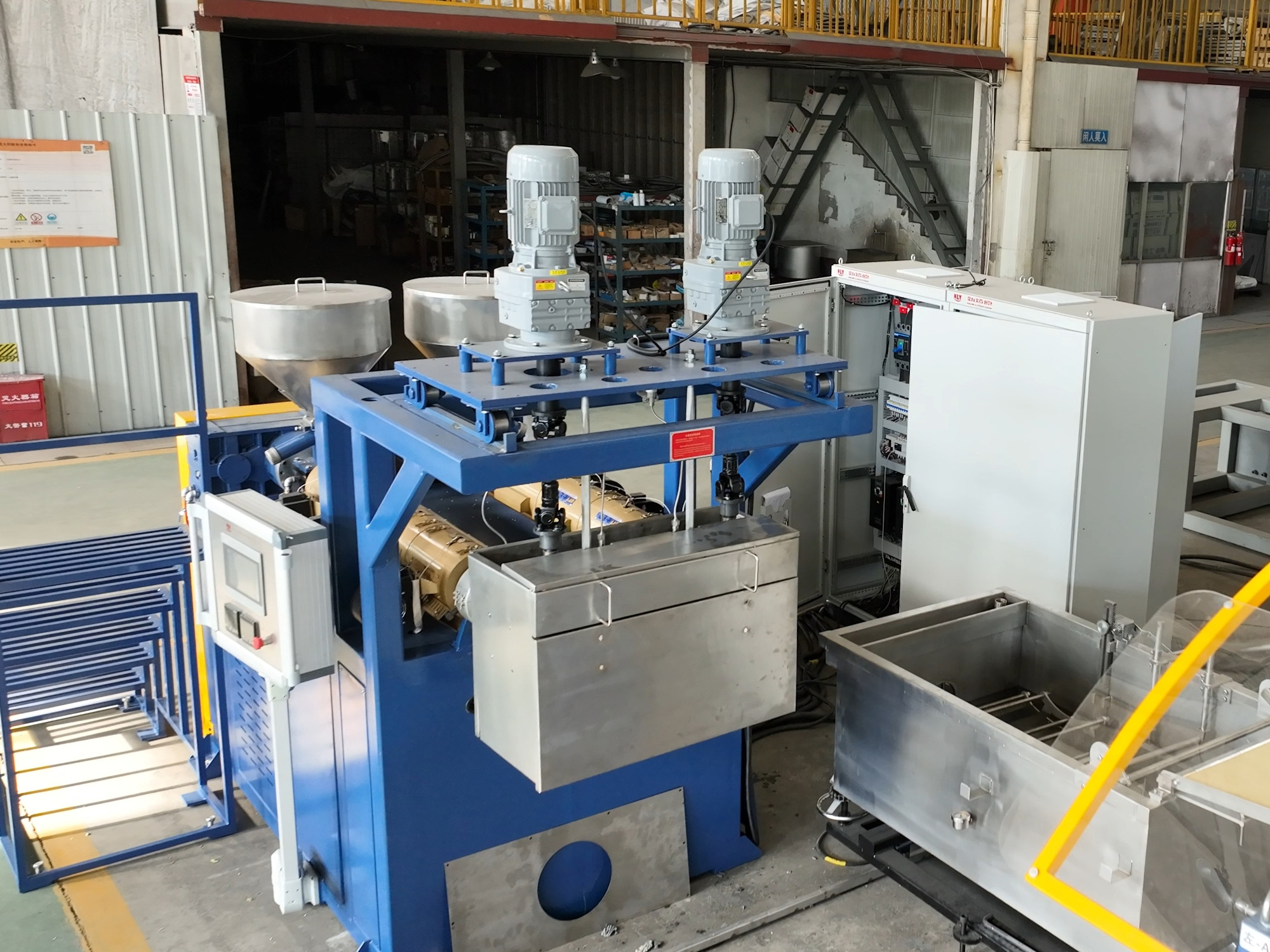
You’ve probably seen it on the line: the filament runs true for two hours, then the diameter starts walking, ovality creeps in, bubbles show up in the draw bath, and breaks follow. Extrusion temperature sits behind all four defects, but not as a single setpoint you can nudge. Melt temperature is the actual polymer temperature at the die, melt pressure is the resistance the melt meets as it moves, residence time is how long any given pellet spends hot, draw ratio is how far the filament is stretched after quenching, and quench is the water or air bath that freezes the structure you just formed. Treat those as one coupled system and extrusion temperature monofilament quality becomes predictable rather than luck. Published processing guides give polymer-specific ranges and control targets for exactly this reason, and this guide works through them so you can decide what to change, and what to leave alone.
This article is published by Changzhou New Liaoyuan Machinery Co., Ltd. (NLY), a manufacturer of monofilament extrusion machines founded in 1989. For more than 30 years the company has designed and produced complete extrusion lines, with continuous R&D in monofilament technology and in-house design and engineering services. That work on extrusion equipment and filament diameter control is the basis for the guidance given here.
What Extrusion Temperature Actually Controls in Monofilament Quality
Extrusion temperature monofilament quality is not one number on a controller. It is a chain of coupled stages, and every defect you see at the winder has an upstream temperature signature you can trace backwards.
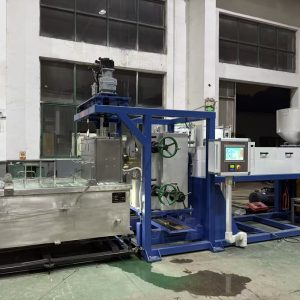
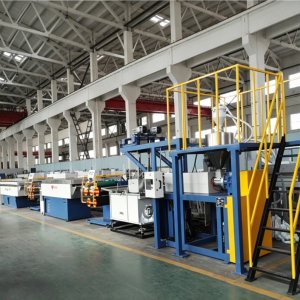
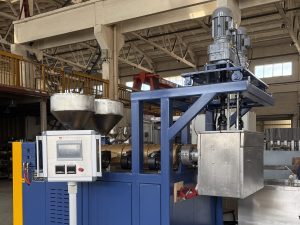
Think of the line as links: hopper, four to six barrel heating zones, adapter and die zones, melt pump, quench trough, godets, winder. Temperature in the barrel and die sets melt viscosity. Viscosity sets melt pressure, the pressure the molten polymer carries as it leaves the extruder, and residence time, how long the polymer stays hot before it exits. Those two set throughput and as-spun diameter. The quench and draw stages then convert that diameter into final diameter, ovality, strength and surface finish.
The chain is why a small drift travels. When barrel zone 3 runs 8 °C above setpoint, the viscosity drop shows up as a diameter excursion two stages later, not at the barrel.
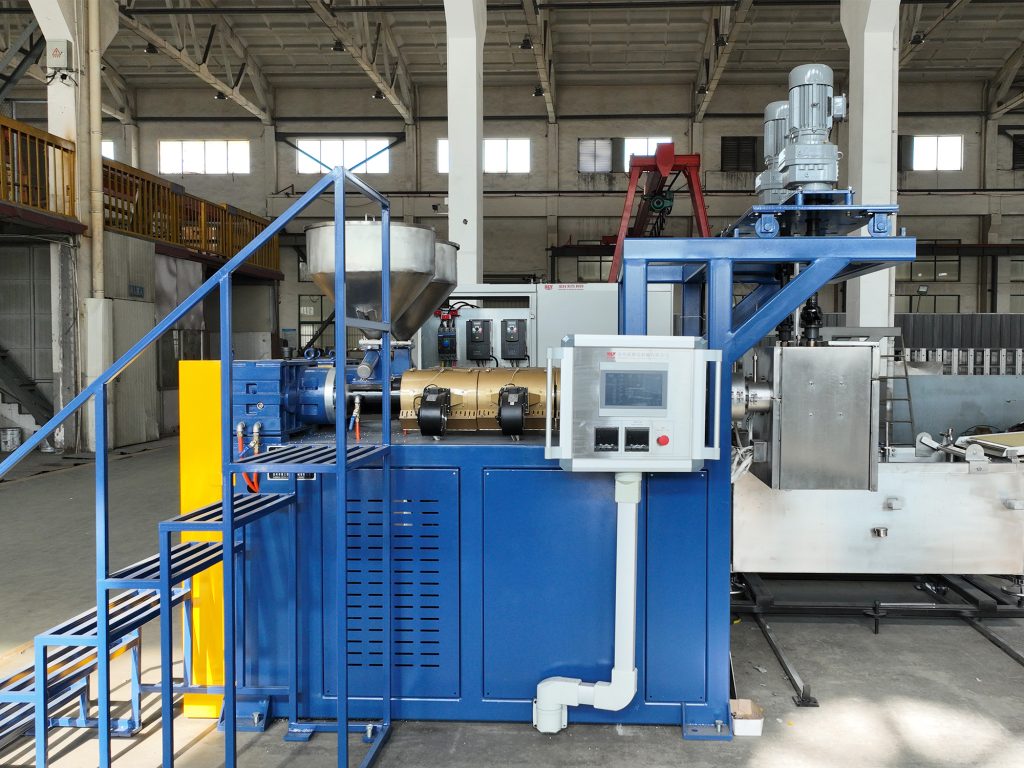
NLY’s troubleshooting map that links each defect back to a temperature variable sets out the coupling: melt stability governs diameter and surface, quench governs ovality and internal stress, draw-zone temperature governs strength against elongation, and annealing governs shrinkage. Their guide to how a monofilament extrusion line holds a temperature profile end to end notes that a typical line uses about four to six barrel zones plus adapter and die zones, and that the number worth specifying is the actual variation during production, not the displayed setpoint.
That is the monofilament extrusion temperature profile: a chain of controlled points, each one feeding the next.
The Temperature Window: Where Quality Lives and Where It Breaks Down
Every polymer has a melting floor and a degradation ceiling, and monofilament quality is lost at both ends. The polymer degradation temperature window sits between them, and it is narrower than most operators assume.
PA6 melts at roughly 220 °C and PA66 at roughly 260 °C, with typical extrusion melt temperatures of 240–270 °C for PA6 and 275–295 °C for PA66 (the melt points and typical melt targets for PA6 and PA66, 2026). PET is tighter still: it must stay above its 255–260 °C melting range but below about 285 °C, above which thermal degradation and acetaldehyde formation accelerate (a full PET monofilament process guide with zone-by-zone setpoints, 2026).
Those are boundaries, not setpoints. Published per-polymer barrel starting ranges put PA6 at 220–230 °C feed, 240–260 °C transition, 250–270 °C metering-to-die; PA66 at 240–250 / 260–275 / 265–285 °C; PET at 240–250 / 255–275 / 265–285 °C; and PP-PE at 180–200 / 210–230 / 220–245 °C. The same source presents them explicitly as engineering starting ranges rather than universal production standards, because the working value is set by the grade, the additive package and the line.
⚠️ Warning: A barrel setpoint is not a melt temperature. The controller display shows what the heater is trying to hold, not what the polymer is actually at when it reaches the die.
Why Temperature Uniformity Matters More Than the Setpoint
A correct average melt temperature with a non-uniform profile still produces ovality, roughness and gauge spread, because melt temperature diameter consistency depends on the profile across the die, not on the number on the controller. Gradients across the die melt change local viscosity and the velocity profile, so the strand exits with a non-uniform shear and thermal history (the die-flow study on why temperature uniformity, not just average temperature, sets the cross-section).
Line-control guidance puts numbers on that requirement: barrel and die temperature stabilised within ±1 °C to avoid viscosity-induced, surging-driven diameter variation, and die exit pressure within ±0.5 bar to keep melt delivery consistent (the control tolerances a line has to hold to stay in spec). Those two figures are recommendations from vendor engineering documentation, not measured experimental results. A melt gear pump that holds volumetric output within ±0.5 % supports the same goal, and is described as vital for tight diameter tolerance (how a monofilament extrusion line holds a temperature profile end to end).
How Temperature Errors Show Up as Diameter, Ovality and Surface Defects
You can usually narrow a monofilament defect to one temperature variable before you touch a setpoint. The symptom itself is the clue: what changes, and when it changes, points to a specific stage of the line.
Symptom | Most likely temperature-related driver | First check |
|---|---|---|
Diameter drifts over minutes to hours | Cooling-water instability at the quench | Quench water temperature and flow stability |
Oval, flattened cross-section | Uneven cooling across the filament | Quench bath zoning and independent temperature control |
Diameter variation beyond ±2 % | Line can no longer hold tolerance under normal load | Real-time laser gauging with closed-loop puller feedback |
Rough, cloudy surface | Die-exit temperature imbalance contributing to build-up | Die exit temperature and die design |
The table above reflects a troubleshooting map that links each defect back to a temperature variable, which pairs each symptom with the stage most likely to cause it.
For melt temperature diameter consistency, the ±2 % threshold is the practical line: beyond it, the line can no longer reliably hold tolerance under normal load. Real-time laser gauging with closed-loop puller feedback corrects deviations in under 100 ms, enabling ±5 µm control above 200 m/min, and multi-zone quench baths with independent temperature control prevent oval cross-sections from differential shrinkage, per the control tolerances a line has to hold to stay in spec.
Quench water temperature monofilament defects follow the same logic: ovality that shifts with water temperature or flow points to the quench stage rather than the barrel.
Not every defect is thermal. Contamination, worn screws and moisture are not temperature causes, and die drool is a processing-condition and die-design phenomenon, so temperature imbalance at the die exit is a contributing cause rather than a purely mechanical defect, as the SPE study on processing conditions and die drool describes.
Setting the Quench and Draw Temperatures That Lock In the Result
Quench water temperature in monofilament production is the variable that decides whether a correctly melted polymer becomes a strong, round filament or a cloudy one that snaps in the bath. For PET, the quench bath is held at 15–25 °C; above roughly 35 °C, slow cooling lets spherulitic crystallization develop, which makes the filament cloudy and brittle and causes breakage during stretching, according to a full PET monofilament process guide with zone-by-zone setpoints. Across polymers, the same source family puts the bath at 30–50 °C overall, with PET at 35–50 °C, PA66 at 30–45 °C and PP at 25–40 °C, as described in how a monofilament extrusion line holds a temperature profile end to end.
Draw temperature then fixes the molecular orientation the quench left available. PET monofilament is drawn in two stages: a first-stage hot-water draw of 1:2.5–1:3.5 at 75–95 °C, reaching a total draw ratio of 1:4.8–1:6.2 after the 160–210 °C hot-air stage, per the draw-ratio and hot-draw stages in the PET process guide. That sequence is not arbitrary. A slow, staged quench from an amorphous precursor followed by hot drawing is the standard route to high-tenacity PET monofilament: first-stage pre-draw just above Tg in hot water, second-stage orientation in hot air, then annealing, as documented in the staged quench-and-hot-draw route to high-tenacity PET. Quench and draw are one coupled setting, and the barrel only feeds it.
Pro Tip: Do not adopt a single PET quench setpoint. The correct bath temperature is line- and filament-specific, so treat any published range as a starting window to be tuned on your own line.
Moisture, Drying and the Temperature Interaction That Causes Bubbles and Breaks
Water in the polymer is a temperature-coupled defect, not a separate one. The same barrel profile that runs clean on dry resin produces voids, brittle filament and breaks in the drawing bath on wet resin, because absorbed water flashes to vapour at melt temperature and, in polyamides and polyesters, also drives hydrolytic degradation: chain scission that permanently shortens the molecule while it sits in the barrel. That is why the fix for bubbles is often a dryer setting rather than a heater setting.
The drying targets and moisture limits before the resin reaches the barrel published by NLY put numbers on the window. PA6 and PA66 need desiccant drying at 80–100 °C for 4–6 h to below 0.05 % moisture; PET needs 160–170 °C for 4–6 h to below 0.02 %, with a dryer dew point of −40 °C or lower. PP and HDPE need no pre-drying unless you are running regrind or a moisture-sensitive masterbatch.
⚠️ Warning: Drying temperature is itself a temperature window. Too low leaves moisture in the resin; too high oxidises it.
Holding the Window in Production: Measurement, Logging and Control Targets
Melt temperature diameter consistency is not something you can hold by watching a controller display. It becomes provable only when setpoint, actual temperature, line speed and diameter are logged together at fixed intervals, and when a bath or zone is allowed to stabilise before anyone judges a change successful, the logging practice that makes a temperature change provable (NLY, PET Monofilament Production technical guide, retrieved 2026-08-17).
That record matters because the useful specification is not the setpoint at all. It is the actual temperature variation the barrel holds during continuous production, which is why the zone-count and variation logic behind a monofilament extruder specification is written around sustained behaviour rather than a single reading (NLY, PET Monofilament Production technical guide, retrieved 2026-08-17).
What to log | Interval | Deviation that triggers a check |
|---|---|---|
Barrel zone setpoint vs. actual | Fixed interval, every zone | Any sustained gap between the two |
Melt temperature at the die | Fixed interval | Drift beyond the control tolerance |
Line speed | Fixed interval | Any change not matched by a diameter response |
Diameter | Fixed interval | Movement outside the acceptance target |
Quench bath temperature | Fixed interval | Change not yet stabilised |
Two published targets frame the table. The diameter tolerance a PET line is specified to hold is ±0.005 mm, achieved through a closed-loop laser gauge and tension control, stated as an acceptance target rather than a measured result (NLY, PET Monofilament Production technical guide, retrieved 2026-08-17). The control tolerances a line has to hold to stay in spec are ±1 °C and ±0.5 bar (NLY, How Does a Monofilament Extrusion Machine Produce Industrial Mesh Filament, retrieved 2026-08-21). Neither source publishes the test method or sample size behind those figures, so treat them as specification targets to design your logging around, not as results to expect on the first run.
Frequently Asked Questions
What is the ideal extrusion temperature for monofilament?
There is no single value, because extrusion temperature monofilament quality depends on the polymer. Published barrel melt starting ranges are PET 270–295 °C, PA66 275–295 °C, and PP 210–250 °C (the per-polymer barrel starting ranges, retrieved 2026-08-21). The working value sits between that grade’s melting floor and its degradation ceiling.
Why does my monofilament diameter drift even when the temperature is on setpoint?
Because the setpoint is an average, and the cross-section responds to the distribution. A die-flow study on why temperature uniformity, not just average temperature, sets the cross-section shows uneven zone temperatures change local viscosity, and therefore local flow. Hold barrel and die within about ±1 °C and die exit pressure within ±0.5 bar for stable melt temperature diameter consistency. If drift persists, check quench water temperature monofilament stability next.
Can I fix ovality by changing the barrel temperature?
Usually not first. Ovality is a quench-stage symptom: differential shrinkage across the cross-section as the filament cools unevenly, so multi-zone quench control is the primary lever. The barrel and die tolerance of roughly ±1 °C is the secondary check, since a cold barrel zone leaves the melt entering the die already uneven.
What happens if the melt temperature goes too high?
You cross the polymer degradation temperature window and start losing the material itself. Above roughly 285 °C, PET thermal degradation and acetaldehyde formation accelerate, so chain scission lowers viscosity and melt delivery becomes unstable (a full PET monofilament process guide with zone-by-zone setpoints, retrieved 2026-08-21). The ceiling is set by the polymer, not by what the line can reach.
Does extrusion temperature matter for PP and HDPE monofilament?
Yes, and the window sits lower than for PET or PA66. HDPE (PE100) runs 170–190 °C feed, 190–210 °C compression, and 210–230 °C metering, with die body 215–230 °C, die lip 220–235 °C, and a target melt of 190–230 °C; PE80 shifts each zone down about 10–15 °C (the polyolefin version of the same rising profile, 2026-04-04). Polyolefins need no pre-drying unless regrind is in the blend, so temperature control is the dominant variable.
Conclusion
Extrusion temperature sets monofilament quality through a coupled chain, not a single number. The window defines where the polymer flows and solidifies predictably; uniformity across barrel, adapter, die and pump decides whether that window holds along the whole line; quench and draw temperatures lock in the diameter and structure the melt leaves behind; moisture control keeps bubbles and breaks out of the picture; and logging turns all of it into something you can see drifting before the product does. Consistency beats any setpoint you can write on a card.
If you want to move from mechanism to your own line, the practical next step is a low-commitment one: a line configuration review, a sample run on your material, or a FAT plan discussion. Bring your current temperature profile and your defect data, and the conversation starts from what your line is actually doing.