In plastics manufacturing, “extrusion” is one of those words people use every day, but it’s easy to talk past each other.
A maintenance manager may hear “extrusion problem” and think about heater bands or motor load. An engineer may think about melt viscosity and die pressure. A production supervisor may just see the same symptom: dimensions drifting, surface defects, or scrap piling up.
This article gives a practical definition of extrusion, then explains why the process matters and what happens in a typical extrusion line.
The meaning of extrusion (in plastics)
Extrusion is a continuous manufacturing process where a material is forced through a shaped tool (a die) to create a long product with a consistent cross-section.
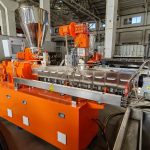
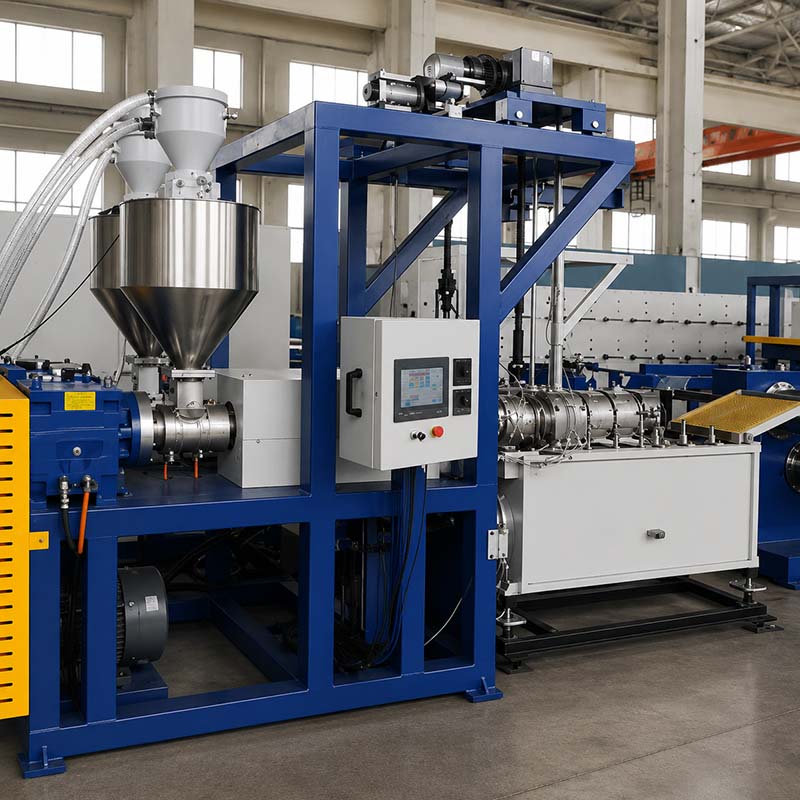
For plastics, plastic extrusion means you feed solid thermoplastic (usually pellets or granules) into an extruder machine, melt and pressurize it, then push that melt through an extrusion die to form a continuous shape.
A widely used technical definition comes from The Welding Institute (TWI) in its plastics extrusion FAQ, which describes extrusion as a high-volume, continuous process that melts polymer and forms it into a profile.
Why extrusion matters in manufacturing
Extrusion is built for steady output and repeatable dimensions. Most extrusion products only work if their cross-section stays within tolerance.
Examples:
Pipe and tubing need stable OD/ID and wall thickness.
Profiles (trim, frames, seals) need stable geometry to fit assemblies.
Film and sheet need thickness uniformity.
Filament and monofilament need stable diameter and surface quality.
Extrusion is also a foundation process. Once you can make a stable “base shape,” you can add downstream steps (calibration, printing, stretching/drawing, winding) to meet final specs.
How plastic extrusion works (step-by-step, in plain terms)
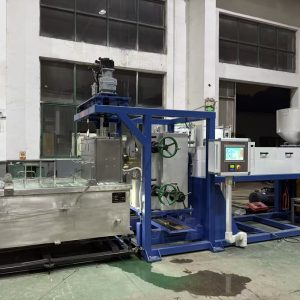
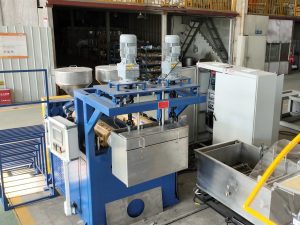
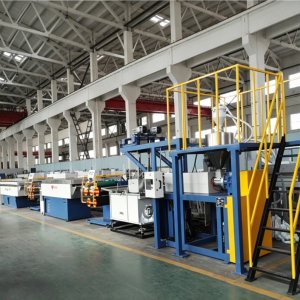
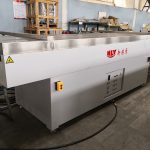
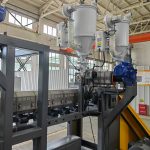
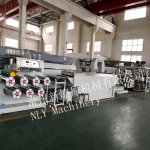
A typical extrusion line is a system: the extruder creates a stable melt flow, the die creates the shape, and the downstream equipment locks in dimensions.
1) Feed: resin enters through the hopper
Plastic pellets, granules, flakes, or powder drop through a hopper into the feed throat.
Some materials (especially moisture-sensitive resins) are dried before feeding. If moisture enters the barrel, you can see bubbles, rough surface, and unstable output.
2) Melt + convey: the screw and barrel turn solids into a stable melt
Inside the heated barrel, a rotating screw conveys material forward.
Heat comes from:
barrel heaters (external heat)
shear/friction created by screw rotation and material compression
Many lines use a single screw extruder with three functional zones (feed → compression/transition → metering). In practice, the point is simple: the extruder is doing three jobs at once, melting, mixing, and building pressure.
3) Condition the melt: screen pack and breaker plate (when used)
Before the die, many lines use a screen pack supported by a breaker plate.
This filters contamination and creates back pressure that can improve melt uniformity.
4) Shape: the melt is pushed through the extrusion die
The die is the precision tool that sets the profile.
Different dies create different product families:
annular dies for pipe and tube
flat dies for sheet and film
small round dies for filament and monofilament
The key idea: the die sets the cross-section, but final dimensions are still controlled by cooling and pulling.
5) Cool and (sometimes) calibrate
Once the hot extrudate exits the die, it has to be cooled in a controlled way so the shape and size stabilize.
Cooling methods vary by product (water bath, air cooling, chill rolls). For some profiles and pipe, calibration equipment (often vacuum sizing) helps hold shape during cooling.
6) Pull: haul-off (take-off) sets line speed and affects dimensions
A haul-off (also called a take-off) pulls the product at a controlled speed.
If the pulling is unstable, you’ll often see thickness/diameter variation or waviness.
7) Finish: cut to length or wind
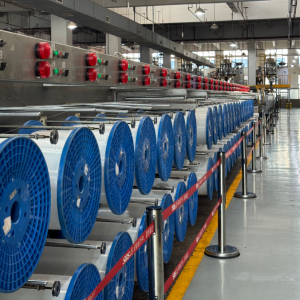
Rigid products are typically cut to length. Flexible continuous products (film, filament, monofilament) are usually wound.
Pro Tip: Dimensional stability is a system result. The extruder, die, cooling, and haul-off have to be tuned together.
Extrusion vs. molding vs. drawing (common confusion)
Extrusion vs injection molding
Extrusion makes a continuous profile, then it’s cut or wound.
Injection molding fills a closed mold cavity to make discrete parts.
Extrusion vs drawing (stretching)
In filament and monofilament production, extrusion and drawing are often both present.
Extrusion forms the initial strand by pushing melt through a die.
Drawing stretches the strand after extrusion to orient polymer chains and improve final properties.
If this confusion shows up in your plant, NLY’s short explanation of the extrusion vs drawing process is a useful reference.
What actually controls quality in extrusion
Extrusion quality is mostly about process stability. Here are the variables that usually move the result.
Temperature profile
Temperature affects melt viscosity, mixing, and stability.
Too low can mean incomplete melting and rough surface. Too high can mean degradation or unstable flow.
NLY’s overview of temperature control in extrusion is a good next read if you’re chasing dimensional drift.
Screw speed and feeding stability
Screw speed influences output rate and shear, but stable output also depends on stable feeding (consistent resin, consistent drying when needed).
Die condition and pressure stability
The die shapes the profile, but it also adds resistance to flow. That resistance shows up as melt pressure.
Cooling uniformity
Cooling is where dimensions become permanent. Uneven cooling often shows up as warpage, ovality, or unstable sizing.
Haul-off speed and tension
Haul-off speed directly changes draw-down. If dimensions drift during speed changes, don’t only look at the die. Look downstream.
Next steps (and where NLY fits)
If you’re using “extrusion” as shorthand for “we need more stable output,” the fastest way to make progress is to write down:
material (e.g., PP, PET, nylon)
target diameter/thickness and tolerance
output rate target
main failure mode (dimension drift, surface defects, breakage, gels/contamination)
NLY (Changzhou New Liaoyuan Machinery) builds plastic monofilament extrusion machinery and complete lines, and we publish process-oriented notes like this plastic extrusion overview plus a deeper look at how a monofilament extruder works.
If you want, share your material + product spec, and we can suggest which parts of the line (extruder section, die, cooling, haul-off, controls) typically matter most for stability.