If you run plastic filament production long enough, you start to see the same “small” problems become expensive ones: a slow diameter drift that turns into scrap, ovality that shows up later as draw breaks, or a winding package that looks fine on day one and becomes a mess on day three.
Understanding what monofilament is (in manufacturing terms) helps you troubleshoot faster and specify equipment more clearly—because the word doesn’t just describe a product. It describes a process target: one strand, one geometry, one set of properties, produced consistently.
Monofilament meaning (in plant terms)
A monofilament is a single, continuous strand of polymer made by melting resin, pushing it through a die to form a strand, then conditioning it (cooling, drawing, heat-setting, winding) until it reaches a target diameter and mechanical behavior.
In plain English, dictionaries define monofilament as “a single synthetic filament.” Merriam-Webster’s definition of monofilament captures that core idea: one strand.
What manufacturing adds is the practical implication: plastic monofilament quality is not “one number.” It’s whether the strand holds geometry, properties, and stability over time.
Key Takeaway: In production terms, filament is a control problem: diameter + roundness + properties, held stable across the shift.
Monofilament vs multifilament (why it matters)
It’s easy to confuse filament with other “string-like” plastics. The differences matter because the line design, die design, cooling approach, and downstream handling can be completely different.
Monofilament
One strand with one cross-section.
Commonly used where you need a defined diameter, stiffness/flexibility balance, and abrasion resistance.
Typical downstream forms: spooled filament, cut bristles, woven/knitted technical textiles, nets, or ropes.
Multifilament (yarn)
Many very fine filaments combined into one yarn.
Used when you need softness, flexibility, and textile-like hand feel.
Production lines often look closer to fiber spinning than industrial monofilament line layouts.
A simple rule of thumb: if the product spec is written around diameter tolerance and roundness, you’re usually in monofilament territory.
Where monofilament is used in industry
Monofilament shows up in everyday products, but from a manufacturing point of view, the applications group into “property families”:
Brush bristles (industrial, household, personal care)
What matters: stiffness, recovery after bending, abrasion resistance, and surface finish.
Typical risks: surface marks from guides/rollers, inconsistent diameter that changes brush feel.
Zipper monofilament
What matters: consistent geometry and stable mechanical behavior for downstream forming and assembly.
Typical risks: ovality (out-of-round) that shows up later in handling.
Fishing line, nets, twine, and rope elements
What matters: tensile strength, elongation behavior, abrasion resistance, and package build (good unwinding).
Typical risks: winding tension issues and diameter drift.
Trimmer line
What matters: toughness, abrasion resistance, stable diameter, and consistent behavior at speed.
Typical risks: brittle behavior from poor moisture control (for some materials) or unstable drawing.
For a broader applications overview, see NLY’s guide to common filament applications.
Common monofilament materials (and why manufacturers pick them)
Monofilament is commonly made from PA (nylon), PET, PP, and PE. The “best” material depends on the end-use and the plant’s ability to control moisture, temperature windows, and drawing stability.
PA (nylon) monofilament
Often chosen for abrasion resistance and a balanced stiffness/flexibility feel.
Practical manufacturing note: many nylon grades are moisture-sensitive, so resin conditioning and drying discipline matter.
PET monofilament
Often chosen for dimensional stability and strength in many technical applications.
Practical manufacturing note: PET is commonly treated as moisture-sensitive in extrusion; poor drying can show up as unstable running or defects.
PP monofilament
Often chosen when you want low density and good chemical resistance.
Practical manufacturing note: PP can be very stable, but geometry control (cooling symmetry) still drives roundness.
PE (often HDPE) monofilament
Often chosen for toughness and chemical resistance.
Practical manufacturing note: as with PP, many day-to-day issues show up as cooling/drawing stability rather than moisture.
If your application is specified by “denier” or linear density rather than diameter, you may need to translate between the two for purchasing and QA—but the process still has to hold diameter and roundness stable.
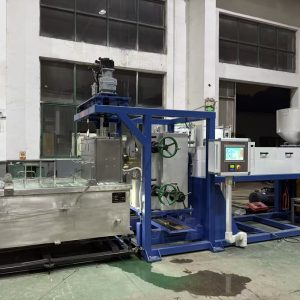
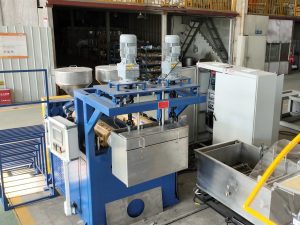
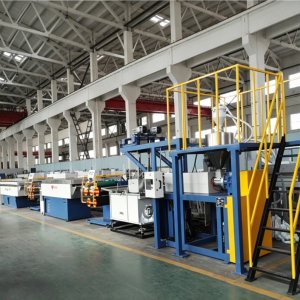
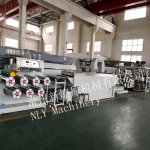
How monofilament is made: the monofilament extrusion line in one chain
A practical way to understand a monofilament line is as a linked system:
melt delivery → shaping/cooling → drawing/orientation → heat-setting → winding
NLY summarizes this system view in its overview of a monofilament extrusion line. For a nylon-specific reference, NYCOA also describes monofilament extrusion as melting polymer, pushing it through a die, then controlling final thickness via downstream rolls before spooling in its 2021 note on monofilament extrusion of nylon polymers.
Below is what each stage is trying to control.
1) Material conditioning (drying when needed)
Some polymers (especially many PET and PA/nylon grades) are treated as moisture-sensitive in filament production. In practical terms, drying is less about “following a rule” and more about keeping melt quality stable.
If moisture or contamination enters the melt stream, it can show up as bubbles/voids, unstable flow, or weak spots—problems that later look like drawing or winding instability.
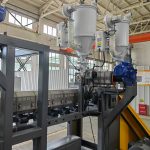
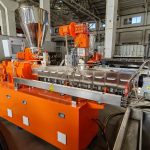
2) Extrusion and melt delivery (make the die see a stable melt)
The extruder’s job is to deliver a clean, uniform melt at stable temperature and pressure.
When this stage is unstable, diameter tends to drift or surge—because the die can only produce a consistent strand if it sees a consistent melt stream.
If you want a step-by-step system description, NLY’s monofilament extrusion process step by step breaks the full chain down clearly.
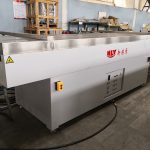
3) Die and quench cooling (lock in geometry)
The die forms the initial strand. The cooling system (often a water bath) solidifies it and “locks” the geometry before downstream tension amplifies any asymmetry.
This is why cooling is a common root cause when teams see:
ovality (out-of-round)
inconsistent diameter even when melt temperature “looks fine”
draw breaks that start after a speed increase
NLY’s article on why the quench water bath matters explains the mechanism in practical troubleshooting terms.
4) Drawing and orientation (set strength and stiffness)
After the strand is solid, drawing is controlled stretching. It aligns polymer chains along the filament axis.
Manufacturing translation: drawing is where you earn mechanical properties—but only if the upstream geometry is stable.
If you’re new to the terminology, NLY’s explainer on the difference between extrusion and drawing is a useful grounding reference.
5) Heat-setting / annealing (control shrinkage and stability)
After drawing, the strand can retain internal stress. Heat-setting (often under controlled tension) helps reduce stress so you don’t get shrinkage surprises later—during winding, storage, or downstream use.
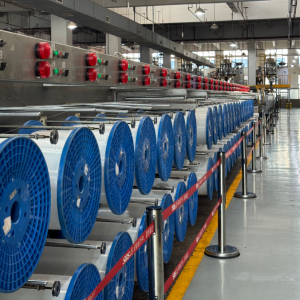
6) Winding (package build and downstream usability)
Winding isn’t “just packaging.” Package build and tension history affect whether customers can unwind smoothly without tangles, telescoping, or surface damage.
In stable plants, winding is treated as a controlled process step with defined tension windows and inspection routines.
What “good monofilament” means: practical quality metrics
A useful monofilament spec normally includes both geometry and properties.
Geometry
Diameter tolerance: stability over time matters as much as the average.
Ovality (roundness): out-of-round strand often shows up later as instability in drawing or downstream handling.
Surface condition: scratches, marks, contamination, gels.
Mechanical behavior
Tensile strength: whether the strand can carry the intended load.
Elongation: how it stretches under load (and whether that behavior is consistent).
Shrinkage / dimensional stability: how it behaves after heat exposure or over time.
Usability
Package build: whether the spool unwinds consistently.
Consistency across spools and batches: variation is often the real cost driver (scrap, downtime, claims).
Common monofilament defects and where to look first
Most defects become easier to solve when you map them to the stage most likely to create them.
Diameter drift
Start by confirming melt delivery stability (temperature and pressure trends, not just setpoints).
Then confirm cooling stability (water temperature, level, flow symmetry).
Ovality (out-of-round)
Often a cooling-path problem: alignment, strand centering, turbulence sources, or contact with guides while the strand is still soft.
Bubbles / voids
Often a resin conditioning issue (moisture control) or contamination/filtration issue.
Draw breaks
Often show up downstream, but can be caused upstream:
unstable geometry from cooling
poor traction/slip in the draw section
an aggressive draw ratio beyond the stable window
If you want a clean system framing of these control intents, NLY’s explainer on what the monofilament extrusion process controls is a good reference.
FAQ
Is monofilament always plastic?
In the manufacturing context, “monofilament” usually refers to a synthetic polymer strand (like PA/nylon, PET, PP, or PE). The core meaning is still “one strand,” but the production line and property targets are typically polymer-based.
Is filament the same as monofilament?
“Filament” can mean any continuous strand. Monofilament is more specific: one strand designed to be used as a single filament (not combined into a yarn).
What’s the simplest way to explain monofilament to a buyer?
Try this: Monofilament is one continuous strand of plastic with a controlled diameter and predictable behavior (strength, stretch, shrinkage).
Next step: define your one-page monofilament spec
If you’re planning a new line—or trying to stabilize an existing one—the fastest way to reduce risk is to write a one-page “process window”:
polymer (PA/PET/PP/PE; virgin vs recycled)
target diameter range + tolerance
target stable output (kg/h)
end-use (brush / zipper / net / trimmer line)
top defects you must eliminate (drift, ovality, surface marks, breaks)
If you want, NLY (Changzhou New Liaoyuan Machinery) can help map those inputs into a practical line configuration and an acceptance test plan (sample run / FAT) so the project starts with clear, measurable targets.