Selecting the right plastic material for monofilament production is the single most critical decision determining your product’s mechanical performance, production yield, and overall cost per kilogram. Monofilament extrusion converts thermoplastic polymer resin into continuous single-strand filaments with tightly controlled diameter tolerances, high tensile strength, and specific flexural properties.
Whether manufacturing heavy-duty lawn trimmer line, high-precision zipper teeth, agricultural shade netting, or industrial filter cloth, choosing between Polyamide (Nylon – PA6/PA66), Polyester (PET), Polypropylene (PP), and High-Density Polyethylene (HDPE) requires balancing mechanical demands against your extrusion line’s processing capabilities.
Key Technical Criteria for Monofilament Material Selection
To determine the ideal polymer grade, extrusion plant managers and engineers must evaluate raw resin properties across five core engineering dimensions:
1. Tensile Strength and Tenacity
Tenacity (measured in grams per denier, $g/d$, or $cN/dtex$) defines a filament’s breaking strength relative to its linear density. High-stress applications like commercial fishing lines or paper-making filter mesh demand tenacities above $7.0\ g/d$, whereas general agricultural netting functions reliably at $4.0 – 5.0\ g/d$.
2. Flexural Modulus and Stiffness
Flexural modulus ($GPa$) determines a monofilament’s resistance to bending and its elastic recovery. High-modulus polymers like PET retain structural stiffness and low creep under continuous load, preventing sagging in zipper monofilament or industrial screens. Lower-modulus polymers like HDPE yield flexible, shock-absorbent lines.
3. Moisture Absorption and Hygroscopicity
Polymers differ significantly in their affinity for water. Hygroscopic materials absorb environmental moisture, which causes severe hydrolytic degradation during extrusion if not removed prior to melting. Non-hygroscopic polyolefins can be processed directly from sealed storage without specialized drying equipment.
4. Thermal Stability and Melting Window
The crystalline melting point ($°C$) dictates barrel temperature profile requirements and maximum working environment temperatures. High-melting-point polymers tolerate hot operating environments but demand higher energy consumption during melt homogenization.
5. Density and Specific Gravity
Density ($g/cm³$) directly dictates material yield (meters of filament produced per kilogram of resin). Polyolefins float on water ($< 1.0\ g/cm³$), giving them a yield advantage over dense polyester ($1.38\ g/cm³$).
Key Takeaway: Material selection is an engineering trade-off. Increasing tensile strength or thermal stability usually requires switching from polyolefins to hygroscopic engineering plastics, which demands stricter drying controls and higher barrel heating capacity on your extrusion line.
Polymer Comparison Matrix: PA6/PA66 vs. PET vs. PP vs. HDPE
The four major thermoplastic resin families used in monofilament production exhibit distinct physical and operational profiles:
Physical / Processing Property | Polyamide 6 / 66 (Nylon) | Polyester (PET) | Polypropylene (PP) | High-Density Polyethylene (HDPE) |
|---|---|---|---|---|
Density ($g/cm³$) | $1.13 – 1.15$ | $1.34 – 1.38$ | $0.90 – 0.91$ | $0.95 – 0.96$ |
Tenacity ($g/denier$) | $5.0 – 9.0$ | $4.5 – 8.5$ | $3.5 – 6.5$ | $4.0 – 7.0$ |
Tensile Modulus ($GPa$) | $2.0 – 3.5$ | $3.5 – 5.0$ | $1.2 – 1.8$ | $1.0 – 1.5$ |
Moisture Equilibrium | $1.5 – 2.5%$ (High) | $0.2 – 0.4%$ (Moderate) | $< 0.01%$ (Hydrophobic) | $< 0.01%$ (Hydrophobic) |
Max Processing Moisture | $< 0.05%$ | $< 0.02%$ (Critical) | No pre-drying needed | No pre-drying needed |
Melting Point ($°C$) | $220\ (\text{PA6}) / 260\ (\text{PA66})$ | $255 – 265$ | $160 – 170$ | $130 – 135$ |
Typical Extrusion Melt Temp | $240 – 270\ (\text{PA6}) / 275 – 295\ (\text{PA66})$ | $270 – 295$ | $210 – 250$ | $180 – 230$ |
Oriented Draw Ratio | $3.5:1 – 5.5:1$ | $4.0:1 – 6.0:1$ | $5.0:1 – 8.0:1$ | $6.0:1 – 10.0:1$ |
Abrasion Resistance | Outstanding | Good | Moderate | Moderate / Fair |
Polyamide (Nylon — PA6 and PA66)
Polyamide resins deliver superior abrasion resistance, high impact toughness, and excellent flexural fatigue resistance.
PA6 melts at approximately $220°C$, offering easier processing, higher elasticity, and smoother surface finish.
PA66 melts at $260°C$, providing higher tensile strength, higher thermal resistance, and superior stiffness under continuous friction.
Nylon is highly hygroscopic. If processed with moisture content above $0.05%$, water vapor causes polymer chain scission in the barrel, creating brittle filament, void formation, and frequent breaks in the drawing bath.
Polyester (Polyethylene Terephthalate — PET)
PET monofilament is selected when high stiffness, dimensional stability, low moisture regain, and low creep are required. Unlike Nylon, PET maintains consistent tensile modulus and diameter dimensions regardless of ambient humidity changes.
⚠️ Warning: PET is extremely sensitive to hydrolytic degradation at melt temperatures above $270°C$. Resin must be dried in a desiccant dehumidifying dryer down to less than $0.02%$ moisture content (dew point $\le -40°C$) prior to entering the extruder hopper. Extruding wet PET permanently destroys molecular weight (Intrinsic Viscosity / IV loss), leading to severe filament brittleness.
Polypropylene (PP)
Polypropylene is the lightest commercial monofilament resin ($0.90\ g/cm³$), offering low cost per meter, zero moisture absorption, and excellent chemical resistance against acids, alkalis, and organic solvents. PP monofilament provides moderate strength and good flexibility, making it an economical workhorse for packaging twines, ropes, and agricultural meshes.
High-Density Polyethylene (HDPE)
HDPE resin provides exceptional impact strength, low friction coefficient, and chemical inertness at a low density ($0.95\ g/cm³$). HDPE monofilaments can achieve high draw orientation ratios ($6.0:1$ up to $10.0:1$), yielding tough, flexible strands ideal for shade netting, anti-bird screens, and marine ropes.
Matching Raw Materials to Monofilament End-Use Applications
Selecting the correct polymer depends entirely on the mechanical and environmental stresses placed on the finished filament:
                  ┌──────────────────────────────────────────────┐
                  │ Target Monofilament End-Use Application       │
                  └──────────────────────┬───────────────────────┘
                                         │
         ┌───────────────────────────────┼───────────────────────────────┐
         ▼                               │                               ▼
┌──────────────────┐                     ▼                     ┌──────────────────┐
│ Impact & Abrasion│           ┌──────────────────┐            │ Low Cost & High  │
│ Resistance Focus │           │ High Stiffness & │            │ Chemical Inertness│
└────────┬─────────┘           │ Dimensional Modulus           └────────┬─────────┘
         │                     └────────┬─────────┘                     │
         ▼                              ▼                               ▼
  Nylon (PA6 / PA66)                 PET Polyester                  PP / HDPE Polyolefins
  - Trimmer Line                     - Zipper Monofilament          - Agricultural Shade Nets
  - Brush Bristles                   - Paper Mill Filter Mesh       - Ropes & Packaging Twines
  - High-Strength Nets               - Industrial Fabrics           - Safety & Construction Nets
Lawn Trimmer Lines and Industrial Brush Bristles
Optimal Choice: Nylon (PA6 or PA66).
Rationale: Trimmer line impacts stones, concrete, and thick vegetation at line speeds over $6,000\ \text{RPM}$. Nylon’s high impact toughness and wear resistance prevent rapid splitting and tip fraying.
Zipper Teeth Monofilament and Technical Fabrics
Optimal Choice: PET Polyester.
Rationale: Zipper teeth demand strict pitch accuracy, tight diameter tolerance ($\pm 0.005\ \text{mm}$), and zero thermal shrinkage during garment dyeing or ironing. PET provides the required high modulus and dimensional stability.
Agricultural Shade Nets, Anti-Bird Netting, and Ropes
Optimal Choice: HDPE or Polypropylene (with UV stabilizers).
Rationale: Outdoor agricultural netting requires weatherability, water resistance, lightweight coverage, and low material cost per square meter.
Marine Fishing Nets and Commercial Lines
Optimal Choice: High-Tenacity PA6 / PA66 or High-Orientation HDPE.
Rationale: Marine applications require high wet-knot strength, impact absorption under wave loads, and saltwater corrosion resistance.
Extrusion Line Adjustments for Different Plastic Materials
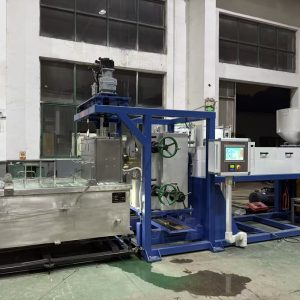
A monofilament line configured for Polypropylene cannot simply be switched to Nylon or PET without adjusting critical upstream and downstream hardware parameters. Understanding extrusion line parameter adjustments for different polymers prevents line stoppage and expensive component damage.
┌─────────────────┐    ┌─────────────────┐    ┌─────────────────┐    ┌─────────────────┐
│ Dehumidifying   │───>│ Barrier Screw   │───>│ Quench Water    │───>│ Multi-Stage     │
│ Desiccant Dryer │    │ (L/D 30:1-33:1) │    │ Temperature     │    │ Draw & Heat-Set │
│ (PA/PET: <-40°C)│    │ (Precision Melt)│    │ (15°C - 35°C)   │    │ (Ratio 3.5:1-10:1)
└─────────────────┘    └─────────────────┘    └─────────────────┘    └─────────────────┘
1. Drying and Material Conditioning
PET: Requires a closed-loop desiccant dryer operating at $160 – 170°C$ for $4 – 6\ \text{hours}$ with a dew point below $-40°C$.
Nylon (PA6/PA66): Requires desiccant drying at $80 – 100°C$ for $4 – 6\ \text{hours}$ down to $< 0.05%$ moisture.
PP/HDPE: Requires no drying unless processing regrind blends or moisture-sensitive masterbatches.
2. Extruder Screw Design and L/D Ratios
Extruding technical monofilament requires precise barrel and die temperature zone control and uniform melt pressure.
Single-screw extruders with $30:1$ to $33:1\ \text{L/D}$ barrier screws are recommended to ensure complete melt homogenization without local shear overheating.
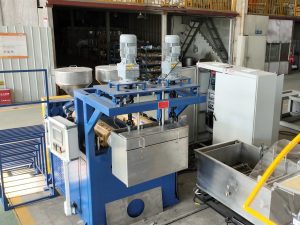
High-viscosity PET and PA require dedicated mixing heads and melt pumps to eliminate pressure fluctuations at the spinneret die.
3. Quenching Bath and Stretching Tank Controls
Following the die, the step-by-step monofilament extrusion process relies on precise thermal quenching and mechanical orientation:
Quench Water Temperature: PA and PET require cool water baths ($15 – 25°C$) to freeze the amorphous structure before drawing. PP and HDPE benefit from warmer water baths ($25 – 35°C$) to control crystallization rates and prevent internal void stress.
Multi-Stage Draw Ratios: Filaments pass through heated water or steam tanks between godet roller sets. Orienting polymers at optimal temperatures aligns molecular chains, directly multiplying tensile strength while maintaining tight filament diameter tolerances.
Troubleshooting Common Material-Related Extrusion Defects
Symptom / Defect | Root Cause | Corrective Action |
|---|---|---|
Bubbles, voids, or hollow filament centers | Moisture in PA or PET resin; excess melt temperature causing degradation. | Verify desiccant dryer dew point ($\le -40°C$); check dryer airflow and reduce barrel zone temperatures. |
Frequent filament breaks in drawing bath | Insufficient melt homogenization; IV drop from wet PET; improper draw tank temperature. | Increase screw backpressure; enforce resin drying protocols; optimize stretching tank temperature. |
Filament ovality or uneven diameter drift | Non-uniform water flow in quench tank; melt pressure pulsing at die head. | Check quench tank baffle symmetry; inspect melt pump speed stability and filter screen pack cleanliness. |
High thermal shrinkage after winding | Inadequate heat-setting (annealing) in final oven stage. | Increase annealing hot-air oven temperature ($180 – 210°C$ for PET) and adjust relaxation godet ratio. |
Pro Tip: When changing raw materials (e.g., transitioning from HDPE to PET), perform a thorough high-viscosity purge. Residual polyolefin in barrel dead zones will carbonize at PET processing temperatures ($>280°C$), clogging spinneret holes and causing severe melt fracture.
Conclusion and Technical Line Configuration
Choosing the right plastic material for monofilament production requires matching end-use mechanical demands—tensile strength, stiffness, abrasion resistance, and chemical exposure—to your plant’s drying, melting, and drawing infrastructure. While polyolefins (PP/HDPE) offer simple, non-hygroscopic processing at low density, engineering plastics (PA/PET) provide unmatched strength and dimensional precision when supported by proper dehumidifying drying and multi-stage orientation.
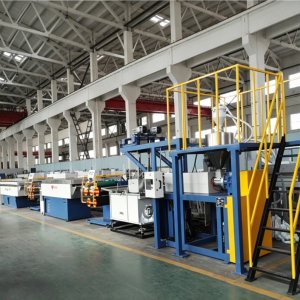
Before investing in new raw material grades or expanding production capacity, ensure your extrusion line machinery is optimized for your target polymer. Reviewing criteria for selecting the right monofilament extrusion machine or consulting with an experienced machinery manufacturer helps align screw geometry, temperature zone capacity, and draw ratios with your operational goals.
For custom extrusion line parameter design, screw L/D configuration, or material sample FAT evaluation, contact the engineering team at Changzhou New Liaoyuan Machinery (NLY).