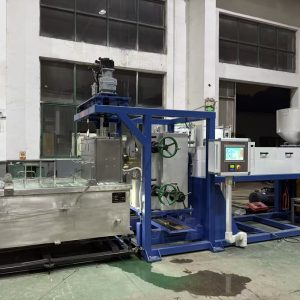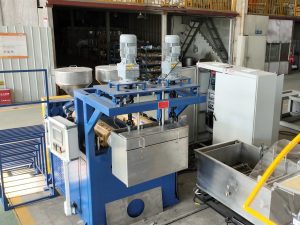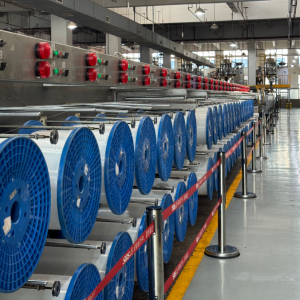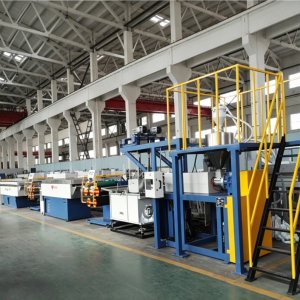
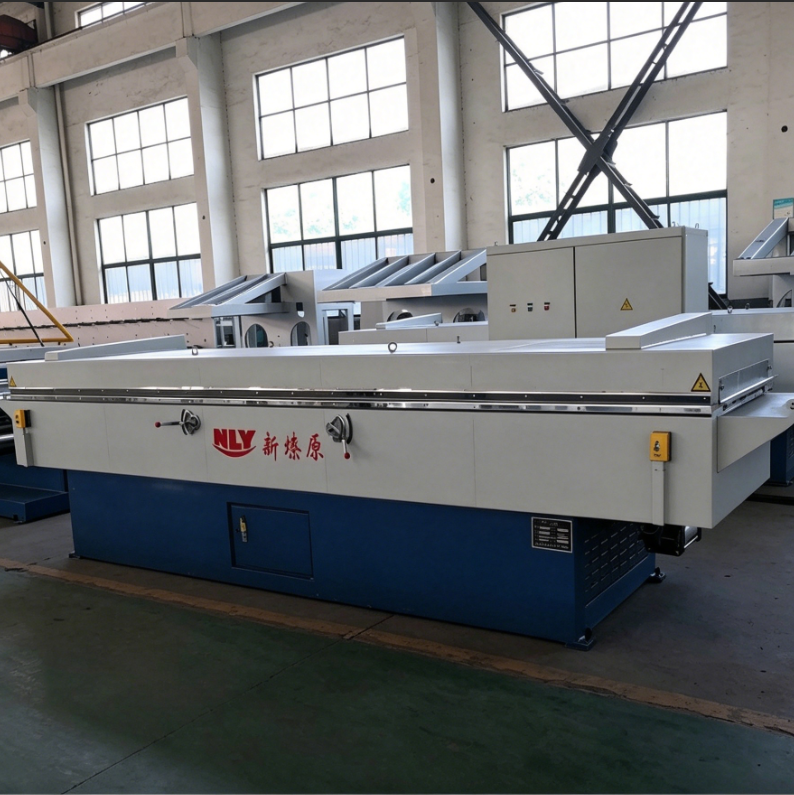
Industrial polyethylene terephthalate (PET) monofilament is an essential synthetic fiber used in demanding application sectors worldwide. From high-strength zipper teeth and agricultural support wires to industrial conveyor belts, paper-making felt mesh, fishing line, and lawnmower trimmer line, PET monofilament is chosen for its high tensile strength, dimensional stability, chemical resistance, and excellent creep performance under load.
However, processing PET resin into high-tenacity monofilament with uniform diameter tolerance (within ±0.005 mm) presents unique engineering challenges. Unlike polyolefins such as polypropylene (PP) or high-density polyethylene (HDPE), PET is a hygroscopic polyester that undergoes rapid hydrolytic degradation at elevated melt temperatures if residual moisture is present. Furthermore, achieving optimal tensile properties requires precise multi-stage orientation and thermal heat-setting to lock in polymer chain alignment.
This technical guide breaks down the complete PET monofilament production process, covering raw material conditioning, extrusion machinery architecture, water quenching dynamics, multi-stage stretching, heat setting, and quality troubleshooting.
Polymer Characteristics & Moisture Control: Preventing Intrinsic Viscosity (IV) Loss
The foundation of high-quality PET monofilament production begins with raw material handling. Polyethylene terephthalate polymer chains contain ester linkages that are highly susceptible to hydrolysis—a thermal-chemical reaction where water molecules break the long ester chains at melt temperatures above 250°C.
When PET resin with excessive moisture is extruded, the average molecular weight drops rapidly. In extrusion engineering, this loss of molecular weight is measured as a drop in Intrinsic Viscosity (IV). A severe IV drop leads directly to:
Frequent filament breakage during high-ratio drawing
Lower tensile tenacity and impact resistance in the finished monofilament
Melt instability at the spinneret, causing diameter variations and ovality
Brittleness and inconsistent thermal shrinkage
Crystallization and Dehumidifying Drying Specifications
Virgin PET chips or recycled PET (rPET) bottle flakes typically carry absorbed moisture levels between 2,000 ppm and 5,000 ppm (0.2% to 0.5%). To safely process PET without IV degradation, residual moisture must be reduced to below 50 ppm (0.005%) prior to entering the extruder hopper.
Achieving this requirement requires a two-stage thermal preparation system:
Pre-Crystallization: Amorphous PET chips or rPET flakes soften and become tacky around their glass transition temperature (70°C to 80°C). If fed directly into a hot dryer, amorphous pellets stick together and form solid agglomerates that block the hopper. A pre-crystallizer uses mechanical agitation and hot air (120°C to 160°C) for 20 to 40 minutes to convert the surface structure from amorphous to opaque crystalline PET, preventing clumping.
Dehumidifying Desiccant Drying: Crystallized PET pellets are transferred into a insulated drying hopper supplied with dry air from a desiccant rotor. The process air must maintain a continuous dew point of -40°C or lower (ideally -50°C) at a drying temperature of 160°C to 180°C for a dwell time of 4 to 6 hours.
Pro Tip: Never attempt to short-cut drying time by elevating the drying temperature above 180°C. Excessive temperatures can cause thermal oxidation and yellowing of the resin before it even reaches the extruder.
The PET Monofilament Extrusion Line Architecture
A complete PET monofilament line operates as an integrated continuous production system. Each sub-assembly must maintain tight speed and temperature synchronization to keep line tension balanced across dozens or hundreds of parallel strands.
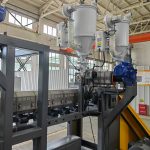
Resin Crystallizer & Dryer
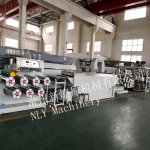
Single-Screw Extruder (L/D 28:1 – 32:1) Hydraulic Screen Changer & Melt Gear Pump Monofilament Die Head / Spinneret Quench Water Tank (15°C – 25°C) Godet Unit 1 (Take-Off Rollers) Hot Water Stretching Tank (75°C – 95°C) Godet Unit 2 (Stretching Rollers) Hot Air Drawing Oven (160°C – 210°C) Godet Unit 3 (High-Tension Rollers) Heat Setting & Annealing Oven (180°C – 220°C) Godet Unit 4 (Relaxation Rollers) Dual-Axis Laser Diameter Gauge Precision Spool Winders
Key Machinery Components
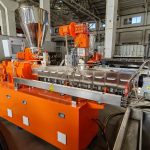
Extruder Barrel and Screw: PET requires a single-screw extruder with a high length-to-diameter (L/D) ratio of 28:1 to 32:1. The screw design features a barrier flighting geometry with a dynamic mixing section to ensure uniform melt temperature without generating localized shear overheating.
Hydraulic Screen Changer: Removes micro-impurities and un-melted gel particles. Dual-bolt continuous hydraulic screen changers allow filter plate swaps without stopping the melt flow or interrupting line tension.
Melt Gear Pump (Metering Pump): Placed between the screen changer and the die head, a high-precision positive displacement melt pump dampens pressure surges from the extruder screw. It maintains pressure fluctuation within ±0.5 bar, ensuring consistent volumetric dosing into the spinneret.
Spinneret Die Head: Specially engineered distribution channels ensure identical melt residence time and flow velocity to every individual capillary hole across the die plate.
To review how line components operate within broader extrusion systems, consult our monofilament extrusion process overview.
Step-by-Step PET Monofilament Manufacturing Process
Understanding the operational sequence helps plant engineers fine-tune processing parameters for different filament diameters (ranging from 0.08 mm fine yarns to 4.0 mm heavy industrial wires).
Step 1: Plasticization and Melt Temperature Control
Dried PET resin enters the extruder feed zone. The barrel temperature is divided into multiple heating zones, gradually increasing along the screw length:
Feed Zone (Zone 1): 240°C – 250°C (Water-cooled feed throat prevents bridge formation)
Compression Zone (Zone 2): 255°C – 265°C
Metering Zone (Zone 3): 265°C – 275°C
Melt Pump & Adapter: 265°C – 275°C
Spinneret Die Head: 260°C – 280°C
The melt temperature must remain safely above the PET melting point (255°C to 260°C) while avoiding temperatures above 285°C, which accelerate thermal degradation and acetaldehyde formation.
Step 2: Quenching and Amorphous Freezing
Molten PET strands exit the spinneret capillaries and immediately drop into a controlled water quenching tank.
The water bath temperature is held strictly between 15°C and 25°C. The primary goal of quenching is to cool the molten polymer rapidly below its glass transition temperature (T g ≈ 70°C–80°C) before crystallization can occur. Rapid cooling freezes the polymer matrix into a ductile, amorphous state. If the quenching water is too warm (above 35°C), slow cooling allows spherulitic crystallization to develop, turning the filament cloudy and brittle, which causes instant breakage during stretching.
An air wiper or suction knife removes surface water droplets from the filaments as they exit the tank to prevent temperature non-uniformity during drawing.
Step 3: Multi-Stage Drawing and Molecular Orientation
As extruded, quenched PET monofilaments possess very low tensile strength because their polymer chains are randomly coiled. To develop high tenacity, the filaments must undergo oriented stretching.
For a detailed analysis of drawing physics across different polymers, refer to our monofilament drawing and orientation engineering guide.
In professional PET lines engineered by manufacturers like Changzhou New Liaoyuan Machinery Co., Ltd. (NLY), stretching is performed in two or three sequential stages:
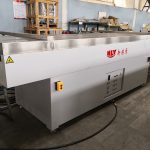
First-Stage Pre-Drawing (Hot Water Bath): Filaments pass through a hot water bath or steam chamber heated to 75°C to 95°C (just above PET’s glass transition temperature). Driven by a speed differential between Godet 1 and Godet 2, the filaments are stretched at a draw ratio of 1:2.5 to 1:3.5.
Second-Stage Main Drawing (Hot Air Oven): Filaments enter an insulated hot air stretching oven maintained at 160°C to 210°C. Godet 3 accelerates the strands further, bringing the total draw ratio to between 1:4.8 and 1:6.2. This high orientation aligns the polymer backbone along the filament axis, increasing tensile strength from 15 cN/tex up to 60–80 cN/tex.
Key Takeaway: Multi-stage stretching distributes internal stress evenly, allowing higher total draw ratios without causing micro-voids or strand snapping compared to single-stage drawing.
Step 4: Heat Setting and Thermal Relaxation
Oriented PET monofilament contains significant internal mechanical stress. If spooled directly after drawing, the filament will exhibit high thermal shrinkage (10% to 20% at 150°C) when exposed to heat during downstream dyeing, weaving, or outdoor sunlight.
To eliminate internal stress, the filaments pass through a heat-setting oven at 180°C to 220°C between Godet 3 and Godet 4. The speed of Godet 4 is set slightly slower than Godet 3 (a controlled relaxation ratio of 1% to 4%). This controlled shrinkage under high heat allows the aligned crystalline structure to stabilize, reducing residual thermal shrinkage to below 2.5% at 150°C.
Step 5: On-Line Inspection and Precision Winding
Prior to winding, filaments pass through a continuous dual-axis laser micrometer. The laser gauge measures strand diameter in real time, feeding data back to the central PLC to adjust godet speeds automatically if drift occurs.
Finally, individual filaments are wound onto spools or bobbins using torque-controlled or magnetic-tension winders. Consistent winding tension prevents inner-layer crush on spools and ensures smooth unwinding at high speeds in downstream textile machinery.
For a full step-by-step operational overview across different monofilament polymers, see our monofilament extrusion process step-by-step guide.
Operational Parameter Reference Table
The following parameter matrix summarizes standard operational settings for industrial PET monofilament extrusion lines:
Line Section / Zone | Operating Parameter Range | Primary Technical Objective |
|---|---|---|
Resin Pre-Crystallizer | 120°C – 160°C for 20–40 min | Convert amorphous surface to crystalline state; prevent hopper clumping |
Dehumidifying Dryer | 160°C – 180°C for 4–6 hrs; Air Dew Point ≤ -40°C | Lower residual moisture to ≤ 50 ppm; prevent hydrolytic IV loss |
Extruder Barrel Zone 1 | 240°C – 250°C | Efficient solid pellet feeding without melt bridge formation |
Extruder Barrel Zones 2–3 | 255°C – 275°C | Complete plasticization and homogeneous melt shearing |
Die Head & Spinneret | 260°C – 280°C | Uniform melt viscosity and steady capillary extrusion |
Quench Water Tank | 15°C – 25°C chilled water | Freeze polymer into ductile amorphous state; prevent cloudiness |
1st Draw (Hot Water) | 75°C – 95°C; Draw Ratio 1:2.5 – 1:3.5 | Initial orientation above glass transition temperature (T g) |
2nd Draw (Hot Air Oven) | 160°C – 210°C; Total Draw Ratio 1:4.8 – 1:6.2 | Maximize molecular chain alignment and tensile tenacity |
Heat Setting Oven | 180°C – 220°C; Relaxation 1% – 4% | Thermal stress relief; lock in thermal shrinkage < 2.5% at 150°C |
Winding Section | Closed-loop laser gauge & tension control | Maintain uniform spool density and diameter tolerance (±0.005 mm) |
Troubleshooting Common PET Monofilament Production Defects
When operating industrial extrusion lines, process engineers must quickly diagnose and resolve quality non-conformances.
1. Frequent Filament Breakage in Draw Oven
Root Cause A: Inadequate resin drying. Moisture content > 50 ppm leads to IV degradation and loss of melt cohesion.
Corrective Action: Verify drying dew point (must be ≤ -40°C) and extend drying cycle time. Check for air leaks in the hopper return lines.
Root Cause B: Excessive total draw ratio or incorrect draw temperature.
Corrective Action: Lower the speed ratio between Godet 2 and Godet 3 slightly, or increase the hot air oven temperature by 5°C to increase chain mobility during stretching.
2. High Diameter Fluctuation & Ovality
Root Cause A: Melt pressure pulsation from the extruder screw.
Corrective Action: Check melt pump operation and adjust screw speed to ensure stable suction pressure (typically 30–50 bar) at the melt pump inlet.
Root Cause B: Quench bath water turbulence or uneven air wiper pressure.
Corrective Action: Install submerged baffle plates in the quench tank to calm water ripples near the die face. Balance air knife blow pressure.
3. Excessive Thermal Shrinkage in Finished Filament
Root Cause: Heat-setting oven temperature too low, or insufficient relaxation ratio between Godet 3 and Godet 4.
Corrective Action: Increase heat-setting oven temperature to 190°C–210°C and increase relaxation ratio to 2.5%–3.5%.
To explore how these process parameters integrate into complete automated plants, review our guide on continuous filament extrusion line systems.
Machinery Selection Checklist for Monofilament Manufacturers
When evaluating new extrusion equipment or upgrading an existing plant for PET monofilament production, verify the following hardware specifications with your machinery vendor:
Desiccant Drying Integration: Is the system equipped with a twin-tower closed-loop dehumidifying dryer capable of maintaining a continuous dew point of -40°C to -50°C?
Screw L/D Ratio & Metallurgical Treatment: Does the screw feature a 28:1 to 32:1 L/D ratio with bimetallic barrel coating to withstand abrasive additives or recycled flake feedstocks?
Melt Metering Precision: Is a dedicated melt gear pump integrated into the die head assembly with closed-loop pressure control?
Multi-Stage Stretching Configuration: Does the line feature both hot-water immersion pre-stretching and multi-zone hot-air orientation ovens with individual godet temperature regulation?
Tension-Controlled Annealing: Are heat-setting rollers driven by independent servo motors to allow micro-adjustment of relaxation ratios?
Energy Efficiency: Are barrel heating zones equipped with ceramic insulation jackets and invertor-driven drives to minimize specific energy consumption (kWh/kg)?
Conclusion & Next Steps
Successful PET monofilament production demands a complete process discipline—from strict moisture elimination at sub-50 ppm levels to precise multi-stage draw temperature and tension control. By aligning raw material preparation with robust machinery design, manufacturers can achieve superior filament tenacity, tight diameter uniformity, and long-term production stability.
At Changzhou New Liaoyuan Machinery Co., Ltd. (NLY), we bring over 30 years of specialized manufacturing experience to custom-engineer turnkey PET, PA, PP, and HDPE monofilament extrusion lines for clients across more than 20 countries.
Planning a new PET monofilament project or looking to upgrade your line throughput? Contact our engineering team today to discuss custom line configurations, screw designs, or to arrange running sample tests at our manufacturing facility.