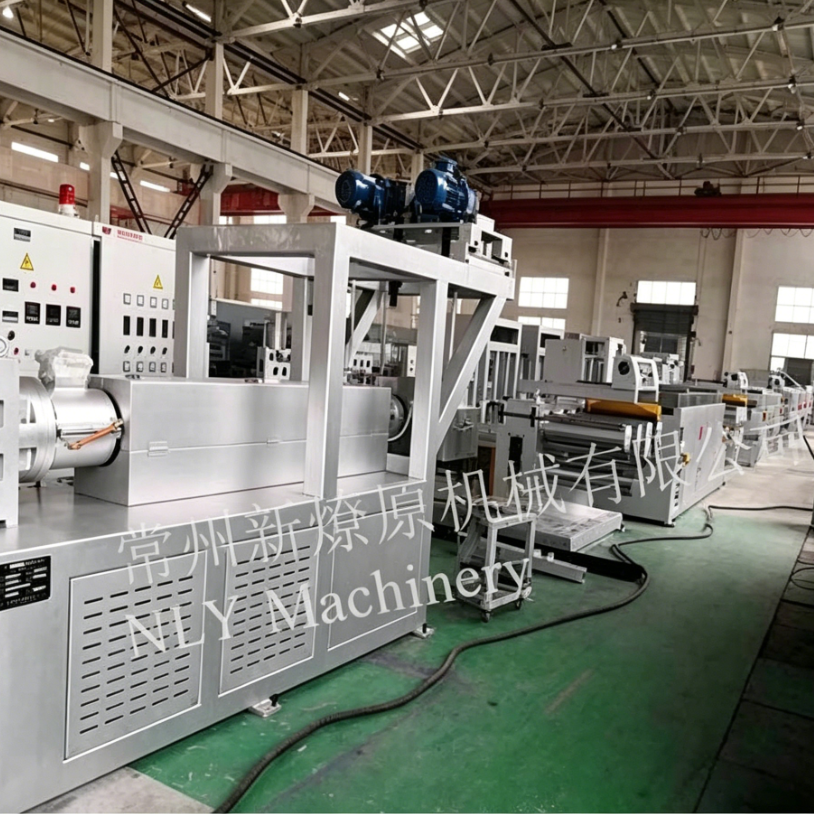
When a brush manufacturer moves from buying finished bristles to producing its own, the single most consequential decision sits at the top of the line: which polymer to extrude. For cost-sensitive toothbrushes, cleaning brushes, and many paint and cosmetic brushes, PET (polyethylene terephthalate) is a deliberate choice — stiff, dimensionally stable, and dramatically cheaper per kilogram than PBT or nylon.
But PET is not forgiving. It hydrolyzes in the presence of moisture, it runs in a narrow melt window, and once it leaves the line it behaves differently in tufting than the premium filaments your operators may be used to. A line that runs polypropylene out of the box will not turn out quality PET bristle without the right drying, melt-delivery, drawing, and heat-setting hardware.
This guide walks through what a dedicated PET brush filament extrusion line needs to do, the material trade-offs that drive machine configuration, and the evaluation criteria a plant manager should take into an RFQ.
Why PET for brush filament? The trade-offs that matter
PET usually gets chosen for one reason: cost. It sits between polypropylene and nylon in price, and its stiffness means you can hit a functional brush performance at a lower material spend. But the reason it is not the default for every brush is also technical.
Property | PET | PBT | Nylon (PA6/66/612) |
|---|---|---|---|
Relative stiffness | High / stiff | Firm | Low to medium, softer |
Water absorption | Low | Very low (~0.1%) | High (3%+) |
Bend recovery | Moderate | Good | Excellent |
Cost position | Lowest | Low–mid | Higher |
Typical brush uses | Economy toothbrushes, cleaning, paint & some cosmetic | Mid/premium toothbrushes, cosmetic, tapered | Premium toothbrushes, cosmetic, industrial |
The practical reading of that table: if the brush needs repeated bend recovery and a premium feel, PET is the wrong choice. If the priority is a stiff, economical bristle that holds its shape in wet service, PET earns its place.
This mirrors how commercial brush-bristle suppliers position the three materials. As an industry note on PET, PBT, and nylon bristle differences explains, PET is the harder, lower-cost option, while PBT trades stiffness for better elasticity and low water absorption, and nylon carries the strongest bend recovery and wear resistance. Because PET has moderate elastic recovery, it is best matched to brushes where the bristle works against a surface rather than flexing repeatedly under load.
For a general comparison of brush filament line configuration across all four polymers, the full buyer’s guide covers the wider material menu.
Key Takeaway: PET is the stiff, cost-first polyester option. Specify it when stiffness and price matter more than elastic recovery — not for premium oral-care filaments that need high bend recovery.
Core line architecture of a PET brush filament extrusion line
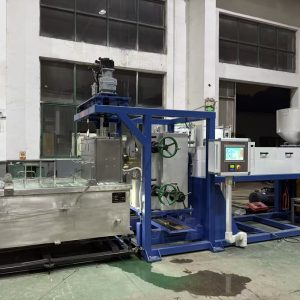
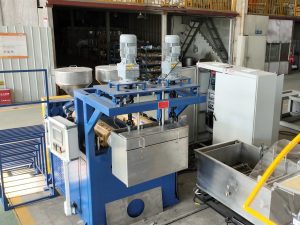
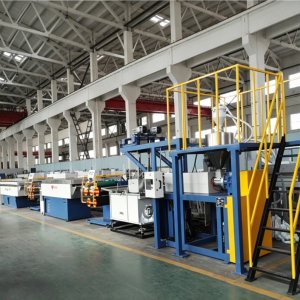
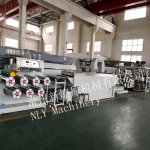
A PET bristle line is an integrated multi-stage thermo-mechanical system. Every stage changes the filament’s diameter, stiffness, straightness, and surface, so the line has to be evaluated as a chain, not as a pile of standalone machines.
The chain runs: drying → single-screw extrusion and melt metering → spinneret die → water quench → first-stage hot draw → second-stage hot-air draw → heat-setting anneal → (crimp/taper/flag) → winding.
1. Closed-loop desiccant drying — the non-negotiable first stage
PET is hygroscopic, and moisture is its worst enemy. When wet PET is melted, water molecules trigger hydrolytic chain scission that drops the intrinsic viscosity (IV) of the polymer, creates internal bubbles and porosity, and shows up as brittle, weak bristle or strand breakage at the die.
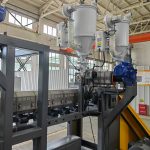
For industrial brush filament, the target is residual moisture at or below about 50 ppm (0.005%) at the hopper, delivered with dehumidified air at a dew point of −40°C or lower, typically drying at 160–180°C for 4–6 hours. This is the same drying discipline outlined in the PET monofilament production process guide.
⚠️ Warning: Skipping or under-sizing drying is the most common cause of failed PET bristle starts. The line’s dryer capacity and dew-point control should be sized to your throughput before anything else.
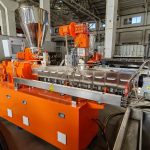
2. Single-screw extruder and gear melt pump
The extruder melts, homogenizes, and pressurizes the PET. Because brush bristle needs tight diameter control and cross-sectional roundness, the barrel and screw must stay thermally and volumetrically stable.
Screw design: A single-screw extruder with an L/D ratio around 28:1 to 33:1, typically a barrier or mixing screw, is standard. Hardened nitrided steel (38CrMoAlA) handles virgin PET; bimetallic screw/barrel coatings are worth specifying if you run abrasive-filled or recycled feedstock.
Gear melt pump: A positive-displacement melt pump between the barrel and die removes screw pulsation and holds constant volumetric flow, which is what keeps diameter from drifting. Closed-loop pressure feedback is the control that makes this stable.
Barrel melt temperature: PET runs in a narrow window, commonly 260–300°C across the zones with a typical die temperature around 280°C. Too hot and the polymer degrades; too cold and melt-fracture and poor surface follow.
3. Water quench bath
Molten PET strands leave the die into a temperature-controlled water bath, typically 15–25°C. Quenching locks the polymer into an amorphous state before crystallization, which is the correct starting point for orientation in the draw section. Stable water temperature and turbulence matter here — swings show up immediately as ovality or diameter variation downstream.
4. Multi-stage hot drawing and orientation
Undrawn PET is weak and dimensionally unstable. The draw section stretches the amorphous strand between godet roller sets running at different speeds, aligning polymer chains to build tensile strength and stiffness. Draw ratio is the speed ratio of the downstream to upstream roller set (DR = V₂/V₁).
For PET brush filament, a practical starting window is a total draw ratio around 4.5:1 to 6.2:1, split across stages — a hot-water pre-draw near 75–95°C followed by a hot-air oven draw. The exact ratio is tuned to the target stiffness, diameter, and feel. The physics of controlled monofilament drawing and orientation shape this decision.
5. Heat-setting and annealing
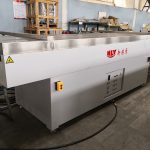
After orientation, the filament carries internal stress and will want to shrink. The heat-setting oven passes the drawn strand through 180–220°C at a slight relaxation ratio (typically about 0.92–0.97), releasing stress and locking in straightness and dimensional stability. This step is what keeps finished bristle from curling or shrinking in the brush.
6. Crimp, taper, and flag
Brush finishing needs vary by product:
Crimping deforms the filament into a controlled zig-zag to bulk up the tuft and improve liquid pickup — common in paint and industrial brushes.
Tapering produces the sharp, gentle tips needed for cosmetic and “tapered” toothbrush bristles. Tapered PET is typically made by blending PET with PBT — around 15–30% — so the tip erodes into a clean point during chemical tapering, as an explanation of PET tapered versus PBT tapered filament describes.
Flagging splits the filament tips, which some sweeping and cleaning brushes require. Controlled orientation from the draw stage is what makes flagging split cleanly without running down the whole strand.
7. Winding
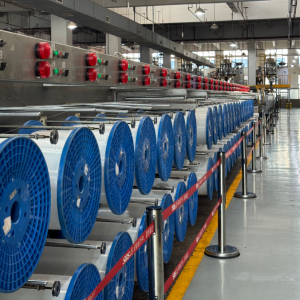
Finally, the finished filament is taken up on multi-spool winders, bobbins, or automatic bundle/hank cutters. Tension control at this stage prevents package defects that later create tufting problems in the brush plant.
Virgin PET versus recycled PET in brush filament
Budget pressure is pushing more brush makers toward recycled PET (rPET), and a PET line is well positioned to handle it — provided the equipment is configured for the differences. Recycling-grade flake and granule bring contamination, viscosity variability, and higher moisture pickup, so the line has to absorb that variance rather than pass it into the filament.
Drying is more demanding with rPET. Flake and granule carry more surface moisture than virgin chip and arrive with more variation. The closed-loop dryer needs reserve capacity and stable dew-point control so the hopper stays at or below 50 ppm even when feed moisture spikes.
Filtration becomes essential. Recycled feed carries more fines and solids. A screen changer with adequate filtration area, and a melt pump that stays stable under changing melt pressure, protect the spinneret from plugging and the finished bristle from inclusions.
Screw geometry and metallurgy matter. rPET can arrive with higher intrinsic-viscosity spread and occasional contaminants. A mixing or barrier screw smooths that out; bimetallic screw coatings extend life if the recycled stream is abrasive.
IV expectations should be set early. Recycled PET rarely holds the same IV as virgin, so finished bristle may be slightly stiffer or more brittle. If your customer’s tufting demands premium bend recovery, rPET is a poor fit — but for stiff cleaning and paint bristle it is a legitimate cost lever.
The practical rule: treat rPET as a distinct feedstock with its own drying, filtration, and screw requirements, and validate it with a sample run before you commit the line to a recycled program.
Troubleshooting common PET brush filament defects
PET’s narrow window means problems show up fast and usually trace back to one of a few root causes. Use this as a starting diagnostic before pulling the line down.
Symptom | Most likely causes | What to check |
|---|---|---|
Bubbles, foam, or voids in the bristle | Moisture driven into the melt (hydrolysis) | Dryer dew point, hopper moisture, drying time/ temperature |
Brittle, weak filament with poor recovery | IV loss from wet processing, or over-drawn | Drying discipline, total draw ratio |
Diameter drift or ovality | Melt pump pulsation, quench instability, thermal swings | Melt pump pressure feedback, quench temperature/ turbulence, zone temps |
Strand breakage in the draw section | Over-drawing, draw-temperature mismatch, feed variance | Draw ratios per stage, oven temperature, feed consistency |
Surface roughness or melt fracture | Melt temperature too low, or die pressure too high | Barrel/die temperature, die geometry, melt pump setting |
Excessive shrinkage after tufting | Incomplete heat-setting | Annealing temperature and relaxation ratio |
Because several of these defects share a root cause in melting and moisture control, fix them in order: stabilize the dryer and melt pump first, then tune the draw and heat-set stages. For a deeper walk-through of the same logic, the general monofilament line troubleshooting guide applies to PET as much as to any polymer.
Specifying a line for PET: what to check first
Before you discuss brands or prices, lock down your own requirements. A needs assessment keeps you from over-buying, but more importantly it keeps you from under-configuring the stages that PET actually depends on.
Ask yourself five questions first:
Which brush products and diameters — toothbrush-grade fine filament, or heavier cleaning/paint bristle?
Do you need tapered, crimped, or flagged filament, or straight only?
What run rate (kg/h) and how many ends do you need?
Will you run virgin PET, recycled PET (rPET) flakes/granules, or both?
What stiffness and diameter tolerance does your customer’s tufting equipment require?
The answers drive very different machines. A fine cosmetic PET line emphasizes diameter control and taper; a broom line emphasizes throughput and fiber stiffness.
The evaluation criteria that actually matter
Once the requirements are clear, judge every supplier on these benchmarks:
Drying capability: closed-loop desiccant dryer with a guaranteed low dew point and enough capacity for your kg/h. This is the top PET-specific criterion.
Melt metering: a gear melt pump with closed-loop pressure control, not just a bare extruder.
Diameter and ovality control: closed-loop laser gauging feeding back to melt pump and line speed, holding a continuous tolerance in the ±0.005 mm range. For troubleshooting around dimensional drift, the filament diameter stability guide is a useful reference.
Draw-section flexibility: enough godet stations and speed range to reach a total PET draw ratio of about 4.5:1 to 6.2:1.
Heat-setting capability: a properly sized annealing oven with relaxation control.
Screw metallurgy: matched to virgin vs recycled/abrasive feedstock.
After-sales support: spare spinneret plates, heater bands, screw, and crimper gears available, plus local service and training.
A practical RFQ checklist for a PET brush filament line
Bring these items to the quotation and Factory Acceptance Test:
Dryer dew point and capacity sized to your PET run rate (≤50 ppm, −40°C dew point)
Gear melt pump with closed-loop pressure feedback
Screw L/D 28:1–33:1, metallurgy matched to feedstock (barrier/mixing screw)
Barrel melt temperature control across 260–300°C with stable die temperature
Quench bath stable at 15–25°C with turbulence control
Draw ratio range that reaches ~4.5:1–6.2:1 across multiple stages
Heat-setting oven at 180–220°C with relaxation control
Laser diameter feedback loop holding ±0.005 mm
Optional taper, crimp, or flag modules per your product range
Certificate (ISO 9001 / CE) and documented FAT procedure
Pro Tip: Run a FAT sample with your actual resin and target diameter before signing. PET’s narrow window means the difference between a good generic line and a well-tuned PET line is best seen on a real sample run, not in a brochure.
Next steps
A PET brush filament extrusion line only earns its keep when drying, melt delivery, drawing, and heat setting are engineered to work together for the specific stiffness and diameter your brush customers require. NLY’s complete monofilament extrusion line packages these stages onto a single turnkey platform with centralized PLC control and FAT support.
If you are evaluating a line for toothbrush, cosmetic, paint, or cleaning brush filament, the engineering team at Changzhou New Liaoyuan Machinery Co., Ltd. (NLY) can prepare a custom line layout proposal and a technical specification audit matched to your resin and product range — a low-commitment first step before you commit capital.