A monofilament that runs a few hundredths of a millimetre oversized can clog a zipper slider mould, leave a brush tuft uneven, or make a fishing net lose its required mesh opening. For anyone running PET, nylon, PP, or HDPE monofilament, “diameter drift” is rarely a cosmetic issue. It is a scrap generator, a downtime driver, and often the first complaint a customer raises on a quality audit. Getting monofilament diameter tolerant to a repeatable gauge is therefore not an option — it is part of the product spec.
The useful news is that monofilament diameter is not controlled by luck. It follows a predictable relationship, and every fluctuation you see traces back to one of a small set of process or machinery causes. This guide walks through those causes one by one and pairs each with the control that keeps the strand on target.
Why Monofilament Diameter Fluctuates: The One Relationship That Explains It
Before chasing individual faults, it helps to hold a single idea in mind: final monofilament diameter is set by the balance between how much molten polymer the die delivers and how fast the line pulls the strand away.
If melt output rises while take-off speed stays the same, the strand gets thicker.
If melt output holds steady but haul-off or draw speed climbs, the strand gets thinner.
If either side wobbles even slightly, the wobble shows up as a change in finished diameter.
This is why most persistent diameter problems are really instability problems on one side of that ratio. The relationship is described plainly in NLY’s engineering series on why stable diameter is a set of interlinked control loops across the line — feed, melt delivery, quench, draw, and winding all talk to each other.
So when you troubleshoot, you are not hunting for a single culprit. You are looking for which loop has gone unstable and is tipping the balance to one side.
Upstream Causes: When the Melt Itself Is Unstable
Most diameter problems begin before the strand ever touches water. If the polymer arriving at the die is not consistent — in pressure, temperature, or composition — the die cannot print a consistent diameter no matter how well the downstream section runs.
Inconsistent feeding
Feeding is the quietest and most overlooked cause of diameter drift. When the hopper bridges, rat-holes, or feeds unevenly, the screw builds an irregular solids bed, and that irregularity resamples itself as periodic output surging.
Watch particularly for fluctuating regrind ratios. If operators change how much recycled material they add between runs or between shifts, melt viscosity and output change, and diameter follows. The control is straightforward: keep feed flow steady at the hopper and hold the regrind ratio constant for the whole run rather than adjusting it mid-run.
Screw pulsation and pressure swings
A single-screw extruder naturally carries some pulsation from the rotation of the screw. In most cases that is manageable, but when head pressure starts to oscillate, the die delivers a thick — thin — thick rhythm that becomes visible as repeating thick and thin sections.
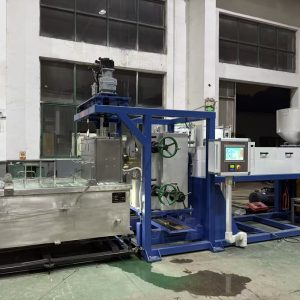
Two things commonly amplify it. The first is a filter or screen-pack loading up: as the media restricts, backpressure climbs and output can fall or surge. The second is an extruder carrying too much downstream resistance, forcing the screw to work against unstable pressure. A practical fix on precision lines is a melt or gear pump, which meters a far more constant volumetric flow to the die and isolates the die from screw pulsation. NLY discusses metering this way in its guide to the working principle of the monofilament extruder section, where gear-pump-backed delivery is treated as a core stabilizer. If you see cyclical diameter variation, check melt pressure first; it will tell you whether the instability is upstream in the extruder.
Temperature drift that changes viscosity
Melt viscosity is highly temperature-sensitive. A slow climb of a few degrees in a barrel or die zone lowers viscosity, shifts backpressure, and changes how much the melt swells as it leaves the die — and that shifts diameter. Temperature swings also reset die swell between cycles, which is why NLY frames temperature control as the lever that shapes filament diameter.
The control is discipline on the thermal side: multi-zone PID control that holds barrel and die zones stable (engineering guidance commonly targets roughly ±1 °C), plus a check of actual melt temperature, not just the setpoint on the panel. A die that appears to hold temperature but actually cycles will produce slow, wandering diameter drift that no speed adjustment fully corrects.
Moisture in moisture-sensitive resins
PET and nylon are hygroscopic. If they are not dried to the recommended low moisture level before processing, the moisture flashes to steam in the melt, creating bubbles or voids that show up as sudden diameter spikes or dips rather than a smooth drift. This is one reason a seemingly “random” diameter problem often appears right after a dryer fault or after material has sat open on the floor.
The control is upstream and boring but reliable: dry PET and nylon properly, keep them covered, and monitor dryer dew point as an early-warning signal instead of waiting for a quality reject.
Geometry Lock-In: When Cooling Sets the Shape
Once the strand leaves the die and enters the water quench, its geometry starts to harden. If the cooling is uneven, the roundness and diameter that get “locked in” are flawed, and downstream drawing will often make the problem worse rather than fix it.
Uneven cooling and ovality
Cooling that is one-sided or turbulent cools one side of the strand faster than the other. That differential shrinkage can push the strand out of round, producing ovality that reads as inconsistent diameter on a gauge. Tools that disturb the bath — dirty filters, a drifting water level, misaligned guides, a strand running off-centre — all quietly contribute.
The fix is a calm, symmetric, repeatable quench. Hold water temperature and level steady, keep the flow even and away from the strand, and confirm the strand path is centred with a consistent entry height and angle. The principle is summarized in NLY’s factors that affect plastic monofilament quality, where cooling stability sits alongside melt stability as a first-order influence.
Pro Tip: If you see ovality or wandering diameter, stabilize the quench first — water temperature, level, flow symmetry, and strand alignment — before you start changing draw settings. A cool, calm bath will often clear up a problem that looked like a speed fault.
Downstream Causes: When Drawing and Take-Off Wobble
Even a perfectly stable melt and a calm quench can produce diameter drift if the drawing and take-off section is not synchronized. This is the side of the ratio that operators usually suspect first, because speed changes have an immediate visual effect.
Draw ratio treated as a moving target
Draw ratio is what converts the thick, soft strand into a thin, oriented filament. If the effective draw ratio changes while the line runs, diameter changes with it. The total line draw ratio for many industrial monofilaments sits in the mid-single digits — NLY’s engineering content commonly cites roughly 1:4.5 to 1:7 for mesh-type monofilament — and drawing guidance in resin manuals puts the initial draw-down ratio just after the first quench bath in the range of 4:1 to 10:1.
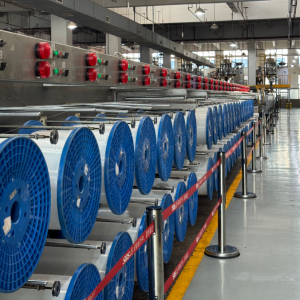
The mistake is treating draw ratio as something to “nudge” freely while the line wobbles. The control is to treat draw ratio as a set recipe for a given product and material, then hold the speed ratio between draw stages constant. NLY covers this logic in its engineering guide to monofilament drawing and orientation, which stresses that speed ratios between godet stages, not any single speed, define how much stretch is realized.
Godet slip and haul-off speed sync
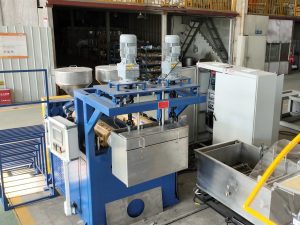
Godets pull the strand through the draw section by surface contact. If a godet starts to slip — from surface wear, contamination, or too few wraps — the effective draw ratio changes even though the motor speed setpoint is unchanged. That slip shows up as diameter drift and can also feed broken filaments.
The control is mechanical hygiene plus synchronization: keep godet surfaces clean and free of build-up, maintain adequate wrap, and confirm haul-off and winder speeds track the extruder output in a coordinated drive rather than drifting independently. When the take-off side wanders, it “stretches” the strand unevenly and changes diameter even though the extrusion side never moved.
Winding tension that hunts backward
Winding is where a lot of engineers first look — and usually last. Tension hunting at the winder can feed back upstream, altering effective draw and adding more drift and more breaks. But if the melt, quench, and draw sections are stable, the winder is rarely the true cause. Treat winding as a symptom worth cleaning up, not the first suspect, and fix upstream loops before blaming the package build.
Cause to Control at a Glance
For quick plant-floor use, here is the same material as a mapping you can print and pin near the panel.
What you see | Most likely cause | First control to apply |
|---|---|---|
Slow diameter drift over a run | Temperature drift, moisture, filter loading, tension swings | Check actual melt temp, dryer dew point, screen-pack ΔP |
Repeating thick/thin sections | Screw pulsation, unstable feed | Stabilize feed, add/verify melt pump metering |
Wandering diameter plus ovality | Uneven or turbulent quench | Steady water temp/level, centred strand, symmetric flow |
Off-size but stable dimension | Draw ratio or haul-off setpoint wrong | Recheck draw-ratio recipe; small speed correction, keep cooling fixed |
Breaks near thin spots | High draw, or slip at godets | Reduce effective draw, restore godet traction. |
How Tight Can a Monofilament Line Hold?
It helps to know the monofilament diameter tolerance you are aiming at before you tune anything. For monofilament products the practical operating window is typically ±0.003 to ±0.01 mm, with high-precision lines — mesh yarn, filter cloth, and fine technical filament — commonly targeting about ±0.005 mm on inline gauging.
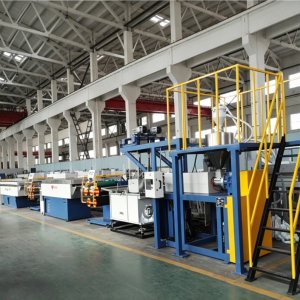
Holding that consistently requires not just good mechanics but a closed loop. On modern precision lines, an inline laser gauge measures the live diameter and the control system adjusts gear-pump speed or godet velocity in real time. NLY describes this on its high-precision monofilament mesh line, noting that a closed-loop system can correct for small ambient or speed shifts to maintain a target diameter. The honest limit is that closed-loop control fixes slow drift; it cannot mask fast oscillation that originates upstream. If you see fast, oscillating diameter, that is an upstream instability, and no feedback system downstream can fully hide it.
A Short Troubleshooting Routine for Your Line
When diameter scrap appears, work in this order instead of jumping between knobs:
Confirm melt stability first. Read melt pressure and temperature trends. A rising or oscillating pressure points to filter loading or feed instability upstream.
Then check the quench. Verify water temperature setpoint against actual, hold the level steady, and confirm the strand runs centred with no one-sided turbulence.
Then lock the draw. Confirm draw-stage speed ratios are on the set recipe and godets are not slipping.
Clean up winding last. Only after the upstream loops are steady does tension hunting at the winder become worth tuning.
Key Takeaway: Monofilament diameter is a ratio outcome — stable melt delivery on one side and synchronized draw/take-off on the other. Diagnose from the melt forward, stabilize the quench before the draw, and treat the winder as the last suspect, not the first.
Frequently Asked Questions
Why does my monofilament diameter change between shifts? The process itself is usually capable of holding target; what changes between shifts is consistency — regrind ratio, dryer condition, hopper level, or quench water setpoint. Standardize the set recipe and the operator check routine, and inter-shift drift usually shrinks.
Is diameter fluctuation the same as ovality? No. Diameter fluctuation is a change in the measured size along the length. Ovality is a cross-section that is out of round — the strand measures larger in one plane than in the perpendicular one. Uneven cooling drives ovality; melt and speed instability drive true diameter drift, though the two often appear together.
Can a melt pump really fix diameter variation? A metering gear pump delivers a more constant volumetric flow to the die and separates the die from screw pulsation, so it directly reduces the thick/thin rhythmic variation that originates in the extruder. It does not fix instability caused by moisture, bad quench symmetry, or slipping godets.
What is a realistic diameter tolerance for monofilament? Most monofilament products run within about ±0.003 to ±0.01 mm, with precision lines targeting ±0.005 mm. The achievable tolerance depends on the entire control chain — melt delivery, quench, draw, and inline feedback — not on the die alone.
The Bottom Line for Your Line
Monofilament diameter fluctuation is frustrating because it seems to come from everywhere at once. In practice it comes from a short, understandable list: feed and melt instability, temperature and moisture drift, uneven quench cooling, and draw or take-off speed that is not synchronized. Fix them in that order, stabilize the quench before you chase the draw, and treat each diameter fault as a symptom of one unstable loop instead of a random glitch.
If you are chasing diameter scrap on an existing line or specifying a new one and you want a process window that holds a tight monofilament gauge, share your line parameters (target diameter, material, tolerance, and current draw recipe) for a line configuration review. A run sample and factory acceptance test can confirm the setup holds your tolerance before you commit to full production.